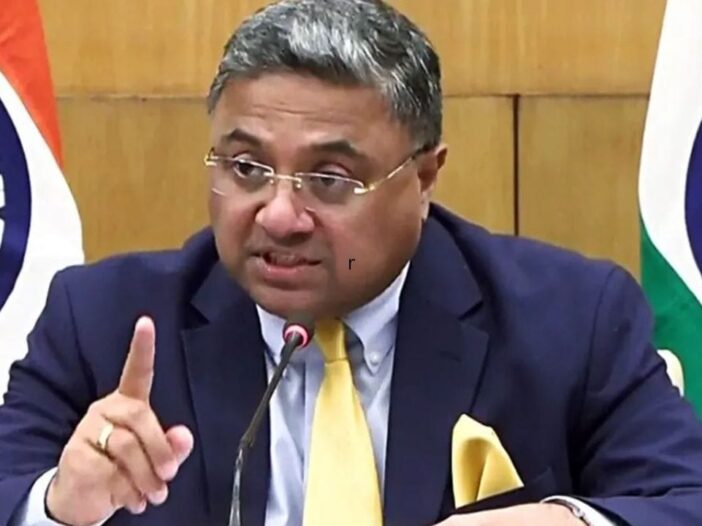
India has expressed strong objection to the mention of Jammu and Kashmir in the joint statement of China and Pakistan. The government has clearly said that Jammu-Kashmir and Ladakh were, are and will always be integral and inseparable parts of India. Along with this it is also said that no other country has any right to comment on this.
External Affairs Ministry spokesperson Randhir Jaiswal said on Tuesday (April 26) that India’s position has already been clear and stable and the parties concerned are fully aware of it. He said that the mention of Jammu and Kashmir in the joint statement issued by China and Pakistan is completely inappropriate and India clearly rejects it.
Jammu-Kashmir and Ladakh will always be a part of India
The spokesperson said in blunt words that the Union Territories of Jammu-Kashmir and Ladakh were part of India earlier also, are so today and will always be so. He said that no other country has the right to speak on this issue.
Pak PM Shahbaz Sharif on China visit
Actually, this joint statement was issued during the recent visit of Pakistan Prime Minister Shahbaz Sharif to China. Sharif was on a visit to China from 23 to 26 May, where he discussed several strategic and economic issues with the Chinese leadership. He met Chinese President Xi Jinping. After this, both the countries issued a joint statement on Tuesday. In which the issue of Jammu and Kashmir was raised. China said that this dispute is old and it should be resolved peacefully in accordance with the United Nations Charter, Security Council resolutions and bilateral agreements.
India’s objection to CPEC projects
India also criticized the mention of projects under the China-Pakistan Economic Corridor (CPEC) in the joint statement and said New Delhi rejects any move by Islamabad to consolidate or legitimize its illegal occupation of territories.
Randhir Jaiswal said, ‘With regard to the so-called China-Pakistan Economic Corridor (CPEC) projects, some of which are in India’s sovereign territory, we strongly oppose and reject any attempt by other countries to consolidate or legitimize Pakistan’s illegal and forcible occupation of these territories, which encroaches on India’s sovereignty and territorial integrity.’
‘1963 border agreement not recognised’
Jaiswal said that this has been clearly told to Pakistani and Chinese officials many times. He said, ‘We have also seen references to so-called ‘cross-border water resources cooperation’ between China and Pakistan. Since there is no border between the two countries, the question of so-called ‘cross-border water resources cooperation’ does not arise. He further said that India has never recognized the 1963 border agreement between Pakistan and China.
Joint statement of China-Pakistan
Following Pakistan Prime Minister Sharif’s visit to China from May 23 to 26 at the invitation of Prime Minister Li Qiang, the two countries had issued a joint statement on Tuesday. The statement said that the Pakistani side informed the Chinese side about the latest developments in the situation in Jammu and Kashmir.
‘Jammu and Kashmir dispute is part of history’
China, for its part, reiterated that the Jammu and Kashmir dispute is part of history and should be resolved in a just and peaceful manner in accordance with the UN Charter, relevant UN Security Council resolutions and bilateral agreements. China had said that both sides expressed readiness to carry out cross-border water resources cooperation under the principle of equality and mutual benefit, although no details were given on the details of the cooperation because the rivers originating in China and flowing into Pakistan pass through India.
China reiterated its “unwavering support” for safeguarding Pakistan’s national sovereignty, independence and territorial integrity and firmly supported Pakistan’s efforts to safeguard its national security, stability, development and prosperity. Both countries agreed to further cooperation under the Belt and Road Initiative and the development of CPEC 2.0. Apart from this, the Karakoram Highway project and developing Gwadar Port as a regional connectivity hub were also discussed.
India has already decided to put the Indus Water Treaty on hold, accusing Pakistan of supporting terrorism.
What is China-Pakistan agreement?
The China-Pakistan Border Agreement was signed between China and Pakistan on 2 March 1963. Its purpose was to demarcate between China’s Xinjiang region and the Pakistan-administered Gilgit-Baltistan region (which was then part of Pakistan-occupied Kashmir). This agreement is also called the China-Pakistan Border Agreement.
Key points of the agreement
Pakistan handed over approximately 5,180 square kilometers of land known as Shaksgam Valley (Trans-Karakoram Region) to China. China recognized Pakistan’s control over Gilgit-Baltistan, thereby strengthening Pakistan’s territorial claims in the region. The agreement was described as temporary and it was said that changes would be possible after the final resolution of the Kashmir dispute. Both countries agreed to maintain peace and stability in the border area.
Why did India protest?
India strongly opposed this agreement and declared it illegal and invalid. India says that Jammu and Kashmir is an integral part of it and Pakistan had no legal right to hand over any part to China. India also considers Shaksgam Valley as its territory, which has been illegally occupied.
strategic importance
- This agreement strengthened the foundation of strategic partnership between China and Pakistan.
- Later, big projects like China-Pakistan Economic Corridor (CPEC) became part of this cooperation.
- China got strategic access to the Karakoram region and South Asia.
This agreement indirectly increased India’s security concerns, especially regarding the growing China-Pakistan strategic cooperation.
international law agreement temporary
- Under international law this agreement is considered temporary, because it relates to a disputed area.
- There is still a dispute over this by India and hence it is not accepted at the international level.
India considers violation of sovereignty
This agreement is often mentioned in discussions on India-China border dispute, Pakistan Occupied Kashmir and China-Pakistan relations. India considers the development being done by China in this area as a violation of its sovereignty. It remains an important center in India’s diplomatic and strategic relations with both China and Pakistan.
The China-Pakistan Border Agreement of 1963 is a strategically important and legally controversial treaty. This strengthened China-Pakistan relations. But it also complicated regional geopolitics, especially for India, by involving disputed territory and changing the strategic balance in the Himalayan region.

Leave a Reply