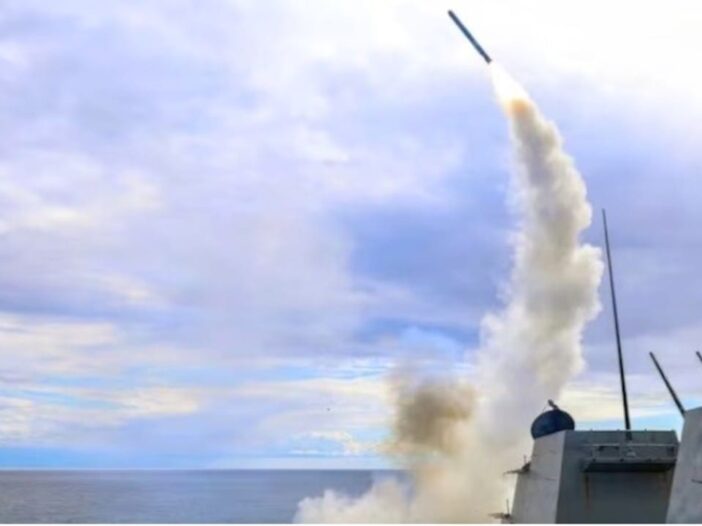
Tensions between the US and Iran increased further on Sunday, when the US military launched new attacks on Iranian military targets around the Strait of Hormuz. These attacks were part of a series of attacks and counter-attacks on each other, as Iran wants to establish its control over shipping through this waterway. The US military attacked Iran’s missile systems, air defense sites and small speedboats operated by the Islamic Revolutionary Guard Corps (IRGC) at several places around this strategic waterway.
The US military said it has launched another round of strikes against Iran to reduce their ability to attack commercial ships passing through the Strait of Hormuz. These attacks continued in Iran throughout the night and till this morning. Earlier on Sunday morning, the army had carried out attacks in response to Iran’s attack on a container ship in this vital sea route a day earlier.
America attacked Iran
Iran responded to those attacks by attacking the Arab countries of the Gulf. This sequence of violence continued to increase, due to which the talks between Tehran and Washington to end the war reached the verge of collapse. America attacked Iran on Sunday. The attack was in response to Iran’s attack on a container ship in the Strait of Hormuz, in which the ship caught fire and left a crew member missing. Iran responded by attacking Bahrain, Kuwait, Qatar, Jordan and Oman, countries on the other side of the strait and which Tehran had pressured into cooperating in managing shipping traffic.
America attacked again later in the day. The governor of Qeshm Island, located near the strait, told Iran’s state news agency IRNA that projectiles were fired at military targets, but there were no casualties. Explosions were also heard in the coastal city of Bandar Abbas and Hajiabad city in the north.
Missile and air defense system targeted
A US official said that to further reduce Iran’s ability to attack commercial ships, missile and air defense systems and paramilitary Revolutionary Guard boats were attacked at some places. He said this on condition of anonymity because he was not allowed to talk publicly about military operations.
Iran and America are almost halfway through their 60-day interim deal, which aims to end the war forever. The Strait of Hormuz, a vital route for global supplies of oil and natural gas and long considered an international waterway, has become a stumbling block in the talks. Such a conversation which now seems to be on the verge of breaking down.
The consequences of the fight will be very dire
According to a statement, UN Secretary-General Antonio Guterres said that if large-scale fighting started again, its consequences would be dire. Iran says that the Strait of Hormuz is closed, but America does not agree with this. On Sunday, the US military said it struck about 140 targets, including missile and drone launch sites, ammunition stores, communications equipment and other targets.
These attacks were more forceful than in recent times. The US launched three airstrikes last week targeting Iran in response to attacks on ships passing through Oman. These ships were using that route to avoid the maritime zones of the Islamic Republic.
A naval officer was killed
President Donald Trump said in NBC’s ‘Meet the Press’ program, last night we bombed them tremendously. Iran’s semi-official news agencies reported that a navy officer was killed. Iran retaliated by attacking countries where US troops are stationed, while insisting that the Strait of Hormuz be its sole control and that it may even levy tolls on ships passing through it.
Keep your word or pay the price
Speaker of Iran’s Parliament and chief negotiator Mohammad Bagheri Ghalibaf wrote, the era of unilateral agreements is over. We told you, stick to your word or pay the price. The reality is coming to the fore. Iran said Hormuz would remain closed until peace is restored, and if there were more attacks, Tehran would consider targeting additional enemy targets in the area. The US Army and Trump claimed that the Strait of Hormuz is open.
The US Army said that more than 140 ships passed through there last week. A multinational agency overseen by the US Navy said ship traffic to both Oman and Iran continued at low levels, with about 140 ships passing through each day before the war.
Before the war, about a fifth of all oil and natural gas traded passed through the Strait of Hormuz. Iran’s control over it led to a global energy crisis, although oil prices have fallen sharply after reaching a high of $120 per barrel during the war.
Oman summons Iranian ambassador
Missile alerts were issued in many Gulf Arab countries. Qatar’s army said that it intercepted the attacks coming from Iran. The sound of explosions was heard in the neighboring country United Arab Emirates. Qatar’s Interior Ministry said that three people, including a child, were injured by shrapnel thrown while trying to stop the attacks.
Missile alerts were also issued in Bahrain, where the US Navy’s 5th Fleet is deployed. Kuwait’s Defense Ministry said three land border posts and an offshore drilling platform of Kuwait Oil Company were damaged in the north, and one worker was injured.
Three Iranian missiles fell in Jordanian areas
Jordan’s state news agency reported that three Iranian missiles fell in Jordanian areas, causing minor damage but no injuries. Oman’s government news agency said the drone attacks took place in an area near the waterway. The incident occurred a day after Oman and Iran agreed to continue talks and discussions on the strait. This strait is located in the maritime area of Iran and Oman.
Oman summoned the Iranian ambassador in protest against the attacks. This is the first such step since the war started. Oman described these actions of Iran as irresponsible.
Indian crew on board harmed by Iran’s attack
The US Army said that the engine room of the Cypriot-flagged container ship, which was the victim of Iran’s attack, has suffered significant damage. Oman’s maritime authority said it rescued 23 crew members, but one member was missing. India’s Foreign Ministry said that he is an Indian citizen. The ‘United Kingdom Maritime Trade Operations’ Centre, which works under the supervision of the British Army, said that the ship was moving along the coast of Oman.
Many ships ignored warnings
Iran’s Revolutionary Guard said that many ships ignored our warnings and did not follow instructions to follow the prescribed route. A warning shot was fired at a ship and it was stopped. Iranian state media later reported US strikes across the country, including on military targets in the southern Iranian provinces closest to the strait and in a province near Tehran.
Interim agreement ends in war
The attacks followed further diplomatic talks regarding the Strait of Hormuz. Trump had said last week that the interim agreement in the war has ended. But mediators including Pakistan, Qatar and Egypt have continued efforts to reach an agreement. A regional official involved in the mediation, speaking about the talks on the condition of anonymity, said that efforts to strengthen the ceasefire continued on Sunday. Pakistan said its foreign minister spoke to Iran’s top diplomat over phone and urged both sides to reduce tensions.
Iran’s new supreme leader Ayatollah Mojtaba Khamenei, who has not been seen since the start of the war, vowed in his first statement on Saturday after the funeral of his father Ayatollah Ali Khamenei that the Iranian people would avenge his killing in the initial attacks of the war on February 28.

Leave a Reply