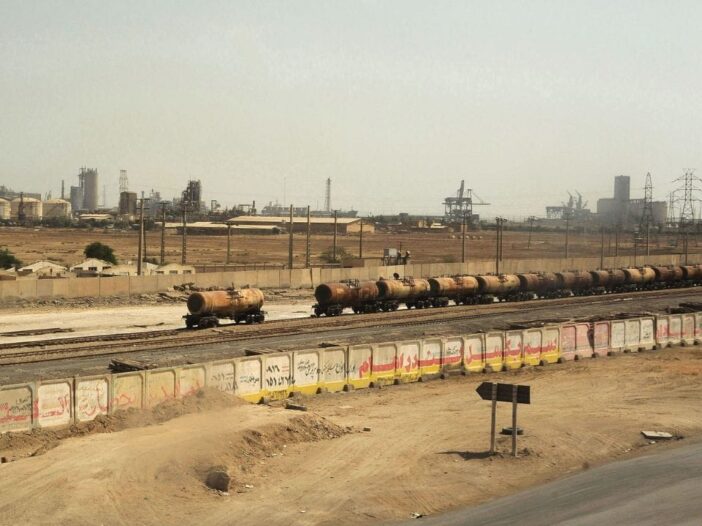
Amidst America’s maritime blockade, Iran has adopted a new route to continue the supply of oil and LPG. According to reports, Iran is transporting oil to China and Pakistan through railways. Iranian news agency Fars claims that about 50 days after the start of the American blockade, the number of goods trains going to China has tripled. At night, long trains filled with oil tankers are continuously seen going towards China. America started the blockade against Iran on April 13.
In fact, most of Iran’s oil exports are via sea route and Hormuz. But due to America’s strictness, Iran is looking for alternative ways. In March 2026, Iran exported an average of 18.4 lakh barrels of oil per day to Asian countries. But the amount of oil that was earlier sent via sea is no longer possible.
Iran EXPORTS OIL and LPG to China and Pakistan VIA RAILWAY
Nearly 50 days into US naval BLOCKADE — number of freight trains to China TRIPLES — Fars
Long line of tankers rolls through the night pic.twitter.com/r9wx56bpmI
— RT (@RT_com) May 29, 2026
Rail use increased in Central Asia
Iran is increasing the use of Central Asia’s rail network. The 10,400 km long China-Iran Railway Corridor, starting from May 2025, is an important part of this plan. This railway route starts from Xi’an city of China and reaches Tehran passing through Kazakhstan, Kyrgyzstan, Uzbekistan and Turkmenistan. While it takes about a month for goods to reach by sea, the journey is completed in about 15 days by rail.
According to Bloomberg report, after the start of the American blockade, the number of goods trains going from Xi’an to Tehran has increased rapidly. Earlier, one train used to run every week, but now one train is leaving every three to four days. In the last few years, China, Iran, Russia and the countries of Central Asia have built many new railway corridors. The China-Kyrgyzstan-Uzbekistan railway project started in 2024, in which China invested $2.35 billion. At the same time, in November 2025, the first goods train from Russia to Iran also reached via Kazakhstan and Turkmenistan.
Will this route become an alternative to the sea?
Experts say that the rail route will definitely provide some relief to Iran, but it cannot become a complete alternative to sea exports. A train can usually carry only 60,000 to 70,000 barrels of oil. In comparison, a normal oil tanker can carry more than 6 lakh barrels and a very large crude carrier (VLCC) can carry more than 20 lakh barrels of oil.
Apart from this, most of Iran’s oil fields are in the southern part of the country, while China’s big refineries are located on its eastern coast. Therefore, sending oil through rail is not easy. If Iran sends 70,000 barrels of oil to China in one consignment, it can earn around 52.5 lakh to 70 lakh dollars. But this amount is much less compared to the billions of dollars of income from maritime exports.
Also read: Trump’s health report came out, doctor said – completely fit to hold the post of President

Leave a Reply