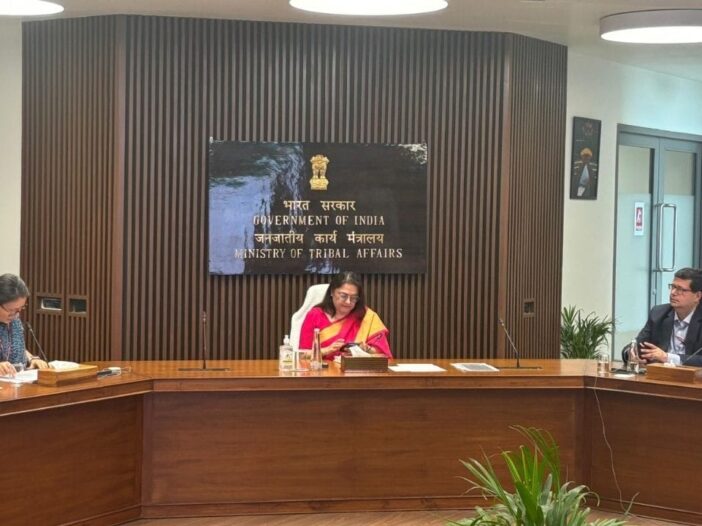
A big meeting of the Ministry of Tribal Affairs was held on Wednesday. It was chaired by the Ministry’s Secretary Ranjana Chopra, in which the status of the schemes and programs of the Ministry in West Bengal was reviewed. There was also discussion on future action plan. The meeting laid special emphasis on strengthening inter-departmental coordination, improving utilization of funds, expediting coverage of pending works in tribal and Particularly Vulnerable Tribal Group (PVTG) areas.
The main point of the meeting was to involve the state government under the two major initiatives of the ministry ‘Pradhan Mantri Tribal Tribal Justice Maha Abhiyan’ and ‘Dharti Aaba Tribal Gram Utkarsh Abhiyan’. The Tribal Affairs Secretary emphasized that this is the right time for the Ministry and the State Government to work together. So that it can be decided that the benefits of these campaigns can reach the tribal communities and PVTG effectively.
Survey of PVTG families started
In the meeting, Choten Dhendup Lama, Principal Secretary, Tribal Development Department, Government of Bengal, said that the state government departments are in the process of preparing and presenting suitable proposals to the concerned central ministries under these campaigns. The survey of PVTG families in the state has started on 27 May 2026. The state government assured to complete this work on time.
The Tribal Affairs Secretary also mentioned the importance of integrating the State Government with ‘Aadi Karmayogi Abhiyan’ (AKA). It was informed by the Ministry that soon there will be a ‘handholding session’ (guidance session) for the state government officials on AKA. The State was further advised to expedite the notification of ‘Adi Seva Kendras’ (ASKs) in villages covered under DA-JGUA and PM JANMAN. Also, efforts should be made to deploy teams of 5-7 volunteers in each ASK through strong community participation mechanism.
signing of memorandum of understanding
In an important step towards strengthening tribal education, ‘National Education Society for Tribal Students’ (NESTS) under the Ministry of Tribal Affairs also signed an MoU with the Government of Bengal for the implementation and monitoring of ‘Eklavya Model Residential Schools’ scheme in the state.
Under this agreement, there will be a significant increase in the amount of money received by each student under the EMRS scheme. Which will increase from ₹ 61,500 to ₹ 1.47 lakh per student. The state government will also take steps to quickly operationalize the approved EMRS and complete the incomplete school infrastructure. Teachers will be recruited through a centralized process.
The objective of the MoU is to strengthen institutional coordination for planning, construction, installation and administration of EMRS in Bengal. It also aims to ensure quality modern education for the holistic development of tribal students by adopting a ‘Common Core Curriculum’ based on NCERT guidelines and in line with CBSE norms and standards.

Leave a Reply