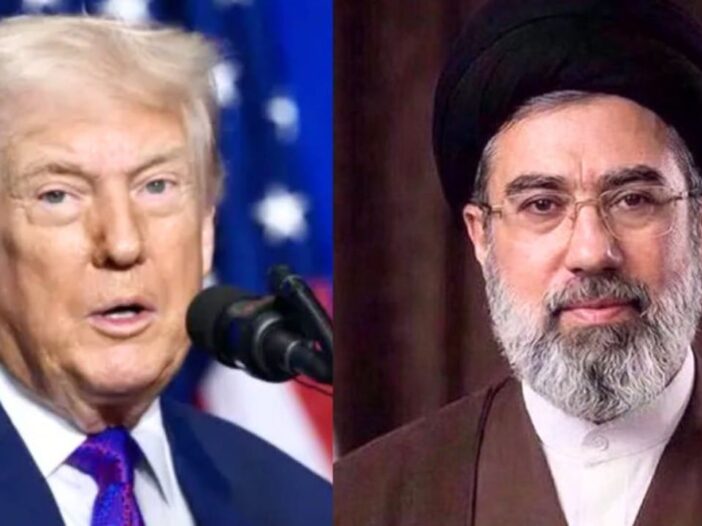
America launched new air strikes against Iran on Thursday. Iranian state media reported explosions in several locations, including Bushehr (home to Iran’s nuclear power plant complex) and the southern port city. Bushehr local official Ehsan Jahanian was quoted as saying that the US attacked near the plant around noon. In response, Tehran targeted America’s allies in the Middle East.
This firing has posed a threat to the interim agreement, which was aimed at ending the war in the Middle East. The ceasefire has been repeatedly threatened by ongoing attacks, including the one a day earlier. But the attacks on Thursday seemed much bigger. In Bahrain, where the US Navy’s 5th Fleet is headquartered, sirens sounded at least three times, and Kuwait and Qatar were targeted by missiles.
Sirens also sounded in Jordan on Thursday afternoon, where America has deployed its troops and aircraft. An Iranian official alleged that later on Thursday the US launched an airstrike targeting the area around Iran’s only nuclear power plant. In the afternoon, there were reports of explosions in other parts of the country also.
Early Friday morning, after days of public mourning, Supreme Leader Ayatollah Ali Khamenei was laid to rest in his hometown of Mashhad. Khamenei was killed in the initial shelling of the Iran war.
The attacks came as US President Donald Trump said recent Iranian attacks on ships in the Strait of Hormuz signal the end of a fragile ceasefire and that if the attacks are not stopped the conflict could escalate. This raised concerns that the region could again fall into war, in which many countries could be involved and this could stop the energy supply from Hormuz, which is very important for the global economy.
Iran’s Health Ministry said on Thursday that at least 14 people were killed and 78 others were injured in two days of US air strikes. According to reports, most of these people were members of the armed forces. The military in Kuwait said one person was injured by falling debris after the country shot down three ballistic missiles, one cruise missile and 10 drones.
Bahrain said it shot down the attacks coming towards it, but did not provide details. At the same time, Jordanian government spokesman Mohammed al-Momani said that all the attacks carried out by Iran were stopped. Iran’s state TV said the country’s paramilitary Revolutionary Guard fired missiles at a US base in Jordan. There was no immediate news of any damage in Qatar.
US attacks targeted more targets. The Central Command of the US Army said that it attacked 90 targets in Iran. They released black-and-white footage, which showed attacks on airport runways and missile launchers.
The US said that the purpose of these attacks was to further reduce Iran’s ability to pose a threat to freedom of movement in Hormuz. Before the US and Israeli attacks on February 28 triggered the war, one-fifth of the world’s trade in oil and natural gas passed through this route.
An initial agreement signed last month included the talk of opening this waterway, after which the traffic here has increased somewhat. Maritime data company ‘Lloyd’s List Intelligence’ said on Thursday that according to preliminary data, at least 576 ships passed through Hormuz in June, while the number was 233 in May. More than 3,100 ships passed through this route in June 2025.
Iranian state media reported explosions in several locations, including Bushehr (home to Iran’s nuclear power plant complex) and the southern port city. Government news agency IRNA quoted Bushehr local official Ehsan Jahanian as saying that the US attacked near the plant around noon. The attack came hours after the Central Command said it had ended its latest round of attacks. When asked about Bushehr, the Central Command referred to a press release which contained information on the targets but made no mention of the nuclear power plant.
For the first time since April, US strikes also targeted Iranian bridges. State media reported an attack on a railway bridge in Iran’s north-eastern Golestan province. The Revolutionary Guard said that two bridges on the road to Mashhad were attacked. Mashhad is the same city where thousands of people gathered on the streets during Khamenei’s funeral procession on Thursday.
He ruled Iran for nearly 37 years before he was killed in US and Israeli air strikes during the war that began on February 28. He was buried in his hometown Mashhad early today after several days of public mourning.
Trump gave another warning to Iran
After leaving the NATO summit in Turkey, Trump posted several videos on his social media sites that he said showed bombings in Iran, and issued another warning to the Islamic Republic. Trump wrote, this is revenge for the bomb attacks on ships by Iran. If this happens again, the situation will become even worse. He said this a day after the attack on three tankers in the Strait of Hormuz.
Trump said that the recent retaliation will not result in a prolonged military action. Trump also reiterated his previous threats to attack Iran’s civilian infrastructure, including power and desalination plants, and to seize Kharg Island. About 90 percent of Iran’s oil is exported from this island.
Parliament Speaker Mohammad Bagher Ghalibaf, the main negotiator in talks to end the war permanently, took a tough stance in a post on X Thursday morning, saying: America has not yet learned that there is a price to be paid for bullying and breaking promises. I say clearly, if you attack, you will also be attacked.
Iranian Foreign Minister Abbas Araghchi said in a post on Telegram that he spoke by phone with his counterparts in Saudi, Turkey and Oman and Pakistan’s army chief Field Marshal Asim Munir – who has been one of the main mediators in the war. This conversation indicates that efforts are being made to reduce tension.
The attacks have increased fears that the war could start again. On Wednesday, Trump increased the concern by saying that the interim ceasefire agreement has ended. He said that he would allow the talks to continue, but he felt that the negotiators were wasting their time. Negotiations on a final agreement were to begin after Khamenei’s funeral, which lasted for several days. Khamenei was killed at the beginning of the war.
The aim of these talks is to focus on the most difficult issues, including the full reopening of the Strait and the withdrawal of Tehran’s disputed nuclear program.

Leave a Reply