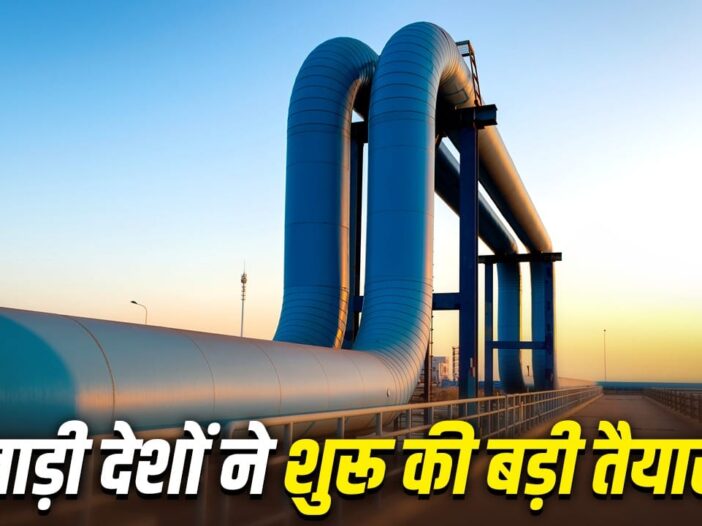
The Strait of Hormuz has been one of the most important sea routes for oil supply in the world. For decades, most of the oil from the Gulf countries used to reach different countries of the world through this route. But after the Iran war, Gulf countries are now working rapidly to reduce their dependence on this route. Saudi Arabia, UAE, Iraq, Oman and Kuwait are investing billions of dollars in building new oil pipelines, rail corridors and large energy storage centers. Their objective is to create such a network so that the supply of oil and other goods can continue even in the event of closure of Hormuz.
1. UAE’s new West-East Pipeline
Abu Dhabi has accelerated plans to build a new West to East crude pipeline to Fujairah. This pipeline will deliver oil to Fujairah port located outside the Strait of Hormuz. With this, UAE’s oil export capacity can almost double by 2027. UAE is also planning a new pipeline through which not only crude oil but also products like petrol, diesel and jet fuel can be sent.
2. Kuwait-Saudi Arabia-UAE Pipeline Corridor
A new pipeline project is also under discussion between Kuwait, Saudi Arabia and UAE. The plan is to transport Kuwait’s oil through pipeline to the ports of Saudi Arabia or UAE. After this, oil should be sent from there to different countries of the world. At present the final route of this project has not been decided.
3. Iraq’s new export routes
Iraq also wants to reduce its dependence on Hormuz. For this, it is considering new pipeline projects to reach the Mediterranean Sea via Jordan, Syria and Turkey. The first proposed route will go from Basra to Jordan’s Aqaba port. Its capacity is said to be around 10 lakh barrels per day. The second proposed route will go from Basra to Duqm port in Oman. With this, Iraq’s oil will be able to reach the Red Sea directly. The Kirkuk-Jehan pipeline between Iraq and Turkey is also being redeveloped.
4. Storage and Export Hub in Oman
Talks are also going on between Kuwait and Oman on building an oil storage facility outside Hormuz. Oman wants to develop its ports as major storage and export hubs for oil and gas. With this, Gulf countries will be able to get alternative facilities in times of crisis.
Options for gas supply are being explored
No new pipeline for natural gas has been officially announced yet. However, there is a discussion among the Gulf countries to rapidly advance the long proposed Gulf Railway Project. With this, petroleum products and some energy materials can also be sent through rail. Discussions are going on to build a gas corridor from Qatar to Saudi Arabia, Jordan and Egypt. Apart from this, the idea of a gas pipeline from Qatar to Saudi Arabia, Jordan and Turkey has also existed for a long time. Once this project is completed, Gulf gas can reach Europe directly.
Are there only 4 routes?
No. At present, these four major options are being discussed the most, but apart from this, Saudi Arabia is considering expanding its existing East-West (Petroline) pipeline. Gulf countries are working on such plans, which will help in transporting oil and gas to ports located outside Hormuz. In the future, more new pipeline and rail corridor projects may come up between the Gulf countries.

Leave a Reply