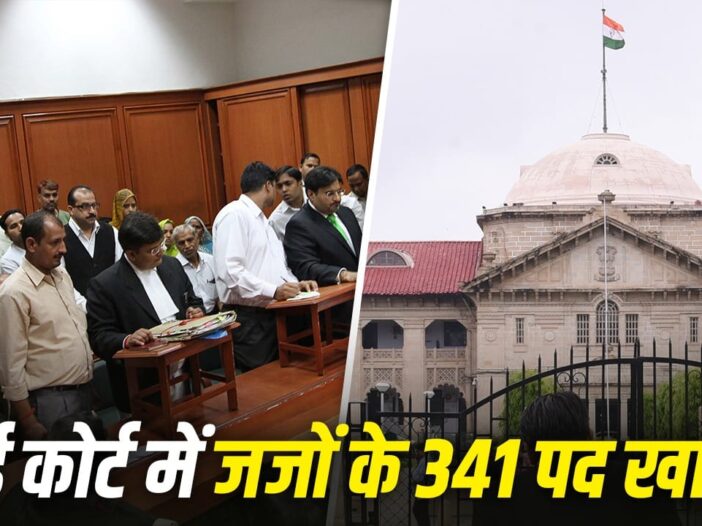
The justice system of the country is currently facing two big challenges. On one hand, a large number of posts of judges are vacant in the High Courts, while on the other hand, lakhs and crores of cases are still pending. The government presented figures on both these issues in the Rajya Sabha on 23 July 2026. It is clear from these figures that the shortage of judges and increasing pending cases are having a direct impact on people getting timely justice. In response to a question in the Rajya Sabha, the Law Minister said that till July 1, 2026, there are 1,122 sanctioned posts of judges in 25 High Courts of the country, but only 781 judges are working in them. That means 341 posts are still vacant. This is about 30 percent of the total sanctioned posts. In simple words, the post of every third judge in the High Courts of the country is vacant. The worst situation is in Allahabad High Court, where 52 posts are vacant and more than 12 lakh cases are pending. After this, there are 31 vacancies in Calcutta High Court, 30 in Punjab and Haryana High Court, 24 in Madras High Court and 19 in Bombay High Court. A total of 176 posts are vacant in these five High Courts alone, which is more than half of the total vacant seats across the country.
Union Minister Arjun Ram Meghwal said that judges in High Courts are appointed under Articles 217 and 224 of the Constitution. This is an ongoing process, in which the concerned High Court, State Government, Central Government and Supreme Court Everyone has a role in collegiality. According to the Memorandum of Procedure (MoP), names should be sent at least six months before the vacancy of any post, so that appointment can be made on time, but often this does not happen, due to which many posts remain vacant for a long time. Such a large number of vacant posts is sure to have an impact on the functioning of the courts. Many High Courts are working with far less judges than their sanctioned capacity, due to which the pace of hearing and disposal of cases is likely to slow down.

The number of pending cases is quite large
The picture of shortage of judges becomes more serious when the figures of pending cases come out. On the same day, in response to another question in the Rajya Sabha, the Minister said that according to the National Judicial Data Grid (NJDG), till July 16, 2026, a total of more than 5.64 crore cases are pending in the Supreme Court, all the High Courts and lower courts. The largest share of these is from district and subordinate courts, where about 4.98 crore cases are pending. 64.72 lakh cases are awaiting decision in the High Courts and 96,024 cases in the Supreme Court. Maximum 12.28 lakh cases are pending in Allahabad High Court.
After this, 6.96 lakh cases are pending in Rajasthan High Court, 6.57 lakh in Bombay High Court and 5.67 lakh cases are pending in Madras High Court. Interestingly, these four are also included in the list of shortage of High Court judges. This clearly indicates that where judges are less, the burden of cases is also highest. Uttar Pradesh leads in district and subordinate courts, where 1.19 crore cases are pending. After this, 61.80 lakh cases are pending in Maharashtra, 41.04 lakh in West Bengal and 37.62 lakh in Bihar.

Minister enumerated the government’s steps in the House
The minister informed about several initiatives of the government to reduce pending cases. He informed that Rs 7,210 crore is being spent on the third phase (2023-2027) of the e-Courts project approved on September 13, 2023. Its objective is to make the functioning of the courts stronger, easier and accessible to the people. He also informed that 775 Fast Track Special Courts are functioning in 29 states and union territories under the Fast Track Special Court Scheme of the Center for speedy disposal of rape and POCSO Act cases. These include 398 special POCSO courts and till now these courts have disposed of 3,87,481 cases. According to the Union Minister, arrears committees have been formed in all 25 High Courts and District Courts to settle cases older than five years. Apart from this, along with laws like New Criminal Law 2023, Negotiable Instruments (Amendment) Act 2018, Commercial Courts (Amendment) Act 2018 and Specific Relief (Amendment) Act, 2018, Alternative Dispute Resolution (ADR) and Lok Adalats are also being promoted.
However, the minister also made it clear that the disposal of cases falls entirely within the jurisdiction of the judiciary. There are many reasons behind the delay in the decision of a case like complexity of facts, condition of evidence, cooperation of lawyers, investigating agencies, witnesses and parties. That is, the government can only provide necessary infrastructure and financial assistance, but it is in the hands of the courts to decide the speed of disposal of cases. Overall, it is clear from both the answers given in Rajya Sabha on 23 July 2026 that the shortage of judges and the burden of pending cases are deeply related to each other. Unless the vacant posts in the High Courts are filled on time, it will be difficult to get the full benefits of schemes like e-Courts, Fast Track Court and Lok Adalat. Allahabad High Court, where the maximum number of posts of judges are vacant and the maximum number of cases are also pending, clearly shows the seriousness of this problem.

Leave a Reply