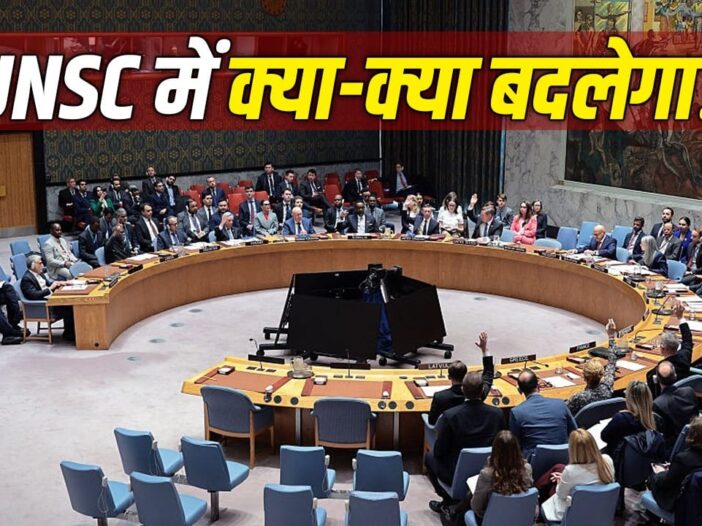
The United Nations General Assembly (UNGA) on Wednesday elected five new temporary member countries to the United Nations Security Council (UNSC). Austria, Kyrgyzstan, Portugal, Trinidad and Tobago and Zimbabwe have been elected for a two-year term starting on January 1, 2027. This election has brought about many major upheavals in global diplomacy. Let us know the five most important changes…
1. Farewell to Pakistan
Pakistan was elected as a temporary member of UNSC for 2025 to 2026. He also chaired the Security Council for a month under the rotational policy in July 2025. Pakistan was also made the chairman of the UNSC’s 1988 Taliban Sanctions Committee and vice-chairman of the Anti-Terrorism Committee. But his tenure is going to end on 31 December 2026. Now Kyrgyzstan has taken its place from the Asia-Pacific group.
2. Entry of Kyrgyzstan for the first time
There was a big change in the Asia-Pacific group. There was a tough competition here between Philippines and Kyrgyzstan. After four rounds of voting, Kyrgyzstan achieved the required two-thirds majority. It got 142 votes, while the Philippines got 49 votes. With this, Kyrgyzstan has become a member of UNSC for the first time.
3. Germany’s historic defeat
The biggest shocking news of this election was about Germany. There was competition between Germany, Austria and Portugal for two seats in the group of Western Europe and other countries. Germany tried hard to win the seat, but got only 104 votes. Whereas Portugal got 134 votes and Austria got 131 votes. With this, Germany lost the elections and could not make it to the Security Council for the first time. Before this, Germany has won the UNSC seat 6 times.
Germany’s Chancellor Friedrich Merz called it a failure. Experts believe that Germany’s soft stance on Israel and America-Iran attacks drove many countries away from it. The interesting thing is that this voting was presided over by former German Foreign Minister Annalena Baerbock. She is currently the President of (UNGA). Germany has been demanding permanent membership of UNSC for a long time. He says that UNSC should be expanded. Germany has also been advocating for more permanent and temporary seats for under-represented regions such as Africa, Asia and Latin America.
4. Shock to America
America has suffered a major strategic blow due to the defeat of the Philippines in the UNSC. Washington was promoting the Philippines as an important partner to counter China’s aggression in the Indo-Pacific region. The Philippines was competing for this seat with Kyrgyzstan, which is a member of the Shanghai Cooperation Organization (SCO). This defeat has raised questions about America’s regional influence and its mobilization on the international stage.
5. Picture of the new council
Zimbabwe has been elected unopposed to the Africa Group seat, replacing Somalia. At the same time, Trinidad and Tobago became the unopposed winner of the Latin America and Caribbean region seat, which will replace Panama. Apart from this, Portugal and Austria will now replace Denmark and Greece. The five new members will work on the council along with Bahrain, Colombia, Congo, Latvia and Liberia.
Earlier on Tuesday, the United Nations General Assembly had elected Bangladesh Foreign Minister Khalilur Rahman as the President of the 81st session of the 193-member UNGA. His tenure will start from September 2026. There are more than 50 countries in the UN which have never been members of the UNSC. The Council is currently facing difficult issues like Ukraine and the Middle East, where its efficiency is being affected by the increasing competition among the superpowers.
Why is UNSC important?
The United Nations Security Council is an organization of a total of 15 countries. It is considered the most powerful unit of the United Nations. This organization takes decisions related to peace and security in the world. It also has the right to impose sanctions on any country and approve military action. There are five permanent members in the Security Council – America, Russia, China, France and UK. These countries have veto power. The remaining 10 members are temporary, who are elected from different areas for a tenure of 2 years. These regions are divided on the basis of Africa, Asia, Latin America, Eastern Europe.
Also read: Rail, storage and pipeline…. 5 countries have prepared 4 alternatives to Hormuz

Leave a Reply