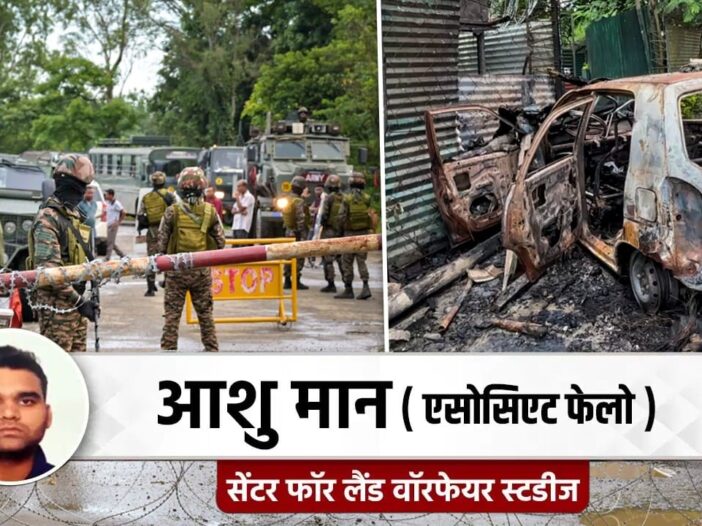
Manipur has been disturbed for a long time. Most of the discussion regarding the violence here has revolved around caste and political deadlock. But what is left behind during this time is its economic aspect. That is, what is the real cost of violence and who is paying it? He is a common man. Such a process of extortion is going on in the name of violence which has made the lives of the common people there miserable.
Any person living in Imphal or Kangpokpi is paying hidden taxes on almost everything. Be it filling oil in your car, LPG cylinder used in the kitchen, child’s school fees, salary received at the end of the month, and even the road which is never fully constructed. No one in the government is collecting this tax. After all, who is taking it, the answer is the criminal network.
This network, which includes rebel groups, drug networks and extortion gangs, has virtually become an interdependent economy. Because of this, Manipur has lagged behind on almost every measure of basic prosperity.
drug trade
Manipur is a small state situated on the western edge of the ‘Golden Triangle’. In the last 10 years, instead of being just a transit route for heroin coming from Myanmar, it has now become a center of its production itself. The state started the ‘War on Drugs’ campaign in 2017. Since then, more than 19,000 acres of opium crops have been destroyed. Even after strict action, this crop grows again and again.
Between November 2025 and February 2026 alone, according to police records, 2,618 acres of illegal opium cultivation was destroyed. This happening on such a large scale and continuously is not the work of common farmers but it points towards an organized criminal network. The money involved is huge for a state with a population of less than 35 lakh.
In just one year, between July 2022 and July 2023, the police have seized illegal drugs worth about Rs 1,500 crore. Investigation of many smuggling cases has revealed links between drug smuggling and people and leaders of rebel groups operating in the valley and hilly areas. Illegally earned money is not only making people rich, but it also leads to recruitment of new people and purchase of weapons, which directly challenges the authority of the state.
extortion trap
Drugs are the fuel of this entire game, while extortion is the thing that brings the real cost of this fight to every home. Manipur has today become the most advanced extortion network run by any terrorist network in the country. There are 26 illegal tax checkpoints operating on the highways that run through the state. On the Imphal-Moreh route alone, transporters charge between Rs 900 and Rs 1,700 per trip.
It was admitted by the government itself that a group was earning around Rs 3 crore a month from Manipuri trucks alone. Government employees working in areas controlled by militants often have to pay “tax” of about 1% of their monthly salary. Sometimes it is deducted directly from the pay slip. No sector is spared from this extortion.
Police investigations have revealed cases of extortion from schools, colleges, pharmacies, brick-kilns, traders and government officials, often using weapons stolen from security forces, a problem so serious that the state has created a special anti-extortion cell with its own hotline.
The investigation by the National Investigation Agency NIA has also revealed that the funds for building roads for the contractors went directly into the accounts of these rebels. Every rupee so taken is a rupee spent under duress, money ill-gotten, and a rupee that was never used to build the road it was meant for.
How much will it cost for a common citizen?
Nowhere is this hidden tax more visible than the price found at the petrol pump. During the blockade on National Highway 2, the price of petrol in Kangpokpi district increased to Rs 250 per liter from the normal price (about Rs 100). A domestic LPG cylinder which is available for around Rs 1,000 in Aizawl or Guwahati is being sold for Rs 5,000 in Manipur.
The same pattern was also seen during the blockades in the years 2010, 2011, 2016-17 and 2023. There has been a reduction of medicines by 40%, movement of essential goods is done only with armed security. While in neighboring states the price of rice, gas or fuel is determined by the market, in Manipur, the price is partly decided by the group that controls the highway that week.
Far behind neighboring Mizoram
The state is suffering huge economic losses due to this caste conflict. The per capita income of Manipur is about Rs 1.12 lakh, which is much lower than the national average (about Rs 1.72 lakh). If we compare this with Mizoram, it ended the ongoing insurgency there with the peace agreement of 1986 and now the per capita income there has crossed Rs 3 lakh. This is almost three times the income of Manipur.
Also, Mizoram’s HDI ranking is in the top-10 and the poverty rate there is the lowest in the country. Assam, which has a per capita income of around Rs 1.59 lakh, is registering a GDP growth of more than 11%. Manipur is naturally beautiful and despite having Moreh as its gateway to South-East Asia, the state is dependent on government spending. Its ‘Act East’ potential—which includes the trilateral highway project—is either stalled or a victim of extortion.
Challenge to break the syndicate
This syndicate runs like the money earned from drugs provides arms to militant groups; Then these groups run extortion networks and organize blockades. Now extortion increases prices, stops investment and wastes government money. Due to this, the slowdown in the area pushes the youth into the drug and arms trade which is flourishing rapidly.
What is called an ethnic conflict is actually a war to capture the income from the illegal economy if seen from an economic point of view. Breaking this cycle means systematically destroying opium crops, the real economic backbone of the conflict, including narcotics and extortion, confiscating assets under the UAPA, NDPS and PMLA, guaranteeing safe transportation routes, and going after those who provide money rather than merely obeying pawns.
If their syndicate is controlled then petrol will be available at Rs 100 per liter instead of Rs 250, people will get a salary on which they will not have to pay tax secretly. Also, a generation will be created which will follow the lines of Mizoram instead of getting trapped in the gun economy. The real challenge for Manipur will not be to stop firing and bring peace in the state but will come when the process of extortion is stopped.

Leave a Reply