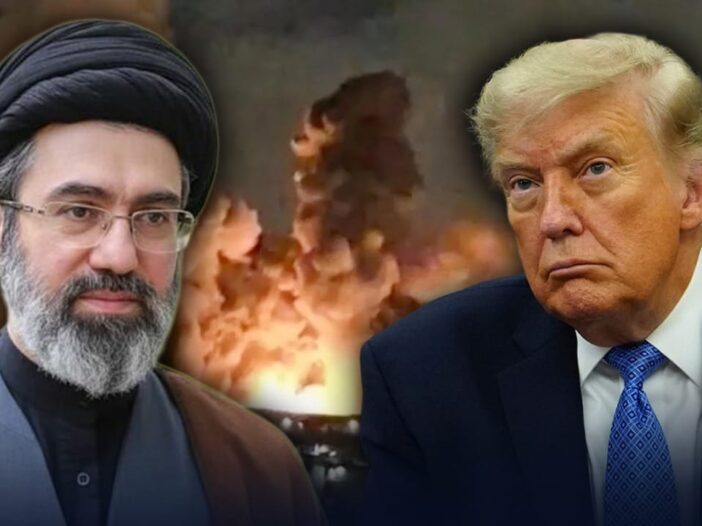
Iran is preparing to collect fees from ships sailing through the Strait of Hormuz. Iran is trying to adopt Turkey’s model in the Strait of Hormuz, but Trump is not only against it but is also warning Iran citing international law. The question is, what is the Turkish formula that Iran wants to implement in the Strait of Hormuz? The bigger question is that if Iran starts charging fees, will it result in another war? All these questions are being raised because there is a tussle between Mujtaba and Trump regarding the collection of fees in the Strait of Hormuz.
strait of hormuz The stance of Iran and America regarding this is completely opposite to each other. Iran not only wants control over this sea route, but also wants to collect fees from the ships passing through this route. Trump is against this demand of Iran. Trump has made it clear that this condition of Iran will not be accepted under any circumstances.
How is Iran adamant on collecting fees in the Strait of Hormuz? Iran’s Deputy Foreign Minister Kazim Gharibabadi has said that the safety of those ships in the Strait of Hormuz which are not following Iran’s rules and regulations cannot be ensured.
What argument is Iran giving for collecting fees?
Iran has made it clear many times that the Strait of Hormuz will never be the same again. Iran will control it. Will implement the new system. Ships from all over the world will have to pass under this system. Iran wants to implement new management in Hormuz in collaboration with Oman. For this, continuous talks are going on between Oman and Iran, but Trump and his team are not accepting this.
Due to this conflict between Iran and America, the question arises that what will be the future of the Strait of Hormuz? Can Iran collect fees in the Strait of Hormuz or not? What argument is Iran giving for collecting the fees? Citing which rules is America opposing Iran’s recovery?
Read this also- Blasts again in Hormuz, attacks on Sirik and Qeshm. Has the US-Iran ceasefire broken?
There are two types of waterways around the world. First is natural waterway and second is man-made waterway. Tolls or fees are collected from man-made waterways because their construction costs money, but no toll tax or fees can be collected from waterways that are natural.
What is the law regarding fee collection?
There is an international law in this regard, which has been made by the United Nations, which applies to the entire world. The name of this law is – United Nations Convention on the Law of the Sea…in short it is called UNCLOS. This law was adopted on 10 December 1982 and came into force on 16 November 1994.
According to this, no country can charge mere passage fees from ships passing through the open seas or natural waterways, because the rights over the open seas or natural waterways do not belong to any one country but to the entire world.
This law named UNCLOS applies to the whole world. Under this, no country can collect tax from ships passing through natural waterways, but it is also true that one country in the world collects fees from ships passing through natural waterways.
Turkey collects tax on natural waterways
A waterway passes near Turkiye. The name of this waterway is Bosphorus and Dardanelles Strait. This is a natural waterway, which connects the Black Sea and the Mediterranean Sea. This strait is a natural waterway. The rules say that fees cannot be taken from ships in the name of passing through natural waterways, but Turkey collects tax from ships in this strait. The question is, why is Turkey doing this? Why is the world letting him do this?
Now the question is that when collecting tax in the open sea or natural waterways is prohibited, when the law does not allow it, then how is Turkey doing so in the Bosphorus Strait and if it is doing so, why does the world not have any objection to it? Now it is important to understand this.
What are the provisions in UNCLOS law?
There is also a provision in the UNCLOS law that if a country provides any kind of facilities to ships passing through any waterway, then it can charge fees from them in return.
For example, if a country guides a ship, provides security, provides tugboat help or ships use the port of that country, then that country can collect tax in return.
The rules are very clear. A country cannot collect tax on natural waterways just because a ship is passing through that route. Fees can be charged only when that country provides various facilities to the ship. If he does this then he can take money in return.
Turkey provides security to ships passing through the Bosphorus Strait, and also provides services such as sanitary inspection and lighthouses. Therefore, Turkey collects taxes only in exchange for these services. This means that the movement of ships in the Bosphorus natural waterway is completely free. Turkey takes the money in return for its services, but now Iran also wants to collect fees from ships on the lines of Bosphorus.
Iran is citing Bosphorus
Citing the Bosphorus, Iran is saying that it will also protect the ships passing through the Strait of Hormuz and show them the way. Iran says that if ships want to pass safely through this sensitive waterway, they can pass only under Iran’s security arrangements. In return they will have to pay fees.
Iran’s argument is that the area is sensitive and dangerous and if we are giving safe passage to the ships, then it is worth it. Iran says that this is not a toll tax, but a fee being taken for security.
Iran is working with Oman to create a management system for the Strait of Hormuz. Under the system that Iran and Oman are building, a plan is being prepared to provide many types of services besides guiding the ships and providing them security.
Iran is talking about security and convenience
In fact, Iran is talking about creating a system and providing security and various facilities to the ships passing through Hormuz, so that these services of Iran can get legitimacy, so that, like Turkey, it can collect fees from the ships in exchange for services.
This demand of Iran is not acceptable to America and other countries. Before the war started, this narrow sea route was safe for all ships and no fee was charged from ships for passing through it.
International maritime law also says that fees cannot be collected merely for the passage of ships in any natural waterway. America is repeatedly citing this law. Obviously, the tough stance taken by both America and Iran regarding the Strait of Hormuz is once again increasing the fear of war.
Bureau Report, TV9 Bharatvarsh
Read this also-Donald Trump will come to India next year, Rubio said – trade deal is also going to be finalized

Leave a Reply