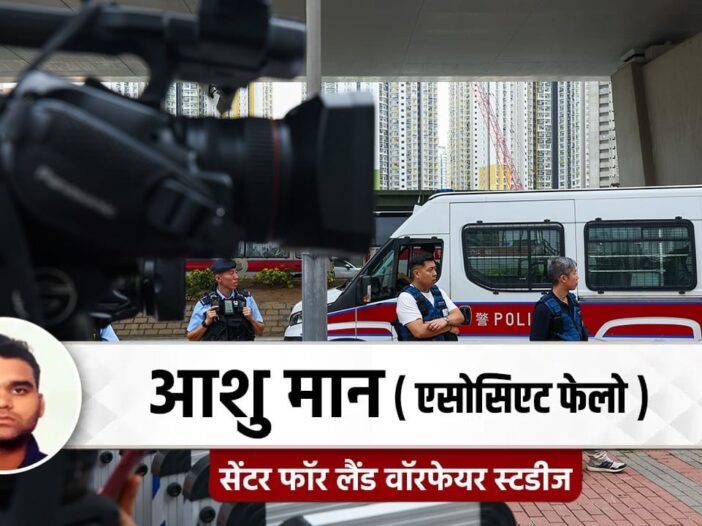
On June 30, 2020, China implemented the National Security Law (NSL) in Hong Kong. At that time the Chinese government had said that this law was necessary to restore peace and stability in the city. Before this, there were anti-government protests in Hong Kong for several months. Beijing claimed that this law has been made to stop activities like separatism, terrorism and foreign interference.
But the situation has completely changed in the last five years. Press freedom organizations, human rights activists and many journalists say that this law has become the biggest weapon to end Hong Kong’s independent journalism. They allege that this law was used more to suppress voices criticizing the government than to protect national security.
How did the environment change?
Hong Kong was once considered a major center of independent media in Asia. The journalists here could investigate the government, administration and big businessmen. This city was also an important center for many international media organizations. But after the implementation of NSL, this environment started changing rapidly. The most recent example of this change is the closure of FactWire, a media organization engaged in investigative journalism. Many experts believe that the closure of FactWire is the biggest evidence that the National Security Act is being used to weaken independent journalism.
Just a month before the closure of Factwire, Hong Kong had suffered a major blow to press freedom. Hong Kong fell 68 places to 148th out of 180 countries in Reporters Without Borders (RSF)’s world press freedom rankings. This was his worst ranking ever and one of the biggest falls in a year. Experts say that this decline did not come suddenly. In the last few years, Hong Kong’s media environment was filled with fear, uncertainty and political pressure. Journalists were not able to understand which report could be considered against national security and when.
What are the provisions in the National Security Act?
Four major crimes have been prescribed in the National Security Act – Secession, Subversion, Terrorism and Collusion with Foreign Forces. Critics say that the definition of these crimes is too broad and vague. Because of this the government gets greater power to take action. Journalists, editors, publishers and even common citizens can come under its purview.
Apart from this, the Hong Kong administration also started using the old sedition laws of the British rule era. This gave the government another legal means to control criticism and opposition.
Many journalists say that after the implementation of NSL, the distinction between investigative journalism and political opposition almost disappeared. If any media organization questions government decisions, exposes corruption, tries to hold officials accountable or maintains contact with international organizations, it may also face legal risks.
Institutions move towards self-censorship
This is why many media organizations themselves started self-censorship. Now many journalists avoid working on such news, which can land them in legal trouble. This fear is clearly visible in the final statement of Factwire also. The institute announced its closure, but did not directly mention the National Security Act. He did not even accuse the officials of putting pressure on them. The language of the statement was chosen very carefully.
Analysts say that this shows how much fear has spread among journalists in Hong Kong. Now many people avoid even taking the name of that law, which they consider to be the root of their problems. Before Factwire, Hong Kong’s two major pro-democracy media organizations, Apple Daily and Stand News, had also been closed.
The action taken on Apple Daily was the most discussed. In August 2020, about 200 police officers reached his office and raided it. This was considered the first major action against the media under the National Security Act. After this, in June 2021, about 500 police officers again reached the newsroom of Apple Daily. They seized material related to journalism and arrested five senior officials early in the morning.
The pictures of that time became a topic of discussion all over the world. In the pictures, journalists were working on their computers and police officers were searching around them. Many people described it as a symbol of the changing situation of Hong Kong. After some time, the authorities froze Apple Daily’s assets and bank accounts. This made it impossible for the newspaper to continue its work and it had to be closed.
Something similar happened with Stand News also. Police arrested its editors and former board members on charges of treason. Officials presented the work of journalism as a political conspiracy. This case showed how the old sedition law and the new national security law can combine to suppress voices of dissent.
Crisis on investigative journalism too
Factwire was separate from these two institutions. It mainly did investigative journalism and stayed away from political commentary. Its reports focused on corruption, abuse of power, government shortcomings and issues related to public interest. Still he stopped. Due to this, many experts believe that now not only political opposition is under target, but independent investigation and fact-verifying journalism is also under pressure.
Analysts say that any authoritarian system is afraid of independent investigation. The reason is that apart from the claims of the government, other information and facts also come to light through investigation. This gives a different perspective to the people and fixes the accountability of the government. He believes that Beijing feared that independent media could keep alive people’s memory, public debate and fact-based discussion in Hong Kong. Therefore, the National Security Act became the legal basis for weakening these institutions.
The policy of pressure is not limited to just one city
The case of Hong Kong is not considered to be limited to just one city. Experts say that this shows that in the modern era, governments can limit freedom of expression not only through police action or use of force, but also through laws. According to critics, the biggest strength of NSL is that it gives legal form to political action. Arrests are said to be a law enforcement process, while closure of media outlets is said to be an administrative or legal decision.
The closure of Factwire is therefore not considered to be the closure of just one media organization. Many analysts say that this is part of a larger strategy, in which independent journalism is made so difficult economically, legally and mentally that it becomes difficult to maintain its existence.
According to him, the biggest fear in today’s Hong Kong is not police raids or arrests. The biggest fear is that people have started believing that the law itself has become a weapon which can be used against those who ask questions, those who investigate and those who demand answers from power. This is the reason why Hong Kong journalism has completely changed in the last five years.
Also read: Russia ready to provide Su-57 fighter aircraft to India, offered partnership

Leave a Reply