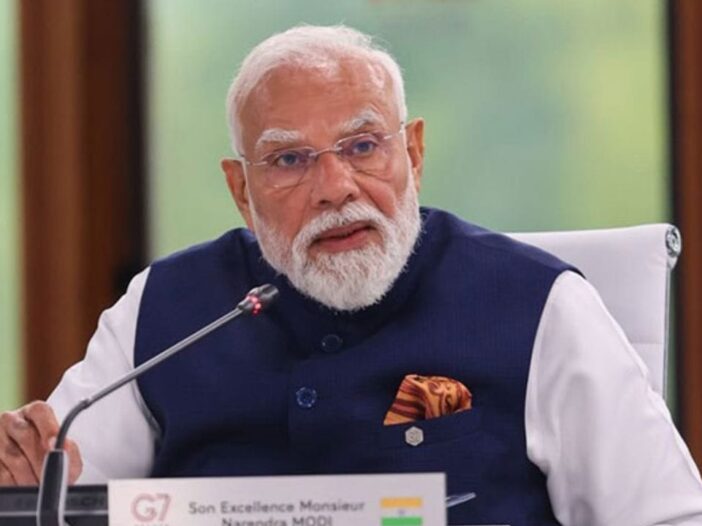
During the G7 summit held in Evian, France, Prime Minister Narendra Modi addressed an outreach session on the topic Reviving a Balanced, Shared and Sustainable Economic Growth for All. Where he presented India’s vision of inclusive and shared development to the world. During the summit, the Prime Minister also held bilateral meetings with European Council President Antonio Costa and European Commission President Ursula von der Leyen, which mainly focused on India-EU relations and the recently concluded India-EU Free Trade Agreement (FTA).
In his address, PM Modi said that today the question of development is not limited to GDP or trade figures alone. Rather, it is important to consider who is benefiting from development and what is the level of participation. He described India’s development journey as a story of inclusion, democratic empowerment and large-scale change. Highlighting the mantra of ‘Sabka Saath, Sabka Vikas, Sabka Vishwas, Sabka Prayas’ as the basis of India’s development policy, he said that this philosophy guides India’s participation on the global stage.
Opportunities for trade, investment, employment and innovation will be created: PM Modi
Describing the India-Middle East-Europe Economic Corridor (IMEC) as an important model for global connectivity and economic cooperation, the Prime Minister said it will create new opportunities for trade, investment, employment and innovation. He advocated expanding such connectivity projects to Africa, Latin America and Pacific Island countries. To this end, he proposed a new global initiative called ‘IMPACT’ (International Mobilization Partnership to Accelerate Connectivity and Trade), which aims to create economic corridors that connect trade, technology, energy and opportunities.
PM Modi gave suggestion
Given the aging population in developed countries and the abundance of young talent in the Global South, the Prime Minister suggested setting up a ‘Global Skills Partnership’. He said this will help facilitate skill mapping and movement of a reliable, skilled workforce.
Meanwhile, on the sidelines of the G7 summit, Prime Minister Modi met European Council President Antonio Costa and European Commission President Ursula von der Leyen to review India-EU relations. The leaders expressed satisfaction at the significant progress made in bilateral relations after the 16th India-EU Summit in January 2026.
India-European Union strategic partnership will strengthen
During the meeting, the recently concluded negotiations on India-EU Free Trade Agreement (FTA) were described as a historic achievement. Both sides stressed the need for early signing of this agreement and its effective implementation. He believes that this agreement will open up vast opportunities for trade and investment and will play an important role in diversifying supply chains amid the current geopolitical uncertainties.
The two sides also reviewed the progress of the joint India-EU Comprehensive Strategic Agenda adopted in January 2026. The leaders expressed confidence that this agenda will further strengthen the India-EU strategic partnership and ensure transformative and mutually beneficial outcomes for both sides.
India-EU agree on FTA and strategic partnership
While discussing regional and global issues, the leaders welcomed recent positive developments in West Asia and reiterated their shared commitment to a strong multipolar global order that promotes peace, stability, sustainable development and prosperity. Thus, while Prime Minister Modi presented a new vision for inclusive global growth, connectivity and skills partnership at the G7 platform, the meeting with EU leaders also resulted in an agreement to give new impetus to the India-EU FTA and strategic partnership.

Leave a Reply