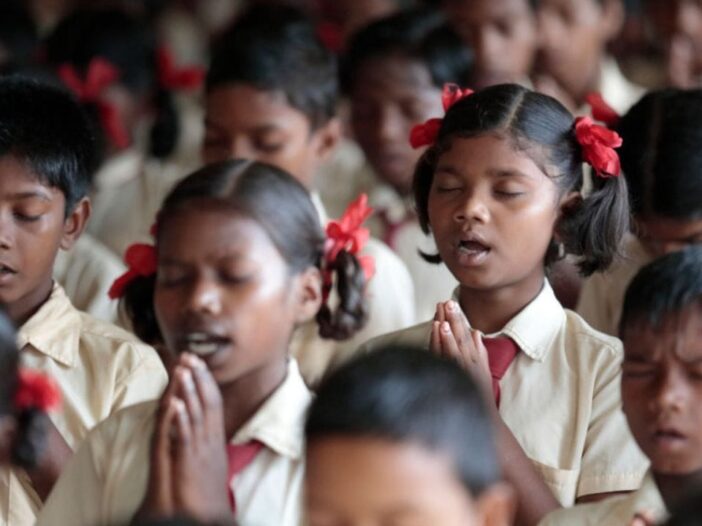
Chhattisgarh High Court on Thursday clarified that no child can be forced to recite Hindu prayers in government schools. The court was hearing a petition challenging a circular issued by the state government on June 12, which made chanting Saraswati Vandana, Gayatri Mantra, Guru Mantra and other Hindu prayers mandatory in schools. Justice Amitendra Kishore Prasad recorded the state government’s contention that though the circular was issued in early June, it had not been implemented yet.
Keeping this statement in mind, the court closed the petition and gave the liberty to the petitioners that if any child has been forced to participate in the prayer lesson, they can approach the court again. The High Court also commented that if any such obligation is brought to its notice, appropriate action will be taken.
Who filed the petition?
Actually, this petition was filed in the High Court by former Chairman of Chhattisgarh Waqf Board Abdul Salam Rizvi, former Chairman of Minority Department Mahendra Chhabra and Bilaspur-based social worker Shafiq Ahmed, who challenged the constitutional validity of the circular of the School Education Department. The petition argued that the circular violated the constitutional principles of secularism and fundamental rights guaranteed under the Constitution.
Instructions to recite mantras in government schools
In the circular issued by the state, government schools across the state were directed to recite the national anthem, national song, Deep Mantra, Saraswati Vandana and Guru Mantra. It also made it mandatory to recite biographies of great personalities, Bhojan Mantra during lunch and Gayatri Mantra and Shanti Mantra before leave. The petition said, ‘Compulsory inclusion of Saraswati Vandana, Gayatri Mantra, Guru Mantra and Shanti Mantra in government schools is tantamount to imparting religious education and promoting a particular religion. Therefore the disputed order is unconstitutional.
The petitions also argued that the circular failed to protect students who did not want to participate in religious rituals. The petition said that by prescribing prayers and mantras associated with one religion and excluding all others, the state creates an unacceptable preference and classification on the basis of religion.

Leave a Reply