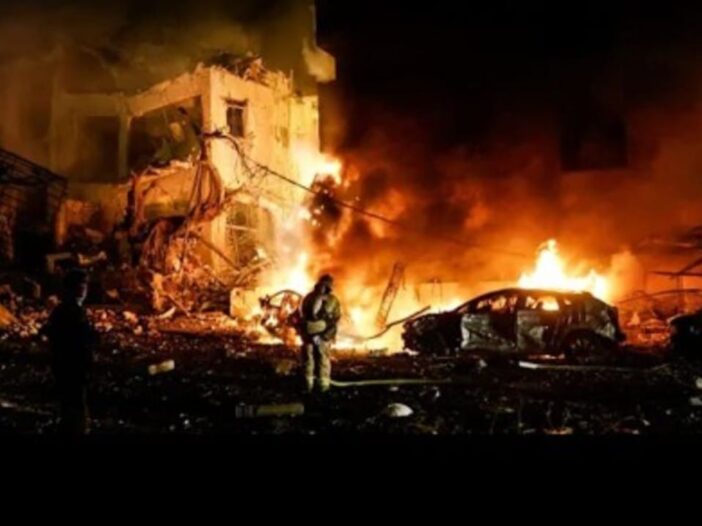
America carried out more air strikes on Iran on Sunday. These attacks were carried out in response to the death of American soldiers. Meanwhile, Iran fired missiles towards Jordan, creating a danger of the conflict spreading to neighboring Israel. America and Iran are gradually moving towards a situation of full war. An interim deal signed last month to end the fighting forever has broken down and the movement of ships in the Strait of Hormuz has largely stopped.
Both sides have targeted civilian infrastructure on which millions of people depend. The US Army said that an American soldier died during controlled detonation of an Iranian drone in Iraq on Saturday.
Earlier, the army had said that Iran’s paramilitary force ‘Revolutionary Guard’ was targeted to avenge the death of soldiers in Jordan on Friday. A soldier was missing after that attack. The army’s new statement said that unidentified remains were found on Sunday and they are being investigated. Since the start of the war, 17 American soldiers have died.
This round of shelling is now in its second week. In this, America has targeted bridges, water desalination plants and power facilities in Iran. Tehran has attacked America’s allies in the Middle East.
Kuwait, Jordan and Bahrain reactivated their air defense systems to counter drones and missiles coming from Iran. Israel warned that for the first time in weeks, fires could spread into Israeli territory due to missiles fired towards neighboring Jordan.
A nuclear site under construction was attacked: Iran
The US military’s Central Command said it attacked Iran’s military coastal surveillance and air defense facilities, maritime capabilities and missile and drone storage sites. He said that the purpose of this attack was to reduce Iran’s ability to control the strait and to immediately punish the forces of the Islamic Revolutionary Guard Corps. It is a power base of Iran’s religious regime which controls its ballistic missile arsenal.
Footage released by the US military showed attacks by fighter jets and sea-launched Tomahawk cruise missiles. A target site seemed to be in a valley in a hilly area. The Guards often hide missile bases and other military equipment in mountainous areas.
According to state television reports, Iran’s Atomic Energy Agency said the US strikes targeted the construction site of a nuclear power plant being built in the southwest. Satellite images from Planet Labs PBC showed land clearing at the Darkovin nuclear plant site, but as of July 9, very little construction had taken place there. Iran had not previously disclosed that it had been targeted.
The International Atomic Energy Agency said that when the UN monitor last visited the site, there was no nuclear material at the site, which was in the early stages of construction. Jordan and almost all Gulf Arab countries have been targeted. The Jordanian army said it shot down several Iranian missiles. America has large military bases in this country and it is dependent on America’s air-defense system. According to the Jordanian army, these missiles caused no casualties and no damage.
According to state TV reports, Jordan later summoned Iran’s chargé d’affaires (diplomatic representative) to register its protest. Israel’s military said Iranian missiles fired toward the Jordanian port city of Aqaba, just across the border, may have strayed here. Additionally, Israelis were warned to be prepared to hear air-raid sirens for the first time in weeks.
Security officials in Aqaba’s neighboring Israeli city of Eilat were quoted as saying that two interceptor missiles were fired from the outskirts of the city to prevent debris from falling. During the recent conflict, Iran has focused on attacking US-allied Arab countries rather than Israel. Israel started war with America on 28 February. Chief of Staff of the Israeli Army, Lieutenant General Eyal Zamir said that we are ready to resume fighting immediately.
Kuwait said that one of its electricity and water desalination plants was attacked for the second time in two days, causing a fire. The Ministry of Electricity, Water and Renewable Energy there said that the power grid is stable. About 90% of the drinking water in Kuwait is obtained through desalination.
The Strait of Hormuz remains important in this conflict. US President Donald Trump has threatened to target Iran’s power stations and bridges to force Tehran to loosen its grip on the Strait of Hormuz. Before the war, one-fifth of the world’s total oil supply passed through here. Recent attacks indicate that the US Army is working on this plan.
Last week, the US again imposed a naval blockade on Iran’s ports to stop the shipment of crude oil. The army said on Saturday that it had since diverted five ships and disabled one ship.
A maritime organization under the supervision of the US Navy said on Sunday that the threat to sailors remains serious following previous attacks by Iran and that the possibility of deliberate hostile action remains very high. The organization said that the traffic was less, eight ships passed there on Saturday and three ships passed there on Friday. Before the war, an average of about 140 ships passed there every day.
Iran’s supreme leader Mojtaba Khamenei warned in a statement on Saturday that if the US continues attacking the Islamic Republic, it will be taught an unforgettable lesson. An Iranian negotiator said Tehran was withholding its commitments under the interim agreement and accused the US of violating the agreement.

Leave a Reply