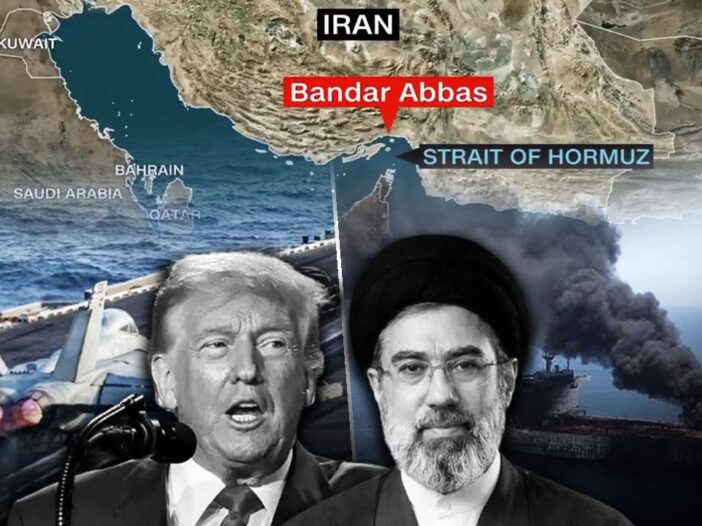
America carried out highly accurate self-defense strikes in the Bandar Abbas and Strait of Hormuz areas of southern Iran. American Central Command i.e. CENTCOM described this operation as an action of very limited scope. America said that this attack was carried out only to protect American soldiers, naval ships and maritime security from immediate threats.
According to Centcom, the US military targeted Iranian missile launch sites and boats of the IRGC i.e. Islamic Revolutionary Guard Corps that were trying to lay mines in the sea around the Strait of Hormuz.
How did America attack?
America adopted Stand-off Precision Strike strategy in this entire operation. This means that American platforms attack while staying away from the enemy’s lethal range so as not to put their soldiers and pilots in danger.
The attack was carried out in several phases
First, MQ-9 Reaper drones and surveillance aircraft identified maritime activities and missile launch positions. After this, selected targets were attacked with Precision-Guided Missiles and Smart Bombs. Boats trying to lay mines in the sea were directly targeted while GPS guided smart weapons were used at missile launch sites.
1- AGM-114 Hellfire Missile, the most important weapon against boats
- The most talked about operation was the AGM-114 Hellfire missiles. It is considered to be America’s most accurate precision-guided missile, which has been designed to destroy small boats, high-speed boats, vehicles and limited military targets.
- Hellfire missile is available in both laser-guided and radar-guided versions.
- Its range is about 7 to 11 kilometers. Its speed is considered to be approximately Mach 1.3.
- Weighing about 45 to 50 kg, this missile is equipped with a high-explosive warhead, which can destroy small but important targets with great precision.
- To destroy Iranian boats laying mines, 2 to 4 Hellfire missiles would have been fired from MQ-9 Reaper drones, Apache attack helicopters or Navy helicopters.
- Reports claimed that at least two IRGC boats were destroyed in the attack.
- The biggest feature of this missile is its high accuracy and low collateral damage capability, that is, it is capable of conducting surgical strikes while causing less damage to civilian areas.
2- MQ-9 Reaper Drone American Hunter-Killer
- The role of MQ-9 Reaper armed drones is considered very important in the operation. This is America’s famous Hunter-Killer drone, which works for both surveillance and precision strike.
- MQ-9 Reaper can fly continuously for about 27 hours.
- Can operate at altitudes up to 50,000 feet.
- It is equipped with live surveillance, target tracking and immediate precision strike capability.
- Hellfire missiles and smart bombs can be installed on this drone. According to reports, this drone monitored missile activity and IRGC boats in Bandar Abbas area and launched immediate attack if needed.
3- JDAM Smart Bombs Technology that makes ordinary bombs smart
- America used JDAM i.e. Joint Direct Attack Munition smart bombs to target missile launch sites and hardened military positions.
- JDAM is not a separate bomb but a guidance kit that turns ordinary bombs into GPS-guided smart bombs.
- This technology gives the fighter aircraft the ability to conduct very precise attacks.
- The range of these bombs can be from 15 to 28 kilometers depending on the launch altitude.
- Their variants are available ranging from 500 pounds to 2000 pounds.
- According to reports, American F/A-18 Super Hornet, F-35 or other carrier-based aircraft may have dropped JDAM-equipped bombs to target missile launch sites. Their advantage is that they can destroy fixed targets, bunkers and launch pads in a short time with high accuracy.
US Navy’s role
US Navy guided-missile destroyers already present in the Strait of Hormuz also helped in the operation. Reports have suggested the possibility of weapons like Harpoon anti-ship missile and Naval Strike Missile (NSM). These missiles are known to hit maritime targets with great precision. However, the possibility of use of Tomahawk cruise missile is considered low because this operation was not of large scale. Tomahawk is generally used in long range and large strategic strikes.
How big was the attack?
CENTCOM itself described it as a very small scope operation. According to reports, a total of 4 to 8 precision munitions would have been used in this entire operation. The operation remained limited, defensive and precision-focused. At present the situation in the area remains very sensitive. Any new incident in the Strait of Hormuz can cause tension to increase again rapidly.

Leave a Reply