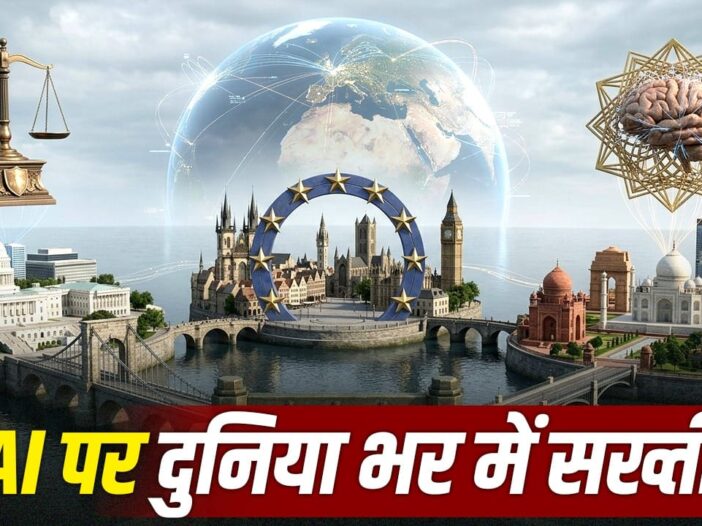
Generative AI tools like ChatGPIT, Sora and MidJourney have transformed the internet and the creative world. But the rapidly increasing power of AI has now become a big challenge for copyright and intellectual property laws. Governments around the world are now trying to decide whether AI companies can use the data of artists, writers and publishers without permission or not. Along with this, the question is also increasingly arising that who will be the real owner of the picture, video or text created by AI. There are many more such questions which are arising after the arrival of AI and for this, laws have also started being made in many countries. Countries like India and Europe have started making laws for AI regulation. Let us know what rules and laws have been made in countries around the world regarding AI.
Rules become stricter on AI content in India
India has chosen a very strict and balanced path regarding AI and digital content. The Ministry of Electronics and Information Technology (MeitY) has implemented major changes in IT rules in February 2026. Under the new rules, it will be mandatory to put clear AI label on any AI generated video, photo or audio. If any deepfake or misleading content comes to light, platforms like Meta, X and Google will have to remove it within 3 hours. If platforms do not follow the rules, they may lose their safe harbor protection and legal action may also be taken against them. The Government of India is now also preparing a licensing model on copyrighted content for AI training.
Preparation to collect royalty from AI companies
India’s DPIIT department has released a working paper on Generative AI and Copyright in December 2025. In this, ‘One Nation, One License’ model has been proposed. Under this model, AI companies may have to take a license to train AI models on the content of Indian writers, artists and creators. In return, companies will have to pay a part of their earnings as royalty. This amount will later be distributed among the content creators. Experts believe that if this model is implemented, India will join the few countries in the world which are creating a separate economic structure to create a balance between AI and copyright.
Europe enacted the world’s largest AI law
The European Union has implemented the world’s first comprehensive legal framework i.e. EU AI Act to control AI. Under this law, AI systems have been divided into different categories based on their risk. The strictest rules have been applied to technologies that involve facial recognition or personal data scraping. Apart from this, it will be necessary for AI companies to tell what kind of data they used to train their models. It will also be mandatory to place a clear ‘AI-Generated’ mark on all AI-generated news and deepfake content from August 2026. This model of Europe is now becoming an example for other countries also.
Human creativity gets priority in America
The battle between AI and copyright in the US is progressing primarily through the courts and the US Copyright Office. There the law has made it clear that only machine created content will not get copyright protection. In March 2025, in the Thaler vs. Perlmutter case, the US court ruled that paintings created by AI cannot be copyrighted. Later the US Supreme Court also refused to review this decision. However, if a person uses an AI tool only as a medium and has creative control over the final content, that portion may be copyrightable. This makes it clear that America is still giving priority to human creativity.
Different path of UK, Singapore and other countries
Countries like the United Kingdom and Singapore are adopting a slightly different strategy regarding AI. The UK is currently considering creating a framework in which content creators can opt out of their data from AI training. The laws of Singapore are counted among the most liberal rules in the world. There, AI companies are allowed to do data training, provided they have legitimate access to that data. Experts believe that these laws of different countries have made it clear that the world is now coming out of the era of data mining without permission. In the coming times, companies like OpenAI, Microsoft and Google will have to pay more attention to content licensing and transparency.
Also read: Know the whole truth before installing SSD, why even today HDD is a better option

Leave a Reply