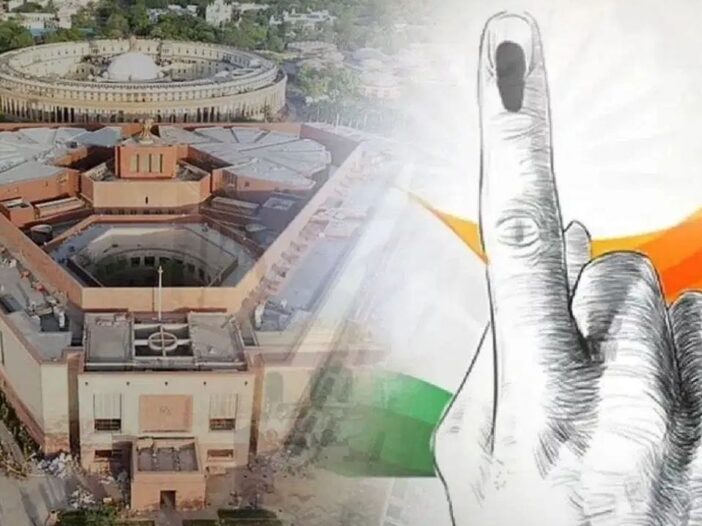
Chairman of the Joint Parliamentary Committee (JPC) and BJP MP PP Choudhary said that work is being done rapidly in the direction of One Nation-One Election. Our aim is to hold simultaneous elections for Lok Sabha and state assemblies across the country in 2029. Necessary constitutional and legal amendments will be made for this. This is not the agenda of any political party, but a comprehensive electoral reform related to the national interest. This will strengthen both democracy and governance. Chaudhary was addressing a press conference in Lucknow on Wednesday.
PP Chaudhary said that Prime Minister Narendra Modi has been supporting the concept of one country, one election for a long time. Frequent elections have an adverse effect on the country’s development, administrative functions and economy. Due to the continuous election process, Model Code of Conduct is imposed again and again, due to which development projects are affected and a large part of the government machinery gets busy in election work. If Lok Sabha and Assembly elections are held simultaneously, time, resources and government money will be saved and governance will be run more effectively.
Elections held simultaneously from 1952 to 1967
JPC President said that simultaneous elections are not a new system in the country. After independence, elections for the Lok Sabha and the Legislative Assemblies of most of the states were held simultaneously in 1952, 1957, 1962 and 1967. At that time there were neither EVMs nor technical facilities like today. Voting was done through ballot paper. Nevertheless the elections were conducted successfully. Later this electoral cycle broke due to various reasons. President’s rule came into effect in some states. Some assemblies were dissolved prematurely. Due to the formation of new states, the timing of elections became different. After this, the tenure of the Lok Sabha was extended during the Emergency, due to which the election calendar was completely affected.
Understanding of voters is the biggest basis of success
PP Chaudhary said that the Indian voter is very aware and politically mature. The biggest basis for the success of democracy is the understanding of the voters. Many times political parties and analysts predict election results, but the results come out different because the Indian voter thinks independently and votes. It is not appropriate to argue that if Lok Sabha and Assembly elections are held simultaneously, voters will get confused. From 1952 to 1967, crores of voters voted in both the elections simultaneously. Today, when the country is more technologically capable and the voters are more aware than before, then there is no solid basis for such apprehensions.
Questions on democracy and federal structure are baseless
Chaudhary also responded to the objections that say that one country, one election is against the basic structure of the Constitution, federal system or democracy. He said that if there was no violation of democracy or federal structure when simultaneous elections were held from 1952 to 1967, then making such an argument today is only a part of political debate. For many years even after 1967, assembly elections of some states continued to be held along with Lok Sabha elections. Therefore, to say that simultaneous elections are contrary to the spirit of Indian democracy is not factually correct.
Many commissions and committees recommended
PP Chaudhary said that the idea of one country, one election is not the creation of any one government. Many constitutional institutions and expert committees have recommended this from time to time. In 1983, the Election Commission in its report had recommended holding Lok Sabha and Assembly elections simultaneously. After this, in 1999 the Law Commission also supported this proposal. The commission formed in 2002 to review the functioning of the Constitution also considered it a suitable reform. In 2015, the Parliamentary Standing Committee on Law and Personnel, headed by a Congress Rajya Sabha MP, had also supported holding simultaneous elections in its report. Apart from this, NITI Aayog in its report in 2018 recommended taking steps in this direction.
More than 18 thousand pages report was submitted to the government
The JPC President said that the Central Government had constituted a high-level committee in 2020 under the chairmanship of former President Ramnath Kovind. This committee included Union Home Minister Amit Shah, Rajya Sabha MP Ghulam Nabi Azad and many experts and experts on constitutional matters. The committee held extensive discussions with various political parties, experts, Election Commission, constitutional bodies and other stakeholders. A report of more than 18 thousand pages was prepared and submitted to the government. In its report, the committee recommended holding Lok Sabha and Assembly elections simultaneously and also suggested holding local body elections within the stipulated time.
The committee has visited 10 states
JPC Chairman said that the committee is visiting various states across the country. So far, about 10 states including Uttarakhand, Punjab, Haryana, Himachal Pradesh, Karnataka, Gujarat, Goa and Uttar Pradesh have been visited. During these visits, suggestions were taken from the Chief Minister, former Chief Minister, Assembly Speaker, political parties, legal experts and various organizations. Many important suggestions have also been received during the visit to Uttar Pradesh. The committee is currently only listening to all the parties and has not reached any conclusion. A final report will be prepared after studying the suggestions.
Election Commission fully capable
On the question asked about EVMs and election preparations, PP Choudhary said that today the technology is much more advanced than before. If the Election Commission gets time to prepare about six months in advance, then it is fully capable of conducting simultaneous elections in the entire country. Earlier elections were conducted successfully through ballot paper, whereas today modern technology and better election management is available. The Joint Parliamentary Committee is seriously studying all the suggestions and objections. The effort of the committee is to prepare such a report keeping in mind the democratic values and constitutional system, so that in the future, the system of one country, one election can be effectively and practically implemented in the country.

Leave a Reply