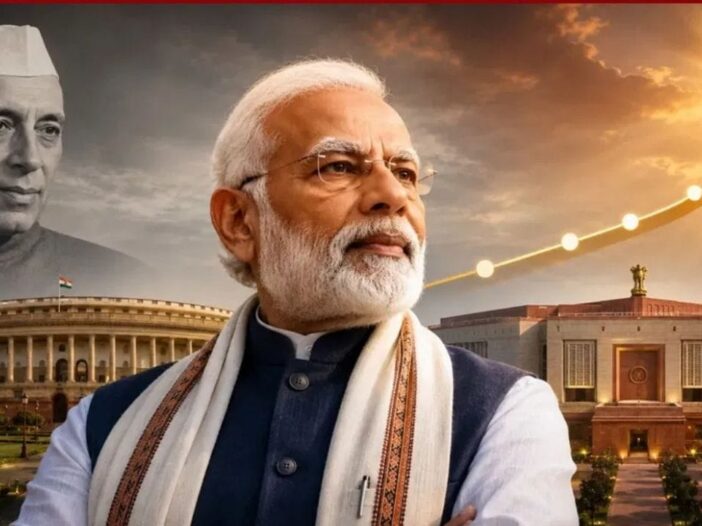
It is natural to discuss the electoral achievements of Narendra Modi, who is leaving Pandit Nehru behind as the elected Prime Minister. Under the leadership of Pandit Nehru, Congress maintained its dominance from the Center to the states by winning three consecutive elections. Interestingly, Narendra Modi is also the Prime Minister of the country for the third time through a hat-trick of victories. Pandit Nehru was in power as the head of the interim government even before independence. Then the presence of the opposition was symbolic.
On the other hand, for the first time at the national level in 2014, Modi was leading the BJP, which had never before been able to achieve full majority at the Centre. The party also lost the coalition government in the 2004 elections. Its performance in the 2009 elections was even more disappointing. Modi gets the credit for rescuing BJP from difficult times and expanding it widely. Read the story of his election achievements,
Nehru was in the front row from the beginning under Gandhi’s patronage.
Pandit Nehru was one of the great heroes of the freedom struggle. His family background was quite rich. Under the patronage of Gandhiji, Pandit Nehru’s public-political career began as a frontline leader of the country. Just before independence, during the British era, in the 1946 Central Assembly elections, Pandit Nehru got the post of Vice President in the Viceroy’s Executive Council formed under the leadership of Congress. This post was equivalent to that of the Prime Minister. After the independence of the country on 15 August 1947, the provisional Lok Sabha accepted Pandit Nehru as the Prime Minister.
Pandit Nehru, who contested the first general elections of 1951-52, was already holding the post of Prime Minister. In this election, apart from the Communists, mainly those parties were in the fray as opposition, whose leaders were part of the freedom movement, but after independence, they became disillusioned with Pandit Nehru or Congress and decided to contest the elections by forming separate parties. In terms of resources and organization, these parties were much weaker than the Congress.
Bharatiya Jana Sangh was in its infancy. Pandit Nehru, along with his aura, had the legacy of the Congress, which was the platform of every freedom lover in the freedom movement. The people, suffering from long slavery, had young expectations from their government. Till the third election of 1962, Pandit Nehru continued his winning streak by maintaining this hope of the voters.
By the time Modi entered the picture had changed
By the time Narendra Modi entered central politics in 2014, 50 years after the death of Pandit Nehru on May 27, 1964, the picture had completely changed. The dominance of Congress started breaking from 1967. She was voted out of power in the 1977 elections. Came back in 1980. Congress won again in 1984, but the era of coalition governments started from 1989. During the period of unstable coalition governments in the nineties, four Lok Sabha elections were held in 1991, 1996, 1998 and 1999. Five governments changed.
In the same decade, BJP’s top leader Atal Bihari Vajpayee got the opportunity to take oath as Prime Minister thrice. The first time the government ran for 16 days and the second time it ran the government for 573 days. His third government coalition in 1999 proved to be durable. In 2004, he contested the elections ahead of schedule with the slogan of India Shining, but the voters rejected him. BJP was reduced to 138 seats compared to 182 seats in 1999. In 2009 it fell further to 116. In both these elections, UPA was led by Congress. Governments were formed. Dr. Manmohan Singh was the Prime Minister. By this time Atal ji had become almost inactive due to health reasons. Advani ji’s aura had also diminished.
Every challenge made Modi stronger
There was an atmosphere of disappointment in the BJP due to the defeat in two consecutive Lok Sabha elections and the reduction of 66 seats and five percent votes as compared to 1999, but in 2013, a decision of the party suddenly filled the party with enthusiasm. Narendra Modi, who was the Chief Minister of Gujarat since 2001, had meanwhile created his national identity. Modi, a member of an ordinary background and economically weak family, had a very struggling life.
Dixit Modi entered the BJP as an ordinary worker by joining the Sangh as a child volunteer and its values. With his hard work and skill, he played an important role in establishing the roots of BJP in Gujarat. He was also successful in leaving his mark in the central organization of the party.
When he was Chief Minister, the opposition continuously attacked him for his role in the 2002 Gujarat riots. He had to fight long battles from the political front to the Supreme Court, but he proved to be spotless on every front. Every blow made him stronger. His ability to overcome every challenge created a large section of his supporters and admirers, from within the country to expatriates settled in distant countries.
Modi broke many myths
With Modi’s entry into central politics, all the equations suddenly changed. It is believed that the path to power at the Center lies through Uttar Pradesh, which sends the maximum number of 80 members to the Lok Sabha. Saying that Mother Ganga has called me, Modi made Varanasi his parliamentary constituency and then created history in the 2014 Lok Sabha elections. BJP reached 282 seats, up from 116 in 2009. The previous vote percentage of 18.80 increased to 31 percent in this election.
For the first time in the long journey of 63 years of Bharatiya Jan Sangh and then BJP, the party was successful in forming a government with full majority at the Centre. Modi not only led BJP to victory in this election, but also broke the record of no party getting majority at the Center in the previous twenty-five years. Modi also broke the myth that it is mandatory to get the support of Muslim voters for majority at the Centre.
Modi-Modi everywhere
In comparison to the era of Pandit Nehru, all the definitions of electoral politics and the conditions of success have changed in the past decades. Along with the competition for wealth and resources, the information revolution has made the challenges more acute. In 2014, BJP had governments in five states: Gujarat, Rajasthan, Madhya Pradesh, Goa and Chhattisgarh. She was part of the governments as an ally in Punjab and Andhra Pradesh. On the national scale, 25 to 28 percent of the population was under the ambit of these governments, but with the rise of Modi, BJP entered a new era.
The party, which depended on its traditional urban base and generally upper caste supporters, expanded widely among backward classes, Dalits and remote rural areas. The crowd gathered in front of Modi’s name and face and started joining the BJP, raising slogans of Modi-Modi. Modi’s magic worked once again in the 2019 Lok Sabha elections. The party increased from 282 to 303. Share in votes increased from 31 percent to 37.3 percent.
Modi is necessary for BJP in every election
Since 2014, Modi’s face has become necessary for the party in every election. The process of contesting elections in the name of Modi for the double engine government in the state elections started. States like Uttar Pradesh, where the party got an absolute majority for the first and last time in 1991, kept shrinking in subsequent elections. BJP was out of the main contest since 2002 amid unsuccessful alliances with Mayawati. Modi’s leadership led the party to victory in Uttar Pradesh for the second time, first in 2017 and then in 2022.
This success was even more special because after 1985, no party had got a chance to form the government for the second consecutive time in the country’s largest state. The 2024 Lok Sabha elections were going to be a cautionary tale for the BJP compared to the last two elections. There was a slight decrease in its vote percentage as compared to 37.3 percent in 2019. It remained 36.97 percent. But in comparison the seats decreased by 63 and the party came down to 240.
The task of 2024 was completed in the elections of five states.
TDP and JD(U) are his main allies in his third government led by Narendra Modi. The opposition was excited and the supporters were worried, but Modi quickly broke the illusion. It became clear that he was not under any pressure and was running the government on his own terms while keeping his allies in confidence. He quickly neutralized the Lok Sabha election shock. The strong victories in one state after another gave the message that his magic over the voters remains intact.
After the 2024 Lok Sabha elections, he was at the center of the party’s victory in the elections of Maharashtra, Haryana, Delhi, Bihar and recently in West Bengal. He has defeated the opposition. Have brought colleagues closer. In 2014, 25 to 28 percent of the country’s population was under the BJP governments alone in five states and with the support of allies in two.
In 2026, its own or NDA governments are ruling about 72% of the country in 21 states. After Modi became Prime Minister, BJP, alone or with allies, has been successful in coming to power in many other states like Haryana, Maharashtra, Assam, Arunachal Pradesh, Manipur, Tripura, Orissa, Bihar, West Bengal, Delhi etc.
BJP is changing and growing with changing times.
Narendra Modi has worked tirelessly for this huge expansion of BJP. His ability to keep the organization continuously active while discharging the responsibilities of the post of Prime Minister has greatly strengthened the BJP and today it is the party with the largest number of members in the world. BJP has always been identified as a cadre-based party, but Modi’s leadership has enriched it with charismatic face, strategy, electoral skills and recognition in new areas.
Modi has given the party the ability to always be in election mode. The situation is that the counting of one election continues and the party starts laying the chessboard for the next electoral state. In the Modi era, the party has not just reached out to new voters. It has also attracted influential leaders of other parties towards itself. By appointing Hemant Vishwa Sarma in Assam, Samrat Chaudhary in Bihar and Subhendu Adhikari in West Bengal as the Chief Minister, the party has given the message that this is the BJP of the changing times, which gives full respect to those who join together and then dedicate themselves to the party.
Modi and his team, who are experts in political maneuvering, have given huge blows to Shiv Sena, NCP, AAP Party and in the latest developments, Trinamool Congress has been disintegrated. As Prime Minister, he has been successful in creating a distinct identity for himself and the country in the country and the world. He has drawn a big line. New idioms of politics have been coined. When any challenge comes, the supporters are confident that if Modi is there then everything is possible.

Leave a Reply