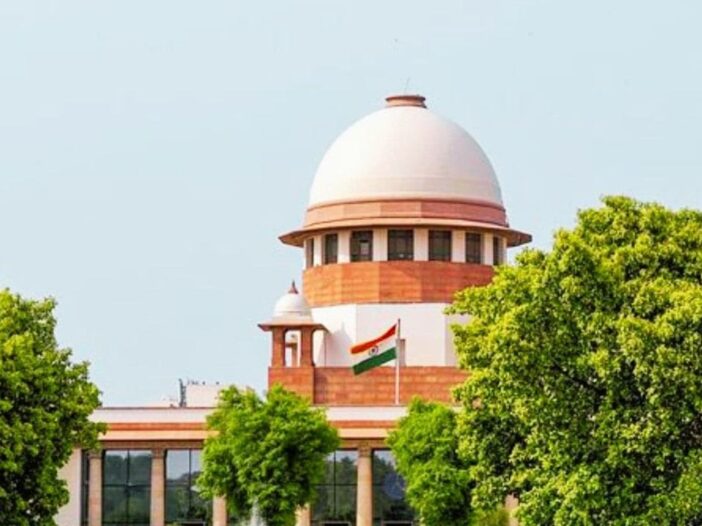
Chief Justice (CJI) Surya Kant has issued a special roster, under which 4 special benches will hear the oldest civil and criminal cases of the Supreme Court. In the Supreme Court’s first systematic docket-management exercise in years, efforts are being made to dispose of old cases quickly. For this, about 800 such cases have also been identified, which are pending for a long time and now they will be resolved quickly.
This step has been taken at a time when the Supreme Court is starting to function fully after partial functioning during the summer months. It is expected that this will speed up the disposal of some of the oldest pending cases of the court.
restore confidence in the justice system
Speaking to English newspaper Hindustan Times, Chief Justice Surya Kant said the initiative was aimed at rebuilding public confidence in the justice system by ensuring that even very old cases receive sustained judicial attention.
The Chief Justice said yesterday on Sunday, “The biggest responsibility of the judiciary is not only to decide the cases, but also to dispose of them within the time limit so that people have faith in the rule of law. Every old pending case is associated with a litigant who waits for many years, and sometimes decades, for the case to be resolved.”
“The fact that a case is very old cannot be a reason for continuing to ignore it. By creating special benches to hear the oldest civil and criminal cases, the Supreme Court seeks to create a system in which long pending cases receive sustained and uninterrupted judicial attention.”
New roster, four special bench finals
According to the new roster notification in the Supreme Court coming into effect from Monday (July 13), the 2nd Division Bench led by Justices PK Mishra and SVN Bhatti will hear the oldest civil cases on non-miscellaneous days (Tuesday, Wednesday and Thursday). Similarly, two other division benches headed by Justice Manoj Mishra and Ujjwal Bhuyan will hear the oldest criminal cases on the same days.
According to the notification, “A 2nd Division Bench headed by Justice PK Mishra and Justice SVN Bhatti will hear exclusively the oldest civil cases on non-miscellaneous days. Similarly, a 2nd Division Bench headed by Justice Manoj Mishra and Justice Ujjwal Bhuyan will hear exclusively the oldest criminal cases on non-miscellaneous days.”
People with knowledge of the cases pending in the court told the newspaper that about 200 oldest cases have been identified for each of the four benches, that is, a total of about 800 old cases will now get special judicial attention.
This initiative to expedite disposal of pending cases is one of the first major administrative reforms undertaken by CJI Surya Kant and is in line with his aim to solve the problem of pendency through targeted judicial management instead of sudden drives to dispose of cases.
How big is the challenge of pendency?
According to the National Judicial Data Grid (NJDG), there are currently 95,911 cases pending in the Supreme Court, which include 74,145 civil and 21,766 criminal cases. Of these, 37,826 cases (about 39.4%) are less than a year old, which shows that a large portion of the pending cases include old cases that are yet to be disposed of.
Now it is expected that these 4 special benches will exclusively hear these old cases for 3 working days every week and during this time they will be free from the regular burden of hearing other cases.
This change in the roster is important because Justice Kant has repeatedly stressed on adopting structural reforms to reduce the increasing judicial caseload. A day earlier, while inaugurating the silver jubilee celebrations of the Indian Institute of Arbitration and Mediation (IIAM), the CJI had said that the crisis of long pending cases in the country cannot be resolved by court hearings alone.
He had then said, “There are currently more than five crore cases pending in Indian courts. No judicial model, no matter how resource-rich, can single-handedly solve the burden of pending cases on such a large scale. It will have to be partially resolved outside the courts, not as a matter of convenience, but as a matter of mathematical necessity.”

Leave a Reply