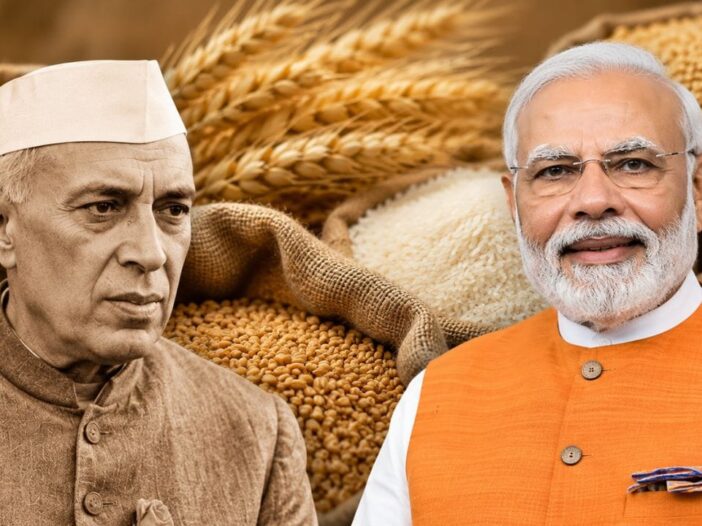
On June 10, 2026, Prime Minister Narendra Modi is going to make a historical record in his name. He will become the longest continuously elected Prime Minister in the history of Indian democracy. With this, he will leave behind the record of the country’s first Prime Minister Pandit Jawaharlal Nehru. From the early India of Nehru to today’s Digital India, the social and economic face of our country has completely changed.
There was a time when things which were considered only the domain of the rich or ultra-luxuries, have today become the basic needs of every common Indian. Let us understand how during the era of two different captains, India’s economy traveled from the helplessness of ‘ship-to-mouth’ (food is filled when the food comes by ship) to giving free ration to 80 crore people.
The era of ‘Hindu Rate of Growth’ when the growth rate was stuck at 3-4%
The economic structure implemented immediately after independence was completely under the control of the government. Although the foundation of some basic industries was laid during this period, the avenues for private companies were largely closed. This excessive control had a direct impact on the progress of the country. For several decades after independence, India’s average GDP growth rate remained limited to just 3 to 4 percent. Economists named this slow pace as ‘Hindu rate of growth’. Due to slow growth rate and limited opportunities, the country lagged behind in achieving its true economic potential.
Days of ‘ship-to-mouth’ dependence on foreign wheat
In today’s time, when government ration is reaching every needy’s home, it seems scary to even imagine the times of 1950s and 1960s. At that time, the country’s population was less than 37 crores, yet India was completely dependent on foreign aid for its food needs. The biggest example of this helplessness was the ‘PL-480’ agreement with America, under which India used to import wheat from America on a large scale. That period was called ‘ship-to-mouth’, which simply meant that when ships filled with grains from foreign countries reached Indian ports, only then the countrymen could feed themselves. Frequent droughts, outdated farming methods and poor rural infrastructure deepened this national crisis.
Journey from 10th position to world’s top economy
During the tenure of Prime Minister Narendra Modi, despite being hit by the worst pandemic of the century like Covid-19, the Indian economy emerged as a ‘bright spot’ (ray of hope) for the world. India, which was the 10th largest economy in the world in 2014, is now moving rapidly towards becoming the top 5 largest economic power by 2025-26. Today, highways being built on a large scale in the country, transparent digital governance and expansion of the manufacturing sector have re-established the confidence of both foreign and domestic investors in the Indian market.
According to a report by the International Monetary Fund (IMF), India will remain the sixth largest economy in the world in the year 2026. Immediately after this, there will be tremendous growth in the Indian economy and by 2027, India will once again overtake Britain (UK). Talking about figures, Britain’s estimated GDP in 2027 will be $4.47 trillion, while India’s GDP is expected to increase to $4.58 trillion.
Apart from this, IMF has also revised its estimates and said that India can move ahead in the list of the world’s largest economies by 2031. According to the report, India’s GDP is expected to reach $6.79 trillion in the year 2031. This figure will be much higher than Japan’s estimated GDP of $5.13 trillion.
The country is supporting 80 crore people today
The most revolutionary change has been seen in the food security of the country. India, which was once dependent on others’ food grains, is today among the world’s largest food producers. Today we are not only meeting our needs, but are also exporting grains to the world on a large scale. Under the Pradhan Mantri Garib Kalyan Anna Yojana, more than 80 crore Indians are being given free food grains, which in itself is the world’s largest food security program. Apart from this, nutrition is being provided to crores of children, pregnant women and mothers through ‘Poshan Abhiyaan’.

Leave a Reply