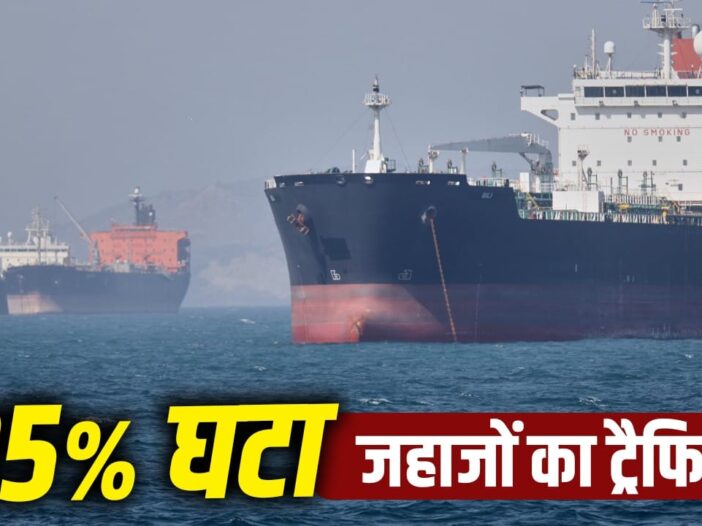
The Iran war has completely changed the world’s most important sea route, the Strait of Hormuz. Before the war started at the end of February 2026, hundreds of ships used to move on this waterway every day, but now this traffic has reduced to a mere nominal amount. On normal days, more than 80 to 130 ships pass through the Strait of Hormuz daily, that is, more than 30,000 tankers annually. Most of these were cargo ships, which carried essential goods for the global supply chain.
Before the war, about 3,000 ships passed through this strait every month, with oil tankers exporting about 15 million barrels of crude oil and other petroleum products daily. That means about one-fifth of the world’s total oil trade. According to data from PortWatch, run by the IMF and Oxford University’s Environmental Change Institute, more than 20 million barrels of oil were transported daily in 2022, which was about 80% of the Gulf region’s total oil exports and 20% of global oil exports. Of these ships, 50 to 60% were tankers that carried oil and liquefied gas.
Bad condition of traffic after the war
The situation changed completely after the US-Israel attacks on 28 February. Between 1 and 8 March, an average of only 6 ships passed here every day, whereas before the war in February this number was an average of 100 ships per day. Only 191 ships were able to pass through this route in the entire month of April, and the traffic was running at only 5% of the average in the last two months.
No improvement even after ceasefire
There was a two-week temporary ceasefire in April, but even this did not change the situation. Only 5 bulk carriers passed in the first 24 hours of the ceasefire, while 9 ships passed in the last two days. According to Marine Traffic, more than 400 oil-laden tankers and dozens of LNG/LPG carriers remained at anchor outside the bay. They kept waiting for a safe way out. Despite the ceasefire, there was a decline of about 95% in traffic. The ships sailing mostly belonged to Iran’s Dark Fleet or Russia-China flags, which were passed under the supervision of the Iranian Revolutionary Guard.
The situation will worsen in June 2026
On June 10, 2026, Iran announced the complete closure of the strait to all commercial and tanker traffic. According to PortWatch, only 2 ships passed through this route on June 7.
Will traffic be normal?
As of June 12, 2026, most traders on the prediction platform Polymarket believe that the movement of ships in the Strait of Hormuz will not return to normal until June 30. The probability of it not becoming normal has been estimated at 77.5%, because till now no concrete and reliable agreement has been reached. The current traffic is only 2 ships per day i.e. 2% of the normal level. Experts believe that even if a concrete ceasefire is achieved, it may take weeks to months for complete normalcy to occur.
Also read: Which countries made profit from Hormuz closure, converted disaster into opportunity

Leave a Reply