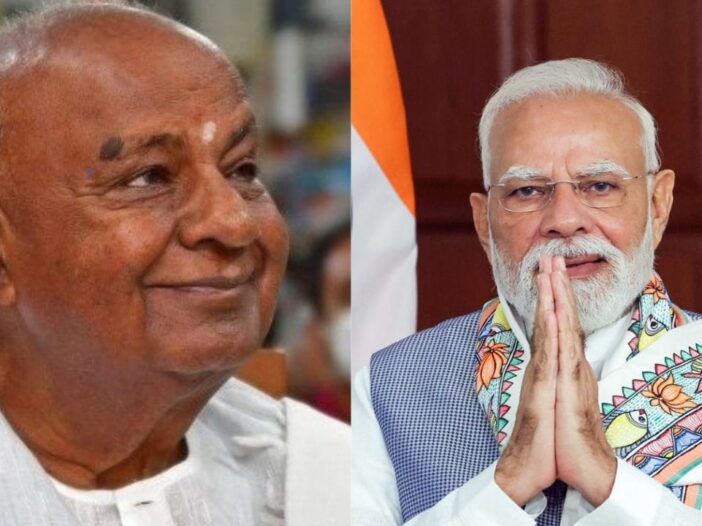
Prime Minister Narendra Modi has created a new history in Indian politics. He has completed 12 years as PM. He has broken Pandit Nehru’s record of remaining on the post of PM for a long time. With this, he has become the leader who has been elected Prime Minister for the longest tenure of the country. PM is being congratulated for this historic achievement. Be it ruling party or opposition, all the senior leaders are congratulating him and appreciating his leadership. In this context, former Prime Minister and Janata Dal (Secular) chief HD Deve Gowda has openly praised PM Modi. He said that Modi is so successful because he takes decisions thoughtfully. He said that the PM never made any compromise in protecting national interests.
HD Deve Gowda has written an article in a newspaper. In which he praised PM Modi. He said Modi has now become India’s longest serving democratically elected Prime Minister. He has broken Nehru’s record. Deve Gowda said that more importantly, this achievement of the PM is a big proof that democracy in India has not only survived but also flourished.
Jawaharlal Nehru was elected the first Prime Minister
The former PM said that in 1947, Jawaharlal Nehru was elected the first Prime Minister of the country from among many talented and dedicated people, all this happened in very special circumstances. He said that in reality this appointment was possible only because of Gandhiji’s moral influence on the public. After this, in the first general elections of 1952, Nehru had both the blessings of Gandhiji and the glorious influence of the freedom struggle.
‘Monopoly of Congress Party’
He said that at that time the Congress Party had a monopoly. He did not have to face any political competition. He had no political challenge. He said that although 53 political parties took part in the general elections, their presence and influence was very less i.e. negligible. He said that from that period till 2014, India had completely changed. By the time Modi became Prime Minister for the first time in 2014 and for the third time in 2024, India had become a completely different country. In terms of size, diversity and economy, it had become almost beyond recognition.
‘It was easy to become Prime Minister in 1952’
According to the former Prime Minister, becoming Prime Minister in 1952 was easier than in 2014 or 2024. He said that by the time he himself became the Prime Minister in 1996, the situation in the country and the rules of politics had completely changed. He said that the country had now become more questioning, more engaged and more mature.
‘Outside prime ministers did not have a legacy’
He said that Prime Ministers outside the Nehru-Gandhi family did not have any special legacy or glamour. Others did not have any special facilities, family influence or protection to get ahead. He said that in Modi’s case and in his own case, he did not have the social and cultural clout that many other Prime Ministers had. He said, ‘I did not hold the post for long, my tenure was only for 11 months. And I wonder by what blessings Modi has remained at the top without getting tired. Neither is fatigue visible in him nor in the people who elected him. His stamina and ability to work while in office is really very special.
Figures tell the story of change
The former PM said that if we look at the figures, they show the big changes that have taken place since Nehru’s time. These figures of political competition tell the story of change. He said that if we talk only about political competition, there were only 53 parties in the fray in the 1952 elections, whereas in 2024, Modi was facing competition from 2,593 parties. At the time of Nehru, the number of voters was 17 crore, which increased to 83 crore by 2014. The population of India which was 34 crore in 1952 is more than 146 crore today. That is, the electoral battlefield has become many times bigger, complex and challenging. It is not easy to be selected continuously amidst such a crowd, so much diversity and so much competition.
‘Social diversity seen in Modi cabinet’
Apart from this, he said that another thing which impressed him a lot is that India’s community, cultural and ethnic diversity was not reflected in Nehru’s cabinet. Even when Nehru was in his third and last term as Prime Minister, his cabinet consisted mostly of upper caste men. Nehru had rejected the Kaka Kelkar Commission report, which had talked about giving reservation to the depressed and backward classes.
Deve Gowda said that in contrast, there is tremendous diversity in Modi’s current cabinet. He said that Modi’s cabinet presents a completely different picture in this matter. There are 27 OBC, 10 SC and 5 ST ministers in his cabinet. At the same time, women’s participation has also increased significantly. Modi has also seriously proposed to increase the number of members of Parliament in April 2026, so that women can get historic representation and our country can become a better union. He has already got the women’s reservation bill passed.
Comparison of today’s India and Nehru’s time
While comparing today’s India and the India of Nehru’s time in his article, the former PM said that today’s India is a much more vocal and noisy democracy than the India of Nehru’s time. The level of awareness has increased significantly in all matters like caste awareness, constitutional rights, civil rights, gender awareness and environmental concerns. He said that during Nehru’s time most of the people in India were illiterate. People did not know what to expect from democratic government, it was a new system. Today’s citizens are more educated and aware. Nothing escapes his notice.
Closer attention on Modi than Nehru
In his article he said that Nehru had to face the attention of at most half a dozen newspapers, but Modi has to face the attention of millions of people every moment. This is because of social media platforms, where criticism can be inappropriate without scrutiny and may be too harsh or personal. Apart from this, they have to face round-the-clock criticism and sometimes even opposition from the mainstream media. During Nehru’s time there was no news on television.
Deve Gowda praised PM’s leadership
Congratulating PM Modi, former PM HD Deve Gowda said, ‘I congratulate Modi for the fact that India has become a strong democracy during his tenure. His efforts to keep India as the fastest growing economy, his public-welfare policies and his decision-making ability during military confrontations also deserve special attention. He has never made any compromise in the interests of the country.
He said that Modi has not only been the executive head of the country but has also been the country’s chief advisor, who has consistently and sympathetically interacted with people of all walks of life and all sections of the society. He told that he never misses PM’s ‘Mann Ki Baat’ radio program. He said that through ‘Mann Ki Baat’ radio program, achievers are discovered and honored. He said that here too he has tried to reach out to as many people as possible in every area. He said that there is no other Prime Minister who has used technology like him. He said that all this would not have been possible without selfless dedication. Finally he said that Modi is successful because he has always been introspective. He has constantly kept himself open to public scrutiny and scrutiny.
PM Modi broke Pandit Nehru’s record
Prime Minister Narendra Modi has broken Pandit Nehru’s record of holding the post of PM for the longest period in India. He has become the leader who has been elected Prime Minister for the longest tenure of the country. On June 9, 2024 itself, he took oath as PM in the third term of NDA and his 12 years of being in power are also being completed today. PM Modi took oath as Prime Minister for the first time on 26 May 2014 and today till 9 June 2026, 4398 days of his tenure have been completed. With this, he has now become the Prime Minister with the longest tenure.

Leave a Reply