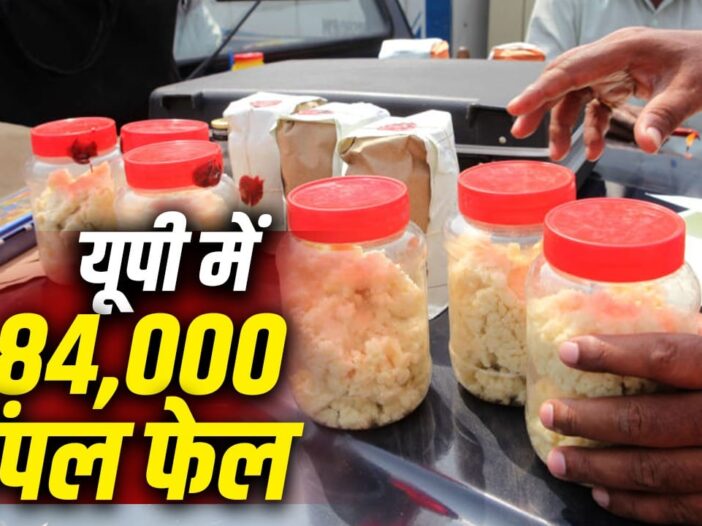
The government itself has made a big revelation in the Parliament regarding adulteration of food items in the country. In response to a question asked in the Lok Sabha on July 24, 2026, Health and Family Welfare Minister of State Prataprao Jadhav said that out of the food samples tested across the country in the last five financial years, more than 1.85 lakh samples have been found unsafe or adulterated. This question was asked by MP Rajabhau Parag Prakash Waje, in which an answer was sought from the government on the increasing incidents of adulteration in milk, cooking oil, spices, sweets, temple offerings and drinks in different parts of the country including Maharashtra.
According to government data, during this period, maximum adulterated samples were caught in Uttar Pradesh, while Rajasthan and Tamil Nadu were also included in the top-3 states. During this period, more than 11 thousand food licenses were canceled and more than four and a half thousand licenses were suspended. According to FSSAI, about 98 percent of the food business operators come under the food safety authorities of the state or union territory, hence the main responsibility for taking action also lies with the states. The government said that efforts are being made to control adulteration through rapid testing kits, mobile food testing labs and public awareness campaigns.
Top-3 states with highest number of food sample failures in five years
According to the data presented in Parliament, in the last five financial years, Uttar Pradesh has consistently been on top in terms of samples not meeting the prescribed standards. In the financial year 2025-26 (provisional), 20,427 samples were found non-conforming in Uttar Pradesh, 4,594 in Rajasthan and 3,984 in Tamil Nadu. Earlier in 2024-25, 16,500 samples failed in Uttar Pradesh, 3,788 in Rajasthan and 2,240 in Tamil Nadu, whereas in 2023-24, 16,183 samples in Uttar Pradesh, 3,493 in Rajasthan and 2,237 in Tamil Nadu did not meet the standards. In the year 2022-23, Uttar Pradesh remained on top with 18,108 samples, followed by 7,924 samples failed in Tamil Nadu and 3,965 samples failed in Rajasthan. Whereas in 2021-22, 13,153 samples were found non-conforming in Uttar Pradesh, 3,778 in Tamil Nadu and 2,900 in Madhya Pradesh.

It is clear from these figures that Uttar Pradesh remained on top in this list every year, while Rajasthan and Tamil Nadu remained at second and third position alternately. However, it is also worth noting that the number of sampling in these states was much higher than in other states, due to which the number of non-conforming samples also naturally appeared higher.
More than 11 thousand licenses canceled in five years
The government said that strict action has also been taken against food business operators in cases of adulteration and violation of rules. The figures of license suspension and cancellation in the last five years were as follows: 1,097 licenses were suspended and 1,830 canceled in the year 2021-22, while 1,100 were suspended and 1,715 canceled in the year 2022-23. After this, 791 licenses were suspended and 1,505 canceled in 2023-24, while 769 were suspended and 1,679 canceled in 2024-25. Whereas, in the year 2025-26, 704 licenses were suspended, but the number of cancellations increased to 4,764.
Overall, in five years, 4,461 licenses were suspended and 11,493 licenses were completely cancelled. The special thing is that in 2025-26, the number of suspensions was the lowest, but the number of cancellations reached the highest in five years i.e. 4,764, which shows that in recent years, priority has been given to permanent action against businessmen who break serious rules.

Food inspection increased by 46 percent in three years
According to the government, the checking campaign against food business operators has also increased continuously. The number of inspections conducted in the last three financial years was as follows:
- 2023-24- 3,57,072 inspections
- 2024-25- 4,01,391 inspections
- 2025-26 (Provisional) – 5,20,566 inspections
That means the number of inspections in 2025-26 has increased by about 46 percent as compared to 2023-24. The government says that this increase is the result of special enforcement and monitoring campaigns being run throughout the year by the four regional offices of FSSAI and food safety authorities of state and UT.
What steps are being taken?
The government also told in the Parliament that many steps are being taken to stop adulteration and strengthen food safety.
- FSSAI has notified 259 NABL approved labs across the country for testing food samples and 24 referral food labs for approved samples.
- Under ‘Food Safety on Wheels’, currently 305 mobile food testing labs are deployed in 35 states/UTs.
- Through the ‘Magic Box’ kit, adulteration in seven food categories like milk, oil, spices and grains can be checked sitting at home.
- 44 normal tests have been described through the DART book, which can be done at home with common things like water and iodine tincture.
- So far, 88 Rapid Analytical Food Testing (RAFT) kits have received approval.
- Through awareness campaigns like ‘No to Adulteration’ and ‘Har Label Kuch Kehta Hai’, consumers are being given information about identifying adulteration and reading labels.
The government says that under the Food Safety and Standards Act, 2006, both the Center and the State have joint responsibility, and systems like Food Safety Connect portal, mobile app and helpline are already in place to resolve complaints. However, statistics show that despite increasing speed of sample testing and action, lakhs of samples are found adulterated every year, indicating that the problem of adulteration still persists on a large scale at the ground level.

Leave a Reply