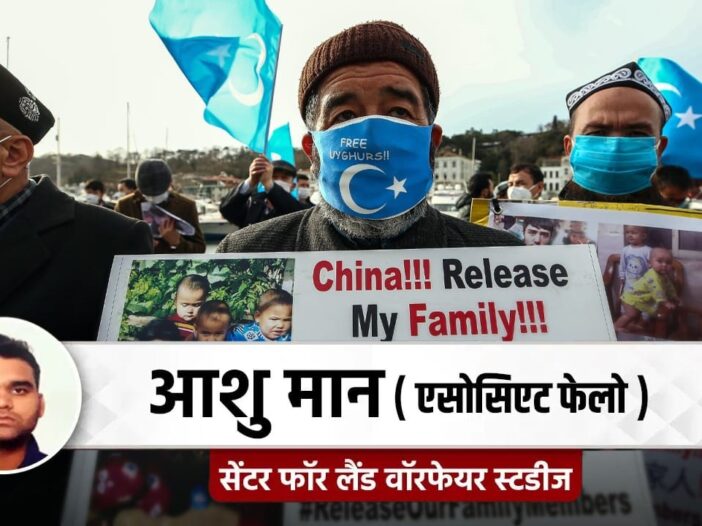
The world has been raising questions for a long time about the treatment of Uyghur Muslims and other Muslim minorities living in China’s Xinjiang region. There are allegations that more than 10 lakh Uighurs and other Muslim minorities have been kept in detention centers without any trial, charges or legal process. In July 2019, this issue was raised vigorously in the 41st session of the United Nations Human Rights Council (UNHRC). At that time 22 countries issued a joint letter against China. These countries said that people are being arbitrarily detained on a large scale in Xinjiang and there should be an independent investigation.
These countries demanded from China that it should allow international investigators to go to Xinjiang, so that the real situation there can be revealed to the world. This letter was signed by many countries in Europe, North America and the Asia-Pacific region, including Britain, France, Germany, Canada, Australia, Switzerland and Japan. But China completely rejected these allegations. Chinese officials at the United Nations said that these are not detention centers. According to him, these are vocational education and training centers where people come voluntarily.
Questions raised on China’s claim
China said that here people are taught Mandarin language, given training for employment and taught to stay away from religious fanaticism. However, many human rights organizations and experts raised questions on this claim of China. He said that the available evidence tells a different story. China took another step to respond to the criticism. A few days later, he presented a separate letter with the support of 37 countries. Many of these countries are part of China’s Belt and Road Initiative (BRI) and receive large-scale investment from China.
These countries praised China’s Xinjiang policy and said that it has promoted stability, security and economic development in the region. This sent a message that the number of countries standing in support of China is more than the countries criticizing it. Meanwhile, many types of evidence also came to light regarding Xinjiang. Large compounds, high walls, surveillance towers, barbed wire and biometric checkpoints were seen in satellite images. Seeing these pictures, critics said that they do not look like any school or training center.
Truth revealed from leaked document
Apart from this, some government documents were also leaked, which contained information related to the operation of these centres. Many former prisoners also gave statements. He said that he was kept confined for a long time, given political and ideological education and attempts were made to weaken his religious and cultural identity. Experts estimate that more than 10 lakh people were kept in these centers without trial, without charges and without the help of lawyers.
Yet despite criticism from 22 countries, no major international action could be taken against China. The reason for this was that the United Nations Human Rights Council did not have any strong authority with which it could force China to change its policies. This situation was very painful for the Uyghur community living abroad. Many people say that they have not had any contact with their parents, siblings and children for years.
There was no impact on China
This step taken by 22 countries in 2019 was considered historic, because for the first time such a large international group had openly challenged China in the United Nations on the issue of Xinjiang. But despite this, China remained firm on its stand. The policies did not change, the controversy over the detention centers continued and the world still has many questions about what is happening inside Xinjiang.
Also read: Scam worth Rs 382 crore… Former CIA officer had created a fake secret mission

Leave a Reply