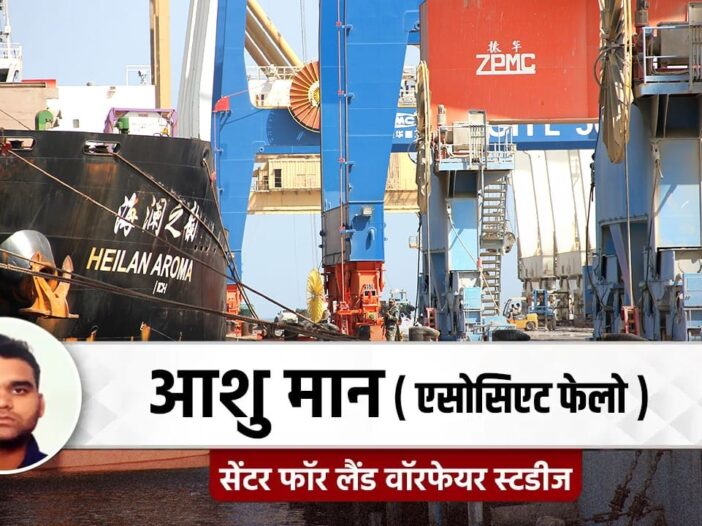
These days, Pakistan is promoting the success of Gwadar Port a lot. The government and many supporters are trying to portray it as one of the most important business centers of the region. The reason for this is the figures of April 2026. According to reports, around 11,000 containers moved through Gwadar Port in April 2026. This number is in discussion because in the entire year 2025, only 8,300 containers were moved from Gwadar.
This means that in just one month, more containers reached Gwadar than in the entire last year. Pakistan is calling it a big achievement. But many experts believe that a port cannot be called a successful international trade corridor on the basis of only one month’s data. According to experts, the main reason for the increase in the number of containers in April was not the strength of Gwadar but the crisis arising in the Strait of Hormuz. Due to the Iran war and regional tensions, many ships had to change their normal routes. Some ships used alternative routes and ports, increasing traffic at Gwadar.
But the success of a port in the business world is not determined by a single increase in traffic. A strong trade corridor is one where there is continuous movement of goods over a long period of time, companies have confidence, insurance costs are predictable, logistics networks are strong and there is stability in operations. Gwadar is not yet considered completely strong in all these matters.
Interestingly, Gwadar Port’s own official documents also state that this port is still undergoing development. Pakistan says that its existing ports will find it difficult to handle the increasing trade in future, hence there is a need for a third major port. This means that Gwadar has not yet become a fully developed and established global trade centre.
Analysts say that Pakistan often presents any temporary achievement as a major strategic success. The movement of some ships towards Gwadar during the Hormuz crisis may be a temporary situation. When the situation in the region becomes normal, shipping companies can return to the same routes which are more developed, safe and reliable than before.
Gwadar’s technical limitations are also a big challenge in its path. The maximum depth i.e. draft of the port is 12.5 meters. Apart from this, there are only three multi-purpose berths here. This means that many of the world’s largest container ships cannot dock here easily.
Gwadar can handle general cargo, fertiliser, steel, breakbulk cargo and project cargo. But the facilities needed to become a large-scale container transshipment hub are still limited. It has been said in many reports that big “mother vessels” i.e. huge container ships cannot be directly berthed here. This is the reason why Gwadar has not yet been able to achieve the potential like Dubai, Singapore or other big international ports.
The biggest challenge facing Gwadar is security. This port is located in Balochistan province, where the problem of extremism and violence has persisted for a long time. Repeated attacks are a cause for concern for investors and shipping companies. According to news agency Reuters, at least 18 civilians and 15 security personnel were killed in coordinated attacks in Balochistan in January 2026. These attacks also had an impact on the Gwadar area.
After this, in April 2026, militants attacked a patrol boat of Pakistan Coast Guard in the Arabian Sea. Three coast guard personnel died in this attack. Reuters had described it as the first major attack on a Pakistan Coast Guard boat. These incidents make it clear that Gwadar has not yet become a completely safe business area. Security is one of the most important issues for any international company. If there is persistent violence and instability in a region, investors and shipping companies avoid doing business there for a long time.
The Government of Pakistan wants to call Gwadar the center of regional trade and logistics revolution. But on the other hand, incidents of militancy, security operations and violence continue in Balochistan. Major attacks in early 2026 disrupted normal activities across the province.
This is why experts do not consider the container figures of April 2026 as a permanent success. He says that shipping companies do not decide their future by looking at the traffic of any one month. They take into account security, stability, cost, features and the possibility of doing business for a long time.
Therefore, the increased number of containers in April cannot be called the final success of Gwadar. It is possible that Gwadar may have benefited for some time due to the Hormuz crisis. But when regional tensions subside and old trade routes are fully opened again, then it will be known how strong and competitive a port Gwadar really is.
At present the situation is that Gwadar is facing limited infrastructure, less business integration and security related challenges. Therefore, it is difficult to call it a big and reliable trade corridor of the world right now. Right now it would be more correct to say that Gwadar has got a temporary advantage during the regional crisis, but it still has a long way to go to achieve permanent success.
Also read: 1 out of every 6 sailors on commercial ships are Indians, new advisory after the attack

Leave a Reply