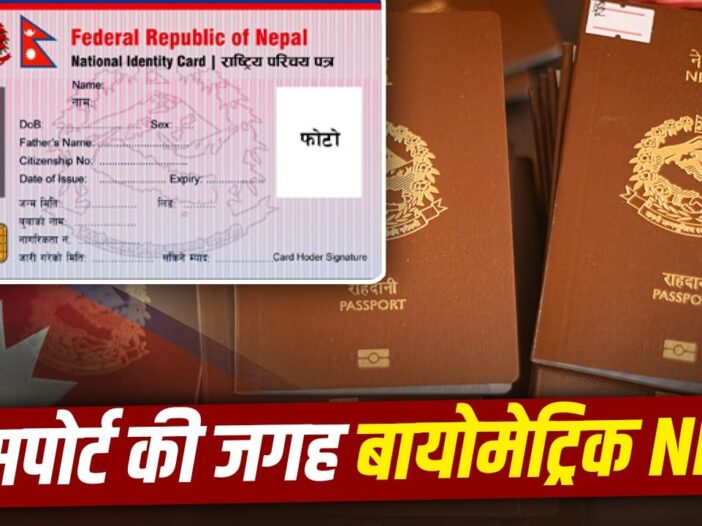
The open borders between India and Nepal are a unique example of international relations across the world. Citizens of both the countries can visit each other without visa. But, for security and identification, it is mandatory to have some important documents during the journey. Now to make this process more modern, safe and convenient, the Government of Nepal has made an important demand from India. Nepal has formally requested New Delhi through diplomatic channels that its new biometric ‘National Identity Card’ (NID) be recognized as an official travel document for cross-border travel. Let’s understand it in detail
What are the travel rules at present?
According to current rules, it is mandatory for Nepali citizens traveling by air to India to show their passport or original citizenship certificate. Similarly, Indian citizens entering Nepal have to show their passport or voter ID with their photograph on it. According to Ram Chandra Tiwari, Director General of Nepal’s Department of Immigration (DoI), the addition of this new card will provide great convenience to those travelers who do not have a passport or old citizenship certificate immediately available.

What is National Identity Card (NID) of Nepal?
The Nepal government is planning to gradually abolish its traditional citizenship certificate completely. In its place it is taking a new biometric NID card.
- This card is completely based on biometric and demographic data, which is issued by the Department of National Identification and Civil Registration (DONIDCR) of Nepal.
- In this card, complete details of the person’s 10 fingerprints, facial photograph and iris are recorded.
- Nepal government has started making this card mandatory for banking, land registry, making passport and all other public services.
- This scheme was started in the year 2009 as a pilot project among Panchthar district and government employees. Till now, more than 45 lakh Nepali citizens have received this card and about 2 crore more applications have been submitted.
Ram Chandra Tiwari says that after some time there will be only one identity card instead of citizenship certificate. This card is fully verified, authentic and technology-friendly.

India’s stance and bilateral talks
Officials of the Immigration Department of Nepal recently had talks with a delegation of the Indian Embassy. The Embassy team has responded positively to this initiative and confirmed that the proposal has been forwarded to higher authorities in New Delhi for final review and decision.
- There is about 1,751 km long open international border between India and Nepal. This border passes through five states of India, Uttarakhand, Uttar Pradesh, Bihar, West Bengal and Sikkim.
- The ‘Peace and Friendship Treaty’ signed between the two countries in 1950 is the basis that allows citizens of both the countries to move, live and work freely in each other’s territory without any passport or visa.
- Due to such a long open border, security threats (such as human trafficking and illegal activities) are always present. According to The Kathmandu Post, there have also been discussions between the home ministries of the two countries to set up a formal mechanism to log cross-border travel data and better manage the movement. Biometric NID card can prove to be a great security tool in this direction.
What do the statistics say?
Records of the Department of Immigration show that last year about 1.50 lakh Nepali citizens traveled to India by air or through official routes. However, there are no accurate records of movement across land borders, so the actual number is many times higher. If India approves this biometric card, not only will travel be easier, but both the countries will also be able to have an accurate and secure database of travelers.

Leave a Reply