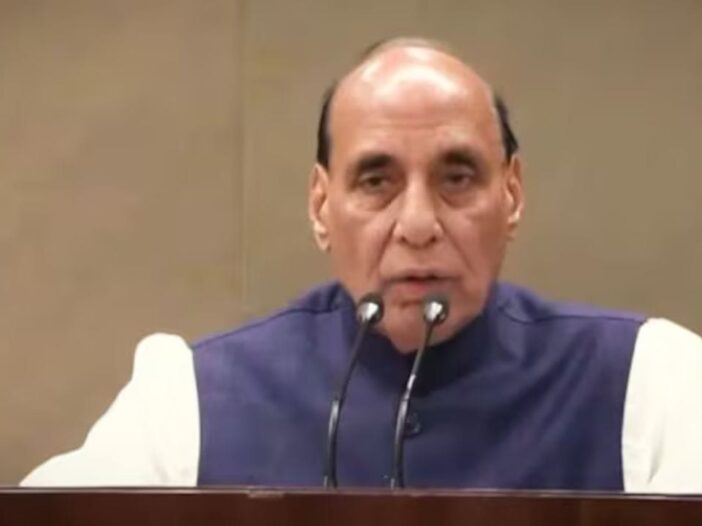
Defense Minister Rajnath Singh on Friday (July 18) described Rashtriya Swayamsevak Sangh (RSS) as a civilizational force and said that it does not need any registration, certificate or recognition. He said that every RSS Sir Sanghchalak has opposed discrimination and untouchability. He said that RSS is a civilizational organization working in the spirit of serving the nation.
Actually, Rajnath Singh was addressing the release ceremony of the book “RSS@100: A Century of Service, Unity and Sacrifice” written by Shyam Jaju and Anupam Trivedi at Vice President Bhavan in Delhi. The book was released in the presence of Vice President CP Radhakrishnan, Delhi Assembly Speaker Vijendra Gupta, INGCA President Ram Bahadur Rai, RSS state Sanghchalak Pawan Jindal and other dignitaries.
‘RSS always worked with the spirit of national supremacy’
Addressing this program, Rajnath Singh said that every Sarsanghchalak of RSS has opposed discrimination and untouchability. He said that the organization has always worked in the spirit of “nation paramount”. He said that this spirit has enabled RSS to become the world’s largest financially self-reliant voluntary organization.
What was said when RSS was not registered?
Referring to comments made by a senior Congress leader about RSS not being registered, Singh said there was no need to answer such questions as the Constitution gives every person the right to form an organization. He said, ‘Till date, every Sarsanghchalak of the Sangh has opposed discrimination and untouchability in the society. The Sangh has always worked in the spirit of national supremacy, and the result is that the RSS has become the largest and financially self-reliant voluntary organization in the world.
‘No license is needed for mother’s love’
He further said, ‘Mother’s love does not require any license. The values taught by a Guru do not need government seal of approval. Mother Ganga does not need a license to flow. The sun does not need registration to spread light. Similarly, RSS is a civilizational force which does not need any certification or recognition.
The Sangh has always worked with the spirit of nation first, always first. This is the reason that today RSS has become the world’s largest and financially self-reliant voluntary organization.
Recently a senior Congress leader asked why RSS is not registered. need to answer such things pic.twitter.com/zp6MJ7SFYq
— Rajnath Singh (@rajnathsingh) July 17, 2026
‘The Sangh does not publicize its work’
The Defense Minister said that there is hardly any organization in the world which has functioned continuously on such a large scale and for such a long time without ever getting divided. He said, ‘This is the result of the quality of leadership of the organization and the basic principle that everything belongs to the nation; I have nothing’. He said that the Sangh never boasts about its works.
Rajnath Singh said that when RSS celebrated its centenary, he said that it is not just an occasion for celebration but for introspection and reflection. He said that the Sangh took five pledges on this important occasion. The objective of these pledges is to create a society that is value-based, efficient, self-reliant, environmentally conscious and conscious of its duties. He said that these five pledges are the five pillars of a developed India.
‘The new generation should know the work of RSS’
Singh said that the new generation should know about the work done by RSS for the unity and integrity of the country. He said ‘In 1947, Golwalkar was sent to persuade Maharaja Hari Singh to merge Kashmir with India. In 1954, volunteers played an important role in liberating Dadra and Nagar Haveli. Volunteers also sacrificed their lives for the liberation of Goa.
RSS’s participation in the movement
Describing RSS as a strong protector of the Constitution, democracy and rights of citizens, Rajnath Singh said that in 1950, when the government tried to suppress freedom of expression, RSS opposed it bravely. He said, ‘When Emergency was imposed in the country in 1975, RSS played a leading role in protecting the Constitution and democracy. Whoever visits the RSS shakha once and watches its work closely, becomes a fan of RSS.
He reminded that in 1932, the government of Central Provinces and Berar had declared the RSS a communal organization and banned government employees from attending RSS events. He said that the representatives of Hindu, Muslim, Christian, Parsi and other communities in the Provincial Assembly had unanimously said that the organization established by Dr. Hedgewar cannot be against any community.
‘Those who make wrong assumptions should read the book’
He said, ‘People who have formed misconceptions about the Sangh due to leftist propaganda will get a correct understanding of the organization after reading this book and their existing misconceptions will be cleared.’ He said that the foundation of RSS was laid by Dr. Keshav Baliram Hedgewar in 1925, which has today transformed into a huge banyan tree. He said that if any voluntary organization is the largest and financially self-reliant in the world today, it is RSS. He said that for a century, RSS has been contributing to the protection of culture, religion and Indian identity, inspired by the values, discipline and spirit of selfless service inculcated in its volunteers. He said that whenever the country is facing any crisis, RSS and its volunteers are the first to come forward to help.
Dear Shri Mohan Bhagwat ji,
My letter will reach you soon. However, I thought it was important to draw your attention to this matter early.
——————————-Firstly, congratulations to the RSS on completing 100 years.
An organization that claims over 60,000 shakhas and crores of pic.twitter.com/IZy4oeKdMp
— Priyank Kharge (@PriyankKharge) June 15, 2026
Congress leader had raised questions
Actually, Congress leader Priyank Kharge had raised questions regarding the registration of RSS. He had written a letter addressed to Sangh chief Mohan Bhagwat, in which he had asked why the organization was working without registration. He also raised the issue of RSS’s funding, its tax compliance and the need for audit.

Leave a Reply