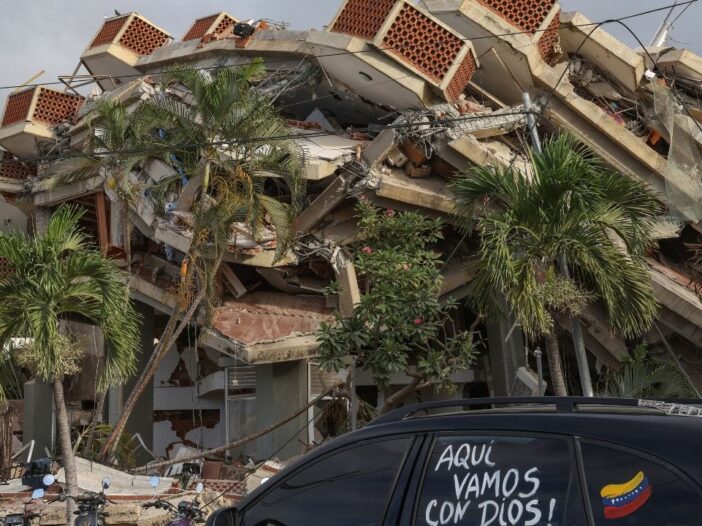
For years Venezuela has been facing one crisis after another. The country faced high inflation, frequent power cuts, large-scale migration of people, political instability, international sanctions and a nearly stalled economy. In 2026, the situation finally started getting a little better. Oil production was increasing again. Foreign investors had started showing interest.
International lenders were slowly resuming negotiations, and energy-related companies were exploring business opportunities in the country after years of staying away. Just when Venezuela was moving towards recovery, disaster struck. On the evening of June 24, two powerful earthquakes struck the country’s northern coast in less than a minute.
The first earthquake was of 7.2 magnitude. Exactly 39 seconds later, an even stronger earthquake of magnitude 7.5 struck. These earthquakes shook the San Sebastian Fault System near Yumare and shook several large areas, including Caracas, La Guerra, Carabobo, Miranda, Yaracuy and Aragua. It was the most powerful earthquake to hit Venezuela since 1900.
More than 1,400 people have been confirmed dead so far, and rescue workers are still searching the collapsed buildings. Independent organizations monitoring missing people believe that due to restrictions on media in Venezuela, the number of missing people may be much higher. This time proved to be very bad for the country which had just started to recover.
Loss estimated at $6.7 billion
Just three days after the earthquake, the United Nations Development Program (UNDP) began assessing the devastation using its RAPIDA system. This technology estimates damage using satellite images, earthquake models and population data, so that rescue teams can get an idea of the damage before they fully reach affected areas.
Its first estimate was shocking. The earthquake caused direct physical damage of approximately $6.7 billion, and total losses are expected to be between $4.7 billion and $8.7 billion. This amount alone is approximately 6 percent of Venezuela’s annual economic production, which was exhausted in less than a minute.
According to UNDP, there were about 17 lakh buildings in the areas affected by the earthquake. About 86 lakh people felt mild to strong tremors, while about 21 lakh people felt the strongest tremors. Later ground reports confirmed that there had been severe power cuts in these areas.
The real loss could be much greater
UNDP says that the current estimates are just the beginning. The $6.7 billion figure only covers direct physical damage, which could include destroyed homes, buildings, shops and other economic assets. This does not include damage caused to roads, bridges, airports and other infrastructure. This does not even take into account the loss of business, disruption of jobs, or the enormous cost of rehabilitating entire communities.
Based on past disasters around the world, experts say the total economic impact is typically 1.5 to 3 times higher than initial estimates of physical losses. This means Venezuela’s total losses could ultimately be between $13 billion and $20 billion, and that figure could be even higher if reconstruction costs continue to rise due to the country’s already weak infrastructure and struggling institutions.
Initial estimates from the US Geological Survey (USGS) model said that the total loss could range from less than $10 billion to $100 billion. It was also said that it is difficult to measure the full impact of such a large-scale disaster, especially in a country where reliable data has become difficult to obtain in the last few years.
Venezuela faces capital shortage
The earthquake was devastating in itself, but Venezuela’s financial situation makes dealing with this disaster even more difficult. According to a New York Times report, the country had an estimated debt of $240 billion even before the disaster. Much of this is related to unpaid government debts and legal cases filed by foreign companies whose assets were seized during the governments of Hugo Chávez and Nicolás Maduro.
Unlike countries that get immediate access to emergency funds after natural disasters, Venezuela cannot easily borrow billions of dollars to rebuild. Its relations with the International Monetary Fund (IMF) have also been tense for years.
During Maduro’s tenure, the government repeatedly criticized the IMF and maintained distance from the institution. Venezuela resumed formal negotiations with the IMF only after Maduro was removed from power in January 2026.
Help was given but not as much as needed.
The first round of international aid has arrived, but experts say this is a small part of the help that Venezuela will need in the future. The International Monetary Fund (IMF) has initially approved $200 million to help in reconstruction. The Trump administration has also announced an assistance of $150 million. This money will be delivered through United Nations agencies and humanitarian organizations.
Meanwhile, America has also sent military aircraft to deliver search and rescue teams and supplies. Additionally, some restrictions have been temporarily relaxed through October 23 to allow the Venezuelan government to conduct earthquake-related financial transactions that would otherwise have been halted. However, all other US sanctions on Venezuela will remain in effect. Compared to the estimated loss of 10 to 20 billion dollars or more, this help is very small.
oil industry safe
There is at least one good news. So far it appears that Venezuela’s oil industry has escaped major losses. The country’s largest refining complex, located on the Paraguaná Peninsula, not far from the earthquake-hit area, is still operating normally. Chevron, which produces about a quarter of Venezuela’s oil output, also said its facilities were not affected. If production continues without major disruptions, oil could provide much of the money needed for recovery.
Why can GDP increase?
Before the earthquake, economists expected Venezuela’s economy to grow this year because oil production and exports were improving. Some people had even estimated growth of up to 8 percent despite the first quarter being slow. The strange thing is that earthquakes can increase GDP even more because the money spent on rebuilding houses, roads and hospitals is counted as new economic activity. But economists say the high growth figures will mask the true impact of the disaster because they cannot reflect the loss of life, families displaced or damage caused by the earthquake.

Leave a Reply