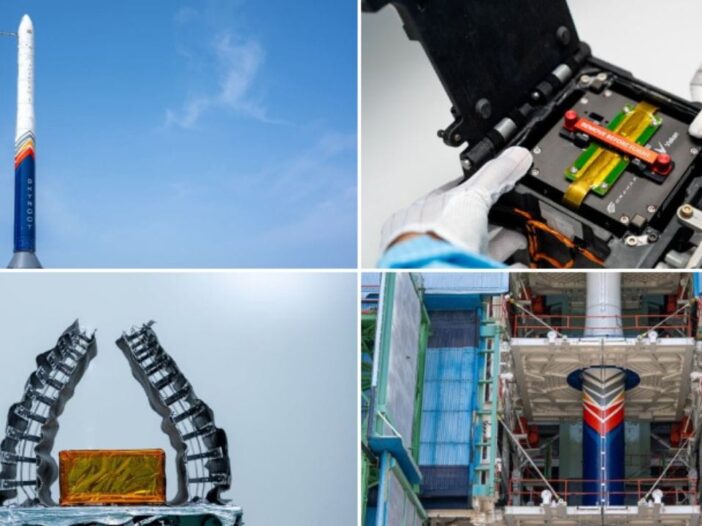
India’s private space company Skyroot Aerospace created history on July 18 (Saturday). This company not only successfully launched India’s first private rocket Vikram-1, but the rocket also entered space after taking off from the Satish Dhawan Space Center in Sriharikota. It has become the country’s first privately developed orbital class rocket to fly from Indian soil. Prime Minister Narendra Modi called and congratulated ISRO scientists and especially Skyroot Aerospace co-founder and scientist Pawan Kumar Chandna on this historic success and said that I am completely with you, keep moving forward like this.
While talking to Pawan Kumar, PM said that ‘You have done two things. Firstly, you have planted new plants in the sky and secondly, you have strengthened the roots in the ground as well, which will inspire the youth of the country to come forward. Your entire team looks 25-30 years old, this was making me more happy. Initially, there was worry on your face, but then I saw that the atmosphere was filled with happiness.
India capable of becoming self-reliant
PM Modi further said, ‘Whatever your mission is, I see it as Vande Mataram mission, to take the dignity of Mother India to new heights, to give the benefits of technology to the new generation and to inspire the new generation to get into technology. There was a time when I used to talk about self-reliant India, people used to make fun of it out of ignorance, but today you have proved that we are capable of becoming self-reliant in this field also and you have shown that capability and I firmly believe that now the proof is in front of us. The evidence is in front of us and your team has shown this.
View this post on Instagram
Who is Pawan Kumar Chandana?
Pawan Kumar Chandana is the co-founder and CEO of Skyroot Aerospace. He founded this aerospace company in the year 2018. Before this, he had worked as a scientist in ISRO for more than 5 years. He has done B.Tech and M.Tech from IIT Kanpur. Pawan did B.Tech from Mechanical Engineering, while he did M.Tech from Thermal Science and Engineering.
Features of Vikram-1 rocket
The Vikram-1 rocket has been designed to carry small satellites weighing up to 350 kg into Earth orbit. The seven-storey high, multi-stage launch vehicle is built entirely of carbon composite structure and has indigenously developed solid and liquid propulsion systems. These include 3D-printed engines and high-powered solid rocket boosters.
A small rocket of 18 carat gold is hidden in Vikram-1
In its maiden flight, Vikram-1 carried several technology demonstration payloads, including Skyroot Aerospace’s Scope payload, Graha Space’s Solarus S3 satellite, DCUBED’s technology demonstration payload and Cosmoserve Space’s Embrace robotic arm designed to capture orbital debris. The mission carries the floral artwork ‘Cosmic Bloom’ created by Cosmos Diamonds as well as a miniature rocket made of 18 carat gold, which has miniature statues of CV Raman, Vikram Sarabhai and APJ Abdul Kalam, which are smaller than a grain of rice.
PM Modi’s handwritten ‘Vande Mataram’ message reaches space
Apart from this, Vikram-1 has also carried a hand-written postcard of Prime Minister Narendra Modi with the message ‘Vande Mataram’ as well as postcards of engineers, scientists and Indian astronauts. Even before the launch, PM Modi had described this mission as a historic achievement for India’s space travel.

Leave a Reply