On the evening of June 3, 1989, a student named Wang Weilin was probably doing what thousands of other young people were doing across Beijing. Weilin was thinking about whether to go home or not? Because, he was standing here along with lakhs of students for the last seven weeks. Tiananmen Square was theirs for seven weeks.
Students, workers, teachers and ordinary citizens transformed China’s most symbolic public space into a place the country had never seen before. An open, lively debate about what kind of nation China should be. They set up camps, sang songs, debated through the night and went on a hunger strike so severe that parents started begging their own children to eat.
The children on hunger strike were not revolutionaries. They were not trying to topple the government. They wanted to talk to the government, but instead of talking, the Chinese government responded with tanks.
How did the show begin?
It began, as many things begin, with sadness. On April 15, 1989, reformist Communist Party leader Hu Yaobang, who had been quietly ousted from power two years earlier for his soft stance toward student protesters, died of a heart attack. He was 73 years old.
In any other country, it might have been a routine death of a retired politician, but in China, it became a spark. The students first gathered to mourn him. Then they continued gathering. What began as a candlelight vigil in Tiananmen Square grew, within days, into the largest mass protest in the history of the People’s Republic of China.
By mid-May, an estimated one million people had taken to the streets of Beijing. The workers joined the students. Journalists joined both. Even some officials privately expressed sympathy. They were carrying banners on which it was written – dialogue, not monologue. He demanded a free press. He demanded accountability. He demanded that his views be heard.
The government took it as a threat
The atmosphere in the corridors of power was completely different. China’s supreme leader Yang Xiaoping had led China towards economic modernization for a decade. He allowed factories, markets and private enterprise to flourish, but political liberalization, genuine pluralism, a free press, true debate were not allowed under his rule.
Yang was afraid that if all this happened, everything would fall apart. When the Tiananmen protests escalated, Deng called a meeting. Yang came to the conclusion that this was not a conversation but a threat.
Subsequently, on May 20, Prime Minister Li Peng appeared on national television to declare martial law. Deng had given the order. The army was coming. Whatever happened next, happened in one fateful night.
Army took to the streets, crushed the crowd
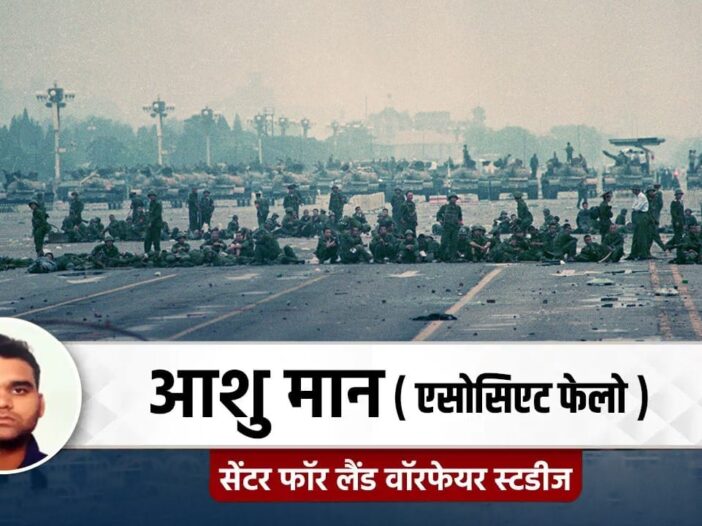
On the morning of June 4, convoys of tanks and armored vehicles moved through the dark streets of Beijing towards the square. Seeing the army convoy, ordinary residents of Beijing came out of their homes. People tried to set up temporary barricades to stop the army. Some people also took to the streets, but their efforts did not work. The army continued moving forward.
After some time the soldiers opened fire on the crowd. Armored vehicles crushed those who did not move in time. Throughout the night the hospital wards were filled with injured people, who were brought in on bicycles, in handcarts, in the arms of strangers. Doctors reported anemia.
The exact number of people killed has never been established, because the Chinese government never allowed anyone to count. Official figures claimed a few hundred dead. Diplomatic messages released from foreign embassies, internal Chinese documents and human rights investigations suggest the actual number was in the thousands.
A picture exposed China
After the army action, the square became completely empty by morning. The Chinese government killed an unknown number of its own citizens that night to express their willingness to participate in its own rule, but a photograph taken the day after the incident exposed China to the entire world.
The morning after the operation, a lone man stepped down from the sidewalk on Chang’an Boulevard and stood in the path of the convoy of tanks. She had shopping bags. No one knows who he was, or what happened to him afterward, but for a brief, extraordinary moment, he refused to move.
Many photographers watching from the windows of the hotel located above the road captured this picture. Within a few hours it spread all over the world. Within China, it was immediately suppressed and has remained suppressed ever since. This oppression is the part of this story that never ended.
This is how China washed away the stain of genocide, 3 points
1. In the days following the massacre, newspapers were confiscated and editors replaced. The workers were arrested. Any public discussion of what had happened was banned. The square was completely cleaned and reopened as if nothing had happened.
2. A few years after the incident, it was removed from school textbooks. Then also from the internet. Search “June 4th” in China today and find nothing, type in the numbers 8964 – a common way of referring to the date – and they disappear.
3. Even pictures of a lone man and a tank, without any context, are enough to activate the automatic censorship system. Young people in China today are often unaware that anything like this happened. This erasure was not accidental. This was the policy.
It is important to consider what this means
A government that carries out any action that it considers just. She spends the next three decades making sure no one remembers her. She doesn’t put people who light candles on the anniversary in jail. It does not create complex digital systems to intercept and quietly erase the words “Tiananmen” and “democracy” before anyone reads them. This censorship is a kind of confession in itself.
More than 35 years have passed since that night in Beijing. The people who gathered in Tiananmen Square in the spring of 1989 were young then – students who had grown up believing that China was changing, that they were part of something historic, that their voices could matter. Many of them were right about one thing. They were indeed part of a historical event, but little did they know that history would be erased before their wounds could heal.
He was not an enemy of China. They were citizens who loved it so much that they were demanding it be made better, and the very state they were asking to change drove tanks at them in the dark.

Leave a Reply