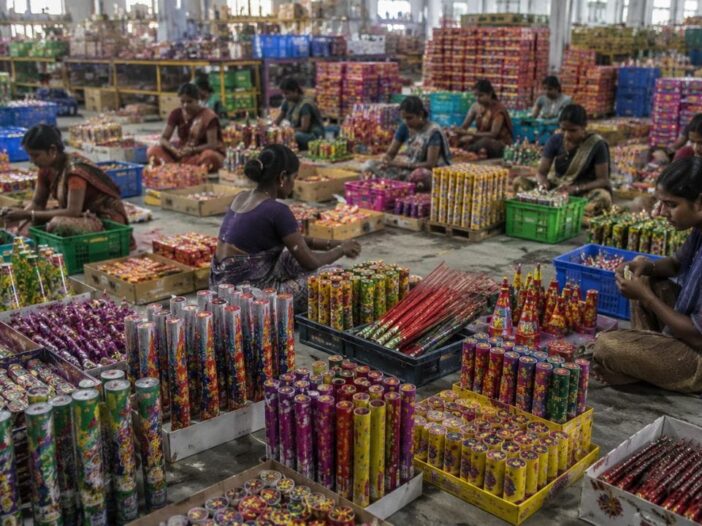
Any festival or celebration in India seems incomplete without colorful fireworks in the sky. 90 percent of these firecrackers that bring a smile on our faces are made in Sivakasi, a small town in Tamil Nadu. This city, which received the title of ‘Kutti Japan’ (Small Japan) from the country’s first Prime Minister Jawaharlal Nehru due to its industrial progress in the sixties, is now ready to take a new flight. Under the leadership of Tamil Nadu Chief Minister C Joseph Vijay, the state government wants to make Sivakasi a global hub of firecrackers, so that it can give direct competition to China, which rules the world market.
6000 crore business, still why behind China?
There are more than 1,200 firecracker factories in Sivakasi and the estimated size of this industry is around Rs 6,000 crore. Despite this, China occupies 90 percent of the global market. Only one city of China, Liuyang, exports 70 percent of the firecrackers to the world. There was a time when huge quantities of firecrackers were exported from India to foreign countries, but there has been a huge decline in this in the last two decades. P. Ganesan, President of Tamil Nadu Fireworks and Amorous Manufacturers Association, says that now the global shipping network is dominated by Chinese exporters. It has become difficult for Indian manufacturers to get shipping containers and cargo space to send goods abroad. Moreover, the firecracker industry has been placed in the ‘red category’ by the Pollution Control Board, due to which manufacturers have to face many administrative hurdles.
Impact on business due to Supreme Court restrictions
It is not so easy for Sivakasi to climb the Chinese wall. Before increasing exports, this industry will have to overcome many regulatory and legal challenges. The biggest problem is the interim ban imposed by the Supreme Court on the use of barium nitrate. This step was taken to control pollution. Barium nitrate is an important chemical, which was used in making 60 percent of firecrackers. Along with this, there is also a ban on stringed firecrackers, which accounted for 20 percent of the total production. This simply means that 80 percent of the industry’s portfolio has been directly affected. Only a few big units get the permit for ‘Potassium Perchlorate’ required for firecrackers exported to cold countries.
Workers work risking their lives
There is a bitter and painful truth hidden behind this dream of becoming a global hub. In Sivakasi and surrounding areas, three lakh people are directly and five lakh people are indirectly associated with this industry, of which 55 percent are women. Farming is very difficult in this area of Virudhunagar district, so poor families have no option but to work amidst gunpowder for their livelihood. Human rights activist A. According to Vijayakumar, more than 644 laborers have lost their lives in accidents here in the last decade. On April 19 this year, 25 people had tragically died in the blast that took place in Kattanarpatti. Many illegal factories do not even have the basic facilities of doctors or ambulances and after accidents, the families of the victims are given a compensation of only Rs 1 lakh and left to fend for themselves.
Conquer the world with safety and respect
Amidst all these challenges, Tamil Nadu’s Industries Minister and Sivakasi MLA S. Kirtana has presented the blueprint of a new vision. The government’s aim is not only to increase export figures, but to make this entire sector safe and sustainable. She clearly believes that if the women working at the lowest rung do not benefit from the progress of this industry, then that progress is meaningless. The government is planning to bring this sector from unorganized to organized form and invest heavily in innovation and research. If the state government is able to turn these promises into reality, then surely the light of Sivakasi will bring glory to India across the world.

Leave a Reply