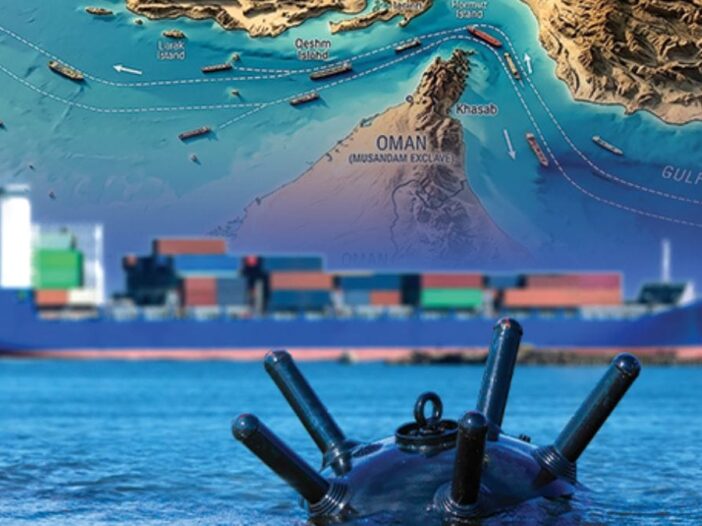
The world feared that if sea mines were laid in Hormuz, their threat would not be limited to Hormuz alone. And now this fear seems to be coming true. Some sea mines have been seen near Musandam coast of Oman. After which the alert has been increased in the entire Gulf area. The question is not just about the mine seen near one coast. The question is, how safe is the world’s most important oil supply line now?
Because in the 1980s, similar mines and attacks on tankers had turned the entire Gulf into a landmine zone. Hundreds of ships were attacked and the global energy market was shaken. It seems something similar is happening this time too. People are speculating like this. Is the same threat returning once again? Will the incident of 1980s be repeated this time also? Let us tell you in detail in this report.
How can the economy handle the threat from the sea?
Actually, floating mines have been seen in the sea water near Musandam Island in Oman. After this, the Government of Oman issued an emergency advisory immediately. After which any kind of ship had to be immediately banned from passing through here. Fishermen have been asked not to go into the sea. Commercial ships passing through here have been asked to change their routes immediately.
These floating mines are being detected and defused on a war footing around the coast of Oman. But it is certain that this threat can have a big impact on the entire world. Because one third of the world’s crude oil passes through this narrow path of the Gulf. Therefore, even a single explosion here can shake the global economy.
But the danger is not only around the coast of Oman. The kind of mines seen floating near the coast of Oman. No one knows what huge area she has reached so far while swimming with the sea waves. The threat has spread from Oman to Kuwait. That means, from the Gulf of Oman to the Persian Gulf, there is a possibility of gunpowder flowing with every wave.
Hormuz area landmine
The entire area of Hormuz has become a landmine trap, where mines scattered everywhere are making the route dangerous. Now the question arises where are the mines? No one knows the answer to this because it was laid out in a hurry. Accurate records were not maintained and today the situation is such that even their location is not clear. That means no one has a solid idea of where the danger lies. The second big problem is that these mines are not in their place. Many of these have been washed away by the ocean waves and strong currents and the exact information about where they have reached now is also incomplete.
Finding and removing mines is the biggest challenge
Now comes the biggest challenge is to find and remove them. Now this will be a high risk operation and it will take a lot of time. Because the technology to remove it quickly is not yet very developed. And the most dangerous part is the missing mines. This means that unseen danger is spread in every direction in the sea. Even what is being described as a safe route. That too cannot be considered completely safe. Finding a mine in the sea does not just mean the risk of an explosion. The entire oil route is in danger. That is, even if the road to Hormuz is completely opened. Even then, these mines floating under the surface of the sea or among the waves can sink any ship in the sea.
Danger from Oman to Kuwait
Spread from Oman to Kuwait, this gunpowder threat has engulfed the entire Persian Gulf. A trap of death has been spread on this sea route extending up to Musandam Island in Oman. This red corridor visible on the map is spread over a length of about 1,000 kilometers. And its width is between 200 to 300 kilometers, where landmines are floating under and above water. This means that overall this huge sea area of 3 lakh square kilometers has become a complete danger zone. The deadly mines laid by Iran in Hormuz have now flowed to the coast of Oman. In view of this huge landmine threat, Oman has issued a high alert for commercial ships and local fishermen passing through this entire route.
The world saw such a crisis 4 decades ago
Four decades ago the world had seen a similar crisis in the Gulf. The difference is that today America is torn between Israel and Iran. And at that time there was a war going on between Iran and Iraq. Commercial oil tankers were deliberately targeted during the Iran–Iraq War of the 1980s. During this entire conflict, attacks on more than 543 ships were recorded. A large number of these were oil tankers. 61% of the ships affected included oil tankers. A total of 239 petroleum tankers were directly hit, out of which 55 tankers were completely destroyed. Therefore, this period is recorded in history as ‘Tanker War’.
Apart from air missiles, sea mines proved to be the most lethal weapon in this war. In July 1987, the Kuwaiti tanker SS Bridgeton, which was under American protection, and in April 1988, the American warship USS Samuel B. Roberts were also seriously damaged after colliding with Iranian mines. And now once again the mines laid in the sea have become the biggest threat. The danger is even greater because now even the IRGC Navy, which laid them, does not know where the mines are.
Difficult to track moored mines
Oil tankers are on the ocean. Mines on the surface can also be removed quickly. But the biggest danger lies beneath the surface. Mines have been planted in different layers inside the sea. Bottom mines placed on the bottom and moored mines floating in the water are not visible from the surface. That is, the ship does not know that danger is present below and due to this it becomes very difficult to track them.
Now not only oil tankers but also Iran’s navy itself is trapped in this danger. Because a large part of the Iranian Navy has been destroyed due to America’s bombing. There is a possibility that the IRGC boats which had laid these mines would also be destroyed. It has spread across the entire route by flowing with the ocean currents. Based on the maps, IRGC boats are trying to find them. But they are getting location missing signals. And these mines have now become a threat to these boats also.
The tanker war that took place in the 1980s had taught the world the lesson that maritime warfare is not fought only between navies. Its direct impact is on the entire world. But both America and Iran have forgotten this lesson. And the whole world is suffering the consequences.
Muir mines are destructive
Moored mines have been used the most in Hormuz. They are kept tied on the seabed with the help of heavy anchors and steel cables. But due to strong storm, sea pressure or rust, many of these cables have broken. Apart from this, there are also floating mines, which have started flowing uncontrollably with the sea waves. The mine seen near Oman could be Iran’s Maham-3 mine. This mine weighing about 300 kg can prove devastating for any cargo ship or oil tanker. The big concern is that with the tides, such mines can reach far from their original place and can continuously increase the scope of danger.
Questions on security of sea routes
Mines spotted off Oman’s coast are not just a maritime threat. This is a warning of a huge danger, because when questions are raised about the safety of sea routes, the first thing that increases is shipping costs and insurance expenses. Its impact reaches the energy markets. In such a situation, countries have to increase naval patrolling. Maritime surveillance has to be intensified. Ships have to adopt additional security measures. This only increases the cost. There is also a danger of new enmities arising. And at present the world is rapidly moving towards this danger.

Leave a Reply