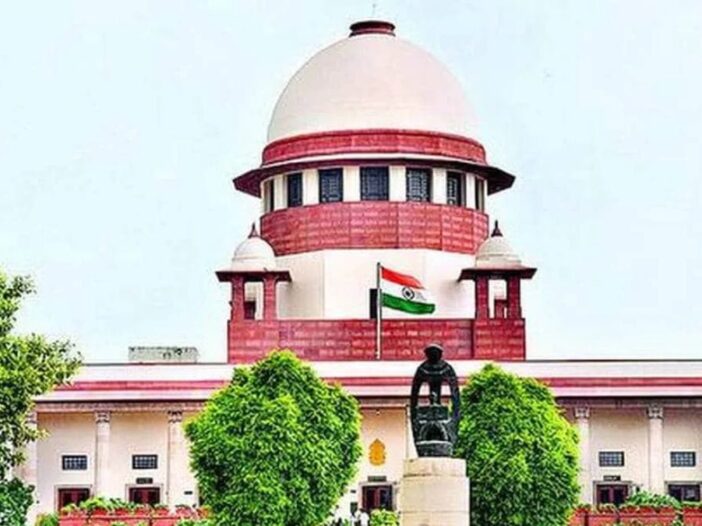
The Supreme Court has considered married daughters dependent on their parents as eligible for compassionate appointment. The SC has said in its decision that a married daughter who is dependent on her parents in their absence is eligible for compassionate employment. If a married daughter fulfills all the conditions related to employment then she will be considered eligible for appointment. Earlier, Allahabad High Court had said in this case that a married daughter is not included in the definition of family for the purpose of compassionate appointment. The Supreme Court has canceled this decision.
A bench of Justice PS Narasimha and Justice Alok Aradhe said that it agrees with all the decisions of the Bombay High Court and the Karnataka High Court, which have said that marital status cannot be a valid ground to deprive an eligible daughter of a welfare scheme. The case relates to a reference to the Supreme Court by a single bench of the Allahabad High Court in which it was asked whether the claims of married daughters for compassionate appointment could be rejected even if there was no such disability in the case of married sons.
Petition was filed for license to run a shop
The petitioner in this case, who is a married daughter. He filed a petition in the Allahabad High Court for a license to run a proper shop on compassionate grounds. In this, the government order of 2019 was challenged, in which married daughters were kept out of the definition of ‘family’. Actually, despite being married, she lived with her family. She took care of a disabled sister and ran a shop with her mother. After the death of his mother, the petitioner applied for a license, which was rejected.
Consideration of some earlier decisions
The single bench of the High Court considered the previous decisions before the court. He noted the Division Bench judgment in Vimal Srivastava v. State of Uttar Pradesh and Others (2015), wherein, while interpreting a similar provision of the Uttar Pradesh Dependents of Government Servants Recruitment Rules, 1974, relating to the definition of “family” for appointment on compassionate grounds in a service related case, it was held that the exclusion of married daughters from the definition of family was unconstitutional as it was violative of Articles 14 and 15 of the Constitution of India and thus the definition of family. The word “unmarried” as used in the Act was repealed.
In this, the government order of 2019 on the claim challenged by the married daughter in the case Kusumlata vs. State of Uttar Pradesh and others (2021) before the Single Bench of Allahabad High Court was also considered. In this it was held that the logic of the Vimal decision cannot be applied. It also said that the use of the word “unmarried daughter” in the definition of family in the government order of 2019 is not discriminatory. It also held that the 2019 government order cannot be interpreted in the same way as the Allahabad High Court had interpreted the provisions of the harness rules.
A similar view was also expressed by the Division Bench in the case of Saida Begum vs. State of Uttar Pradesh and Others (2023). The judge had presented this case before the Supreme Court. However, the Supreme Court upheld the Bombay High Court’s decision in the Ranjana case and set aside the contrary decisions of the Allahabad High Court.
Order to give valid license within four weeks
In the decision pronounced today, the Supreme Court said that Saida Begum’s case does not have a correct legal basis. In this case, the evidence on record proves that the appellant continued to live in the same village even after marriage and actively helped her mother in running the fair price shop. After the death of his mother, the appellant took charge of his sister, who was physically disabled.
Rejecting her application on the basis of her being a married daughter is constitutionally invalid. The Supreme Court quashed the orders denying him the license and directed the competent authorities to issue valid license orders within four weeks.

Leave a Reply