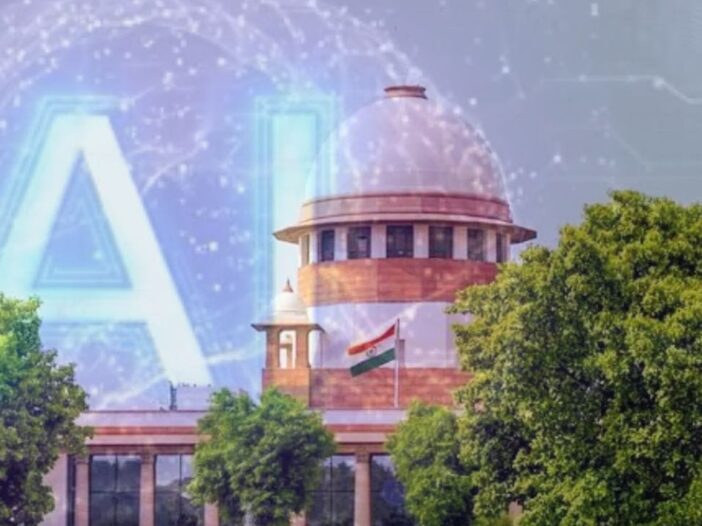
The rapid pace at which technology is changing has also knocked at the doors of our justice system. A huge and historic step has been taken towards the formal use of Artificial Intelligence i.e. AI in Indian courts. The Supreme Court has released the first official draft for the year 2026 regarding the use of AI in courts. Suggestions have been sought from the general public and all stakeholders on this. We will tell you what are the rules in this draft, what are the security measures and can AI really replace judges in the future.
The main objective of this draft issued by the Supreme Court is to maintain human primacy, accountability, data security and judicial independence in the judicial process. The Court clearly believes that technology is welcome, but it cannot change the basic spirit of justice. It is clearly stated in this draft regulation that the use of Artificial Intelligence will be completely subject to human judgment and judicial authority at all times. This means that the final and supreme power within the court room will be reserved only with one person i.e. the honorable judge.
Will AI systems start giving decisions on their own in the future?
This draft has completely rejected all those apprehensions in which it was being said that in future AI systems will start giving decisions on their own. According to the rules, each AI system will work only in the capacity of an assistant. It can never take the place of any duly appointed judicial officer i.e. judge. The work of AI may be to simplify legal research, search documents and manage dates, but only human judges will do the work of applying their mind and giving justice in any case.
The final and complete authority to determine any matter relating to law, facts and justice is reserved only with the judges. The draft regulation makes it clear that no AI system can render a verdict or sentence a person in any case, without human intervention. This has been done so that no innocent person is punished due to any technical glitch, algorithmic error or data bias. Justice requires compassion, discretion and human understanding, which no machine can possess.
The scale of justice is determined by the conscience of a person.
No matter how modern technology becomes, it can speed up the work of the courts, but it can never replace the scale of justice which is determined by a person’s conscience. Expressing this sentiment, a couplet by the famous poet Allama Iqbal comes to mind:
‘Pray to God with all your heart,
The light of the eyes is not the light of the heart.
That is, only the external and technical light of the eyes is not enough, for justice, it is most important to have the inner understanding and discretion of the heart, which only humans have. It is clear that this Draft Regulation 2026 of the Supreme Court is an excellent blueprint to secure and modernize the justice system of the future, where technology will be helpful but not the master.

Leave a Reply