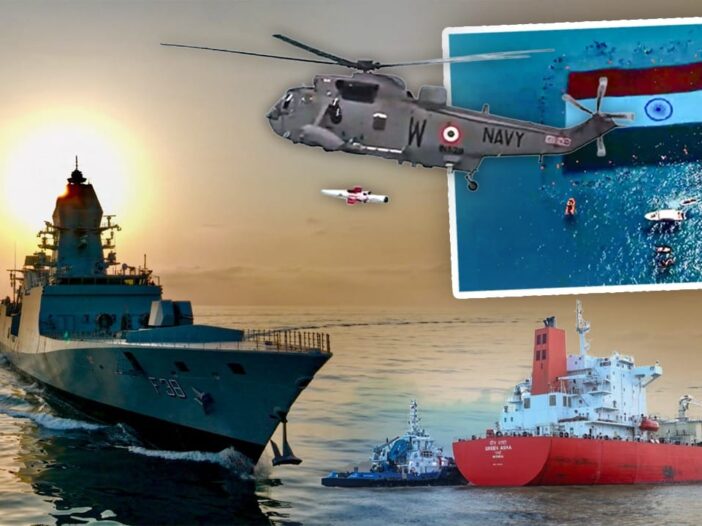
While the whole world heaved a sigh of relief after the historic peace agreement between America and Iran, behind the scenes the story of a brave mission of the Indian Navy came to light, which saved the country’s economy from destruction. On February 28, America and Israel together suddenly attacked Iran. After this, war broke out and the Strait of Hormuz was blockaded by angry Iran, America also retaliated by deploying its army. Then the Indian Navy carried out the largest and most dangerous ‘mission-based deployment’ in its history.
The Indian Navy expanded the scope of ‘Operation Sankalp’ and named it ‘Operation Urja Suraksha’. Its sole aim was to safely rescue India’s crude oil, LNG and LPG ships worth crores of rupees stranded in the battlefield.
24 Indian ships were stuck in the gulf
As soon as the war started, 22 to 24 high-priority ships (Merchant Vessels) coming to India were also stuck in the western part of the Strait of Hormuz. There were more than 600 Indian sailors on these ships. India brings 40% of its crude oil and 90% of its commercial LPG through this route, so the stranding of these ships was an alarm of a major energy crisis for India.
Overall, about 36 to 38 commercial ships (more than 1,100 sailors) belonging to India were affected in this entire tense Gulf region, but the Navy first gave priority to ‘energy-critical’ ships carrying oil and gas.
’Successful rescue’ of major ships
The Navy escorted these ships under its protection under a very strict and secure ‘Layered Security Grid’ and safely transported them from the Gulf of Oman to the Arabian Sea after crossing the Strait of Hormuz. Many famous ships were also included in these. Shivalik, Nanda Devi, Pine Gas and Jag Vasant were prominent among the ships loaded with LPG gas.
India’s ‘Trishakti’ was deployed
Whereas Jag Laadki was a crude oil tanker. Apart from this, the Navy provided continuous monitoring and navigational support to many other ships, so that they could reach the western coast of India (Mundra and Kandla Port of Gujarat) without any loss.
During this entire operation, the Indian Navy provided security to Indian ships on its own without becoming a part of any international coalition. For this, India had put all its strength into the sea.
Deploying frontline warships
To provide safe passage to Indian ships carrying crude oil and LPG, the Indian Navy had deployed several frontline warships in the Gulf of Oman, Arabian Sea and the eastern part of the Strait of Hormuz. Additional deployment was also made. During the crisis, 6 to 7 frontline warships were deployed in this area round the clock (on normal days only 1 to 2 ships conduct routine patrolling here).
The Navy’s most modern Guided-Missile Destroyers such as INS Kolkata, Stealth Frigates and Offshore Patrol Vessels (OPVs) were involved in this operation. The task of these ships was to protect Indian LPG and crude oil tankers (such as Shivalik and Nanda Devi) stranded outside the Strait of Hormuz and safely transport them to the western coast of India (Mundra and Kandla Ports of Gujarat).
Navy personnel and marine commandos
A large number of soldiers are required to carry out operations in such a ‘high-alert’ and war-torn environment. About 1,500 to 2,000 sailors and officers were deployed on different ships in the sea at all times with full combat readiness.
Several teams of India’s special lethal force i.e. Marcos Commandos were deployed on every important warship. Their main job was to conduct ‘boarding operations’ on suspicious boats and to immediately play the role of ‘first responder’ in case of any drone attack or hostage taking.
Air power, aircraft and drones
The Navy had deployed its entire air power to keep a moment-to-moment surveillance over thousands of square kilometers of the sea. India’s most modern long-range maritime patrol aircraft named P-8I Poseidon kept constant surveillance from the sky during this period. Through this, suspicious submarines, warships and anti-ship missile threats were monitored.
Sea-King and ALH Dhruv helicopters deployed on warships were used for aerial reconnaissance and airlift of marine commandos in emergency. While India also used high-altitude MQ-9B SeaGuardian drones purchased from America, which were sending live feed to the headquarters in the skies of the Gulf region for more than 30 hours without stopping.
The biggest success of the mission
In this environment of war, the danger of drone attacks and missiles was highest. Marcos commandos were always ready for ‘boarding operations’ to keep an eye on suspicious boats. The result of this strict vigil by the Indian Navy was that these oil-gas ships, which are called the lifeline of India, were brought safely to the Indian border.
Now after the peace agreement, this important sea route of the Gulf countries has been completely opened. At the same time, the very complex and adventurous operation of the Indian Navy has also ended and our brave warships and sailors are returning to their routine duties.

Leave a Reply