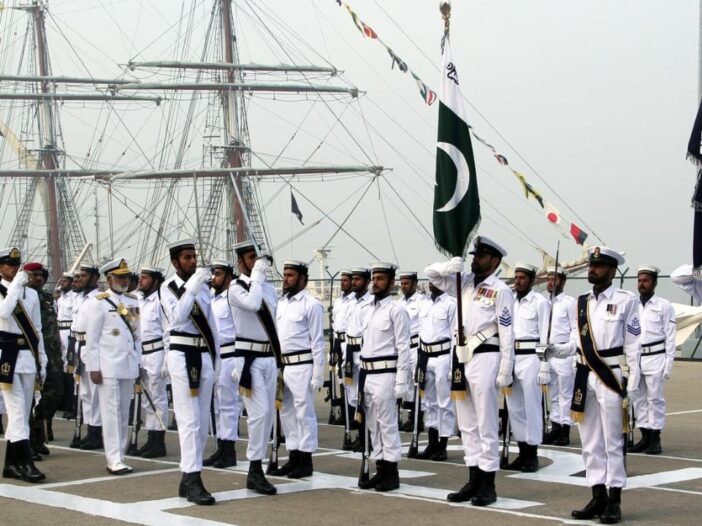
China-Pakistan are trying to change the maritime strategic balance of South Asia. For the first time in the last 55 years after the India-Pakistan war of 1971, Pakistan is working on a very dangerous plan to deploy its submarines in the Bay of Bengal. On the basis of modern ‘Hangor-class’ submarines being received from China, the Pakistani Navy is now trying to encircle India in the wider Indian Ocean Region (IOR) by moving out of its traditional range of the Arabian Sea.
After the statement given by senior Pakistan Navy officer Commodore Omar Farooq in Sri Lankan capital Colombo, Indian security agencies and Navy have become fully alert. Commodore Farooq said that after the induction of the new PNS Hangor submarine into the fleet, the operational capability and reach of the Pakistan Navy has increased, which will make Pakistan’s presence possible even in remote maritime areas like the Bay of Bengal.
Flashback 1971.. The water mausoleum of PNS Ghazi, which Pakistan could not forget
To understand this new audacity of Pakistan, it is necessary to turn the pages of history. Since the 1971 war, Pakistan had never dared to move towards the Bay of Bengal.
14 November 1971: Pakistan had launched its only long-range submarine PNS Ghazi (former American USS Diablo) from Karachi. After traveling a distance of about 4800 kilometers, it traveled around the Indian Peninsula and reached the Bay of Bengal.
What was the mission: Ghazi’s main target was to locate and destroy the Indian aircraft carrier INS Vikrant and lay sea mines at the mouth of Visakhapatnam port.
Midnight of 3–4 December 1971: The Indian Navy laid a net and buried PNS Ghazi in the depths of the sea near the coast of Visakhapatnam. According to India, INS Rajput had sunk it by attacking with depth charges. In this incident, all 93 Pakistani marines (11 officers and 82 sailors) aboard Ghazi were killed. After this crushing defeat, Pakistan Navy had stayed away from this area.
New threat of 2026, China’s ‘hangar-class’ and AIP diplomacy
After 55 years, the real brain behind this new audacity of Pakistan is China. Pakistan, with the help of China, is building a deadly fleet of eight ‘Hangar-class’ submarines, which are based on China’s ‘Type 039B Yuan-class’.
Recent Developments: The first submarine of this project, PNS Hangor, has recently been commissioned into the Pakistani Navy in April-May 2026.
AIP Technology: These submarines are equipped with Air-Independent Propulsion (AIP) system. This means that they do not need to come out of the sea water (to the surface) for weeks, which makes them very difficult to find.
According to Pak Navy Chief Admiral Naved Ashraf, 4 out of these 8 submarines are being built in China and the construction of the remaining 4 will be completed by 2028 through assembling in Pakistan.
Indian Navy’s ‘Anti-Submarine’ wall and impenetrable fort
Pakistani officials claim that they are venturing into the Bay of Bengal in the name of changing diplomatic relations with Bangladesh and security of sea lanes. But in reality its direct purpose is to spy on India’s Eastern Naval Command (Visakhapatnam). However, it is almost impossible for Pakistan to penetrate India’s maze.
Warships and P-8I Poseidon patrol: India has a fleet of modern warships and American-made P-8I long-range maritime reconnaissance aircraft, which are considered the world’s best ‘Submarine Hunters’. Pakistani submarines will come on their radar as soon as they enter the Bay of Bengal.
MH-60R Romeo Helicopter: Romeo helicopters deployed on frontline warships of the Indian Navy have the ability to detect and destroy any submarine hidden under the sea in a moment.
Big challenge of logistics: The distance from Pakistan to the Bay of Bengal is very long. Without refueling and logistics support from a friendly country (such as some secret base in Myanmar or Sri Lanka), it may prove to be a ‘suicide mission’ for the Pakistan Navy to maintain regular deployment in the region.
What is the objective of Pakistan?
This effort of Pakistan in 2026 is actually a part of China’s ‘String of Pearls’ policy to surround India from all sides in the sea. Given India’s nuclear submarines like INS Arihant and the new strategic naval base Project Varsha being built in Visakhapatnam, the Indian Navy is in a completely ‘dominant position’ in the Bay of Bengal. This new effort of Pakistan will definitely increase the regional tension, but in front of the strict monitoring of the Indian Navy, it will not take long for the ‘Hangar’ to meet the same fate as ‘Ghazi’.
Read this also- Army action in Manipur, hideouts of militant organization destroyed

Leave a Reply