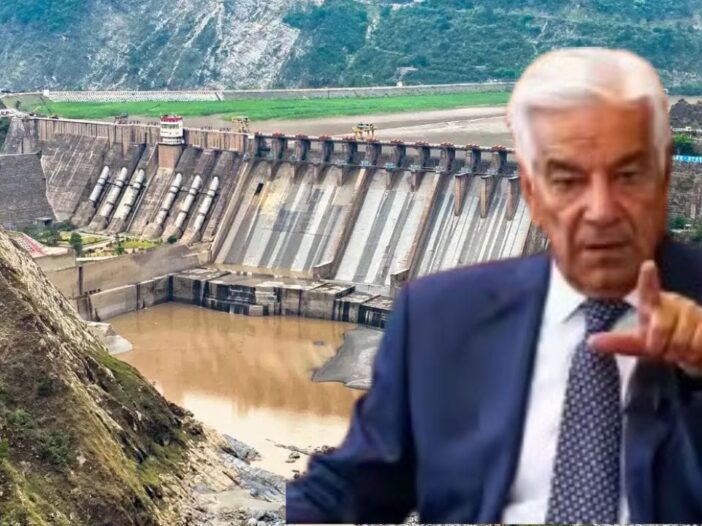
Pakistan’s Defense Minister Khawaja Asif has warned India that if its water security is in danger, Islamabad can take military action. His statement has come at a time when Pakistan is facing worsening water crisis. More than a year ago, New Delhi suspended the long-standing Indus Water Treaty following the Pakistan-backed Pahalgam terror attack.
In an interview to ARY News, Khawaja Asif said, “The moment we feel that water is a part of our national security and is in danger, we will wage war against India. For sure.”
He further said that if there is strong evidence that India is moving at “alarming speed” towards disrupting water supplies, then war will be considered.
Indus water treaty suspended after Pahalgam terrorist attack
His comment came after a clip of Jal Shakti Minister CR Patil, in which he had claimed that Indus River water could be completely stopped in Pakistan by June 2028. indus water treaty But tension had increased between the two neighbors after a deadly attack in Pahalgam, Jammu and Kashmir, in which 26 people were killed.
In response, India suspended the 1960 Indus Water Treaty and said the decision would remain in force until Pakistan stopped funding cross-border terrorism. Under this World Bank-brokered treaty, Pakistan has been given about 80 percent of the Indus water basin, which supports 80 percent of the country’s cultivated land.
Asif accused India of weaponizing water, manipulating the flow of Chenab river and withholding essential hydrological data.
There is an outcry for water in Pakistan
He said that Pakistan had earlier also monitored Indian projects through physical inspections under this treaty, and claimed that Pakistani teams had conducted about 115 inspections. Still, he admitted that he did not have the latest information about last year’s developments.
This warning comes at a time when almost one-third of Pakistan’s population, especially in Sindh and Balochistan, is facing acute water shortage. Data from the Sindh Irrigation Department shows that there is a deficiency of 64.1 percent in the North West Canal, while the deficiency in Rice Canal and Dadu Canal is 38 percent and 82 percent respectively.
Sindh officials have accused upstream Punjab of illegally withdrawing 53,394 cusecs of water against the approved allocation of 44,000 cusecs, which is more than 21 percent. With water flows downstream reducing, local leaders have warned of a coming “economic carnage” as clashes on state borders increase.
Read this also- India’s water strategy changed after Pahalgam attack, plan ready to torment Pakistan further

Leave a Reply