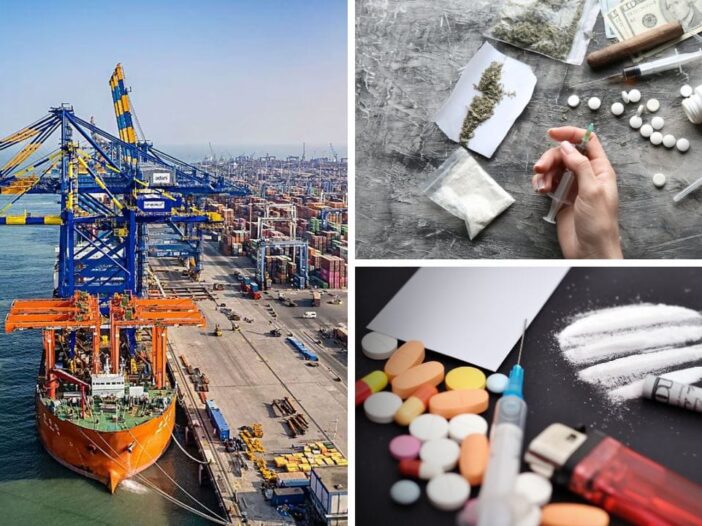
Recently, Union Home Minister Amit Shah, while reviewing the security arrangements of all the ports of the country, has instructed the officials to further strengthen it. He said that the security of ports should be handed over only to licensed private agencies and all the security personnel deployed there should be trained by CISF. Along with this, he asked to immediately activate the Bureau of Port Security (BoPS), prepare a national database of security personnel and start pilot testing of the new security system at major ports like Visakhapatnam, JNPA and Mundra. This will enable effective monitoring of drug smuggling and other security threats through ports.
India’s major sea ports have long been used as transit routes for international drug smugglers. In the last few years, large quantities of heroin, cocaine, methamphetamine and other drugs have been seized at many ports including Mundra, JNPA (Mumbai), Pipavav. In view of these challenges, the Central Government is working towards modernizing the security system of ports and implementing BoPS soon, so that the smuggling network can be curbed at the initial level. The BoPS, to be formed under Section 13 of the Merchant Shipping Act, 2025, will be a statutory body under the Ministry of Ports, Shipping and Waterways. Its main work will be to set standards for the security of ports and ships, inspect them, ensure compliance with international security rules and monitor all security arrangements including cyber security. This is also expected to strengthen the ability to control organized activities like drug smuggling.
How big a challenge is drug smuggling?
Government figures show that the drug smuggling network is continuously active. The quantity of drugs seized across the country in the last few years has been between 11 to 16 lakh kilograms.
| Year | seized drugs | price |
| 2021 | 16,09,612 kg | ₹25,241 crore |
| 2022 | 12,53,662 kg | ₹19,922 crore |
| 2023 | 13,89,725 kg | ₹17,179 crore |
| 2024 | 13,30,600 kg | ₹27,525 crore |
| 2025 (by November) | 11,85,994 kg | ₹16,927 crore |
If we look at the major actions taken only at ports, in September 2021, 2,988 kg of heroin was seized from Mundra Port, which is counted among the biggest drug seizures in the country. Apart from this, in 2022, 52 kg of cocaine was recovered from Mundra, 90 kg of heroin from Pipavav Port and 198 kg of methamphetamine from JNPA. In 2024, a large quantity of Tramadol tablets were also seized from Mundra Container Freight Station. In May 2026, the Indian Coast Guard (ICG) and Gujarat ATS, in a joint operation off the Mundra coast, seized 115 kg of cocaine, estimated to be worth around ₹1,150 crore. This was the 15th joint anti-narcotics operation of the two agencies in the last five years.
What are the preparations of the government?
Under the ‘Vision Document on Narcotics Control 2026-2029’ of the Home Ministry, many big targets have been set to stop drug smuggling. A target has been set to identify 100 international and interstate drug cartels by December 2027 and eliminate them by March 2029.
Under this, many new arrangements will be implemented at ports and borders.
- Container scanning system will be installed at all major ports.
- Only licensed private security agencies and CISF-trained personnel will be deployed for security.
- A national database of all security personnel will be prepared.
- There will be a trial run of the new security system at major ports like Visakhapatnam, JNPA and Mundra.
- The number of canine units at sensitive ports will be increased from 37 to 100.
- Modern patrol ships will be deployed in the Exclusive Economic Zone (EEZ).
- Separate narcotic cells will be created in BSF, ITBP, SSB, Assam Rifles and CISF.
- Full-body truck scanners will be installed at 29 high-risk land customs stations.
- NCB and FIU will jointly develop red-flag indicators to identify suspicious drug transactions.
Why is BoPS important?
The Government believes that sea and land ports are among the most important entry and transit routes for drug smuggling. In such a situation, BoPS will not be just a new security institution, but will become the main mechanism integrating physical security of ports, container inspection, cyber security and monitoring of drug smuggling. In view of the large drug seizures and changing smuggling networks in recent years, the government is making port security an important part of the country’s comprehensive anti-narcotics strategy.

Leave a Reply