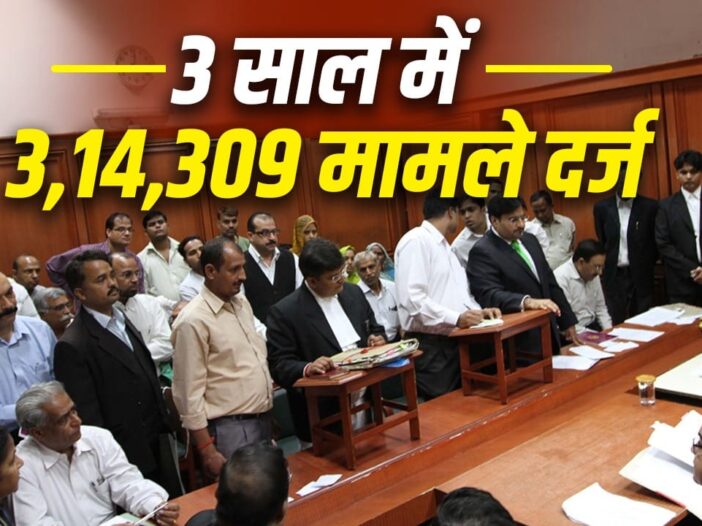
The word “Fast Track” has been in discussion for the last few days. It is again in the headlines after PM Modi talked about the formation of fast track courts in the NEET paper leak case. Even before this, in the cases of Nirbhaya case and all the heinous crimes that followed, the public’s demand was that justice should not be delayed. Currently, there is a protest going on at Delhi’s Jantar Mantar regarding irregularities in the NEET exam, but do you know how fast the fast track court actually is. How many cases have been solved in this? Government Minister Arjun Ram Meghwal himself has given an answer regarding this, according to which, in the last 3 years, more than 3 lakh cases were registered before the Special Court, including POCSO and out of them, 2 lakh 28 thousand cases have been settled. Let us tell you about it in detail. Let us try to explain in simple words what answers the government has given.
According to the information given by the government in Parliament, in the last three years, instead of decreasing, the number of cases pending in the Fast Track Special Court has been continuously increasing. In the year 2023, where 2.02 lakh cases were pending. At the same time, in 2024 this figure will increase to 2.04 lakh. By the end of 2025, the situation worsened and the number of pending cases reached more than 2.45 lakh. It is clear that the pace of disposal has not increased in proportion to the speed with which new cases are being registered every year, which is directly impacting the victims getting timely justice.
What do the year-by-year statistics say?
- In the year 2023, 81,471 new cases were registered, while 76,319 cases were disposed of.
- The number of 2024 new cases increased to 88,902 and 85,595 cases were disposed of.
- Whereas, in 2025, a maximum of more than 1.43 lakh new cases were registered, but only 66,500 cases could be resolved.
- The biggest concern is that the pace of disposal of new cases in 2025 was less than half.
There is a network of courts across the country, yet the pressure is not less.
As of April 30, 2026, a total of 775 fast track special courts were functioning in 29 states and union territories of the country, out of which 398 are exclusive courts set up specifically for POCSO cases. Despite having such a large number of courts, the lack of reduction in pending cases shows that the problem is not just the number of courts, but also their efficiency and resources. At present this scheme has been extended till 30 September 2026, which means the government is in favor of continuing it.

Review meetings and funds released
The government says that regular review meetings are being held with the states and the High Court to improve the efficiency of the courts. The Law Minister has written a letter to all the Chief Ministers and Chief Justices of the High Court, appealing to ensure timely hearing. However, the responsibility of recruiting judicial officers and employees as well as strengthening the infrastructure of the courts has been left to the states and the respective High Courts. On the financial front, Rs 1,259.51 crore has been released to the states and union territories since the inception of the scheme, and additional financial assistance is also being provided to improve the infrastructure of district and subordinate courts.
Overall, the data shows that even though these special courts built in the name of ‘fast track’ had brought the promise of speedy justice in serious cases like rape and POCSO, the ground reality is far different. Unless the pace of disposal surpasses the pace of new cases, the wait for justice for millions of victims will remain long.
Also read- There will be a law against paper leaks and Modi cabinet will increase the punishment and fine.

Leave a Reply