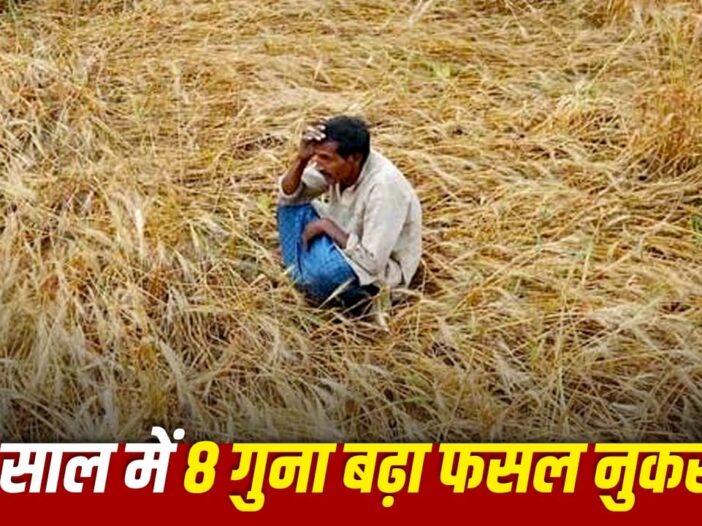
About 60 percent of India’s population is dependent on agriculture for their livelihood. Constant floods, droughts, heat waves, unseasonal rains and other climate related disasters are affecting their livelihood as well as causing huge losses. In response to a question in the Rajya Sabha regarding this loss, the Ministry of Agriculture and Farmers Welfare has said that in the last three years there has been a sharp increase in the agricultural sector affected by natural disasters. In the year 2025-26, this figure reached 103.28 lakh hectares (one crore hectares). This is several times more than the previous two years.
According to the information given by the government, 9.39 lakh hectares of agricultural area was affected by natural disasters in 2023-24. 13.20 lakh hectare crops were affected in 2024-25 and 103.284 lakh hectare crops in 2025-26. This clearly means that the affected agricultural area increased almost eight times in one year. Maharashtra ranks first among the most affected states. However, according to the data released by the government, Bihar, Rajasthan, Kerala, Madhya Pradesh and some other states either did not register any loss or no data was provided.

Which are the states with the most affected agriculture sector in 2025-26?
- Maharashtra: 75.42 lakh hectares
- Karnataka: 14.81 lakh hectares
- Haryana: 4.32 lakh hectares
- Uttar Pradesh: 2.22 lakh hectares
- Punjab: 1.93 lakh hectares
- Andhra Pradesh: 1.51 lakh hectares
How many agricultural districts of the country are sensitive to climate risk?
Climate risk assessment of 651 agricultural districts was also done under the NICRA project of ICAR. Out of these, 310 districts have been found sensitive. Of these, 109 districts are very sensitive and 201 districts are in high sensitive category. At present, in view of such conditions, 448 climate friendly villages are being developed in 151 sensitive districts to avoid much loss in agriculture. During 2014-2024, 2900 new crop varieties were released, of which 2661 varieties have the ability to withstand climate or biological stress.
Through what means is the government providing relief and compensation to farmers after natural disasters?
The government, in its reply in the Parliament, also explained what is the process of providing compensation to farmers for losses caused by natural disasters. According to the Central Government, the primary responsibility of providing relief in natural disasters lies with the State Governments. For this, relief is given to farmers from SDRF (State Disaster Response Fund) in every state. If the matter becomes very serious then the central government helps the farmers through NDRF (National Disaster Response Fund). This amount is given as relief to the farmers, not as compensation for the entire loss. For this, the government provides compensation or benefits to the farmers under two other schemes.
- Pradhan Mantri Fasal Bima Yojana- Under this, losses caused by events like flood, drought, heat wave, hailstorm, cyclone, insect infestation, natural fire and unseasonal rain are covered.
- Weather based crop insurance – In this too, compensation is provided to the farmers in case of damage to crops due to weather events like unseasonal rain, flood, hailstorm, cyclone, heat wave.
Through which other schemes is the government indirectly helping farmers to deal with natural disasters?
Rainfed Area Development Scheme: To ensure that the livelihood of farmers does not come under threat due to natural disasters, the government is helping the farmers through many other schemes. One of these is under a scheme named Rainfed Area Development, along with farming, activities like animal husbandry, horticulture, fisheries and agro-forestry are being promoted among the farmers. Suppose if a farmer does not have irrigation facility. In such a situation, if there is less rainfall in any year, then his livelihood can be adversely affected. In such a situation, farmers are not advised to depend on only one crop under this scheme.
More on Drop Scheme: At the same time, to deal with drought-like situations, schemes like More Drop are being promoted among the farmers. Emphasis is being laid on better use of water by promoting micro irrigation techniques like drip and sprinkler. This reduces wastage of water, reduces the cost of irrigation and makes farming easier even in drought-like conditions.
Agromet Advisory Service (GKMS – Gramin Krishi Mausam Seva): It is jointly run by the Ministry of Earth Sciences and the Indian Council of Agricultural Research (ICAR). Its objective is to provide agricultural advice to farmers based on weather forecast, so that farmers can take right farming decisions at the right time in case of heavy rains and drought.
If the situation remains like this then a big food crisis may arise in the country.
The increase in the area affected by natural disasters from 9.39 lakh hectares to 103.284 lakh hectares in just 2 years shows how weather events are causing huge losses to agriculture. At the same time, it also indicates that climate change is now becoming a major threat not only to the environment but also to agriculture and food security.
In such a situation, climate friendly farming, better irrigation system, effective implementation of crop insurance and providing timely weather based advice are going to be very important for both food security and income of farmers in the coming years. The government has also implemented or is implementing various schemes for this so that the country can be saved from any major food crisis by protecting the crops of the farmers.

Leave a Reply