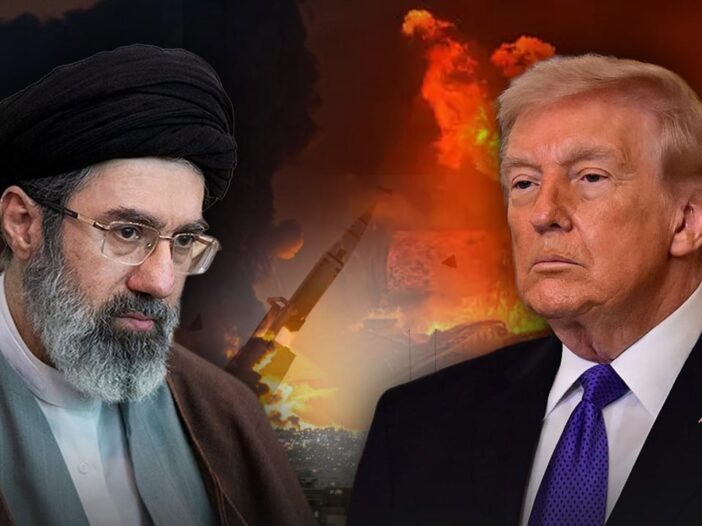
The ceasefire between America and Iran completely broke on Sunday, leaving the Gulf countries again on the brink of a major war. Both sides launched new military attacks, which quickly spread to one of the world’s most strategically important areas, including the Strait of Hormuz. The supreme leaders of both the countries have now become mortal enemies of each other and the war has reached killing mode.
on sunday America It launched a third round of strikes on Iran after it accused Tehran of attacking a commercial container ship in the Strait of Hormuz. In response, Iran announced it had once again closed the strategic Strait of Hormuz and stepped up attacks on US military facilities in the Gulf, warning that any retaliation would be met with a “strong response”.
The latest development comes after days of mutual attacks, prompting US President Donald Trump to declare the ceasefire “over” while saying Washington is ready for talks, while Iran says Hormuz remains off limits. US Central Command has said that commercial ships continue to pass through this route, which typically carries about a fifth of the world’s oil and liquefied natural gas shipments.
Meanwhile, Tehran has claimed missile and drone attacks on US military bases in several Gulf countries. These incidents have increased fears about global energy supply, regional security and the future of negotiations between Washington and Tehran.
Attack on Cyprus ship sparks fire
The new round of fighting began when Iran attacked the Cyprus-flagged container ship M/V GFS Galaxy, accusing it of traveling through “unauthorized passage” in the Strait of Hormuz. US Central Command said the ship’s engine room suffered severe damage and caught fire, leaving one civilian crew member missing.
According to United Kingdom Maritime Trade Operations, the crew later abandoned ship and escaped in lifeboats. In response, the US military carried out its third round of attacks against Iran this week.
US Central Command said US forces struck nearly 140 Iranian military targets on Saturday alone, part of a larger campaign targeting more than 300 sites over three nights. “In response, the United States is paying a heavy price by continuing to reduce Iran’s ability to attack private seafarers and commercial vessels freely transiting the strait,” the US military said. US Defense Secretary Pete Hegseth also warned Tehran, writing on Twitter, “Iran made a wrong decision. Now they will have to pay the price.”
India condemned the attack on the ship
India strongly condemned the attack on the Cyprus-flagged container ship M/V GFS Galaxy, which had 11 Indian nationals on board. He described the continuing attacks on commercial shipping in the Middle East as “very worrying”. The Ministry of External Affairs said that 10 Indian crew members have been rescued, while one Indian citizen is missing.
MEA spokesperson Randhir Jaiswal said, “Our Embassy in Oman is closely monitoring the situation and is continuously coordinating with the Omani authorities in the ongoing search and rescue operations. We thank the Omani authorities for their support.” Reiterating New Delhi’s appeal for restraint, he said, “The continuing incidents of attacks on commercial shipping in the region are deeply worrying. We reiterate our appeal for an immediate de-escalation of tensions and an end to ongoing negotiations for a diplomatic solution so that peace and stability can return to the region.”
Iran closes Hormuz again
Iran announced that the Strait of Hormuz will once again remain closed. Iranian officials said several commercial vessels ignored repeated warnings and tried to use “unauthorized routes” through the strategic waterway. The Islamic Revolutionary Guard Corps announced that the strait would remain closed until “the US interference in it ends.”
Iran also warned that any further retaliation by Washington would invite a “strong reaction”. Although Tehran described the attack on the container ship as a warning, the US accused Iran of deliberately targeting an ordinary commercial ship.
Iran intensifies attacks on Gulf countries
Hours after the latest US attacks, Iran announced a significant increase in its military response in the Gulf. The Revolutionary Guards (IRGC) claimed to have destroyed a command and control center and drone hangar at a military base in Jordan. Tehran also claimed it targeted a US military radar installation in Kuwait, attacked an aircraft carrier support and refueling facility in Oman and a fighter jet maintenance and command facility in Qatar.
The Guards further claimed that they had disabled a second commercial ship in the Strait of Hormuz. Meanwhile, the United Arab Emirates said its air defense system intercepted incoming Iranian missiles and drones. Air raid sirens were activated in Bahrain, while Qatar reported intercepting missile attacks and explosions were heard in Doha. Iranian state media also reported explosions in Bandar Abbas, Sirik, Jask.
Concern increased due to Hormuz blockade
The Strait of Hormuz is one of the world’s most strategically important shipping lanes, carrying about a fifth of the world’s seaborne oil and liquefied natural gas supplies before the fighting began. Due to its closure again, concerns regarding global energy security have increased. Oil prices have risen as markets fear prolonged supply disruptions, raising the possibility of rising fuel prices, inflation and slower economic growth around the world.
The US insists that commercial shipping should continue without restrictions and has repeatedly demanded that Iran publicly guarantee safe passage through the waterway. However, Iran argues that it has the right to regulate navigation and has indicated it will charge ships using the route, which Washington rejects. Despite increasing hostility, diplomatic efforts are continuing.
Is there still hope for talks?
Despite the intensification of fighting, diplomatic contacts continued behind the scenes. Iranian Foreign Minister Abbas Araghchi spoke with Omani counterpart Badr Albusaidi in Muscat on maritime security and ways to ensure safe navigation through the Strait of Hormuz.
According to Iran’s Foreign Ministry, the two sides “exchanged views on the correct methods for the safe passage of ships through the Strait of Hormuz.” Oman’s government news agency said talks would continue “at technical and political levels”. However, Araghchi accused Washington of violating the earlier ceasefire agreement. He wrote on X, “There can only be mutual consent.” Iran’s Parliament Speaker Mohammad Bakar Kalibaf also warned America. He wrote, “The era of one-sided deals is over. We told you: keep your word or pay the price. The reality is in front.”
Read this also- One day or 1 month… How long will the Iran-America war last this time?

Leave a Reply