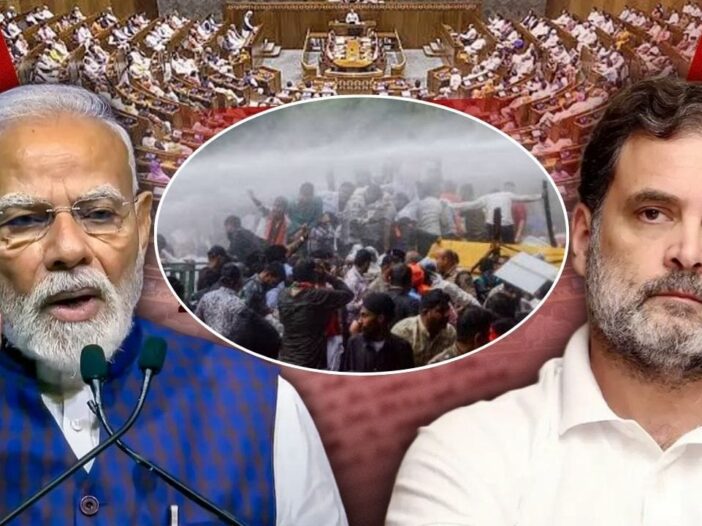
After the resignation of Education Minister Dharmendra Pradhan in the NEET paper leak case, the proceedings of both the houses of Parliament, Lok Sabha and Rajya Sabha, will begin on Monday for the first time. There has been a continuous uproar during the monsoon session against NEET paper leak and police action on CJP’s protest in Delhi and the proceedings have been marred by uproar, but on Monday, all eyes will be on the proceedings of Parliament, because the central government will introduce the Public Examination Amendment Bill, 2026 to stop the paper leak.
The Cabinet has already approved a strict anti-paper leak bill to strengthen the Public Examinations Act and the government will introduce it on Monday. On the other hand, opposition party leaders of Rajya Sabha and Lok Sabha will meet at the office of the Leader of Opposition in Parliament on Monday at 10 am to discuss the ongoing monsoon session So that our further strategy can be discussed.
Meanwhile, Prime Minister Narendra Modi on Sunday Announced the formation of a six-member task force under the chairmanship of Nandan Nilekani, co-founder of Infosys and architect of Aadhaar. This task force will work on examination reforms including NTA.
Government will introduce Public Examination Amendment Bill
The government will introduce the Public Examinations (Prevention of Malpractices) Amendment Bill, 2026 in the Lok Sabha on Monday to prevent future paper leaks during competitive examinations. Union Minister Jitendra Singh will present this bill, which has provisions for strict punishment to deal with paper leak cases.
According to Monday’s Lok Sabha agenda, after presenting the bill, Jitendra Singh will also move a motion to pass it. This law includes seven main amendments whose purpose is to remove the shortcomings of enforcement, create a dedicated judicial system and speed up criminal trials.
The bill proposes major changes in the framework of 2024 by introducing strict time limits for investigation and judicial proceedings. State governments and administrations of union territories will have the power to designate sessions courts as special fast track courts exclusively for the trial of offenses under the Act.
Cabinet has approved the bill
The bill requires that proceedings in special fast track courts be conducted on a daily basis, and trials be completed within three months of the filing of the charge sheet. Let us tell you that amidst the ongoing protests over the paper leak of NEET exam, the Union Cabinet on Friday, July 24 has approved the amendment in the Public Examination (Prevention of Unfair Practices) Act, 2024.
While chairing the Cabinet meeting that approved the bill, PM Modi said that this law should be given the highest priority and directed that it be brought in Parliament as soon as possible.
This decision came after continuous agitation by CJP. CJP had announced to end the movement after the resignation of Minister Dharmendra Pradhan and the government withdrawing the FIR against the protesters and giving financial compensation to the victims.
PM and Shah now on the target of opposition
The monsoon session of Parliament started from July 20 and will continue till August 13. After Dharmendra Pradhan’s resignation on Saturday, opposition party leaders have said that they are ready to allow regular legislative work and debate, provided Prime Minister Narendra Modi makes an official statement on the NEET-UG exam leak in the House. Congress is also demanding a statement from Union Home Minister Amit Shah on the police action and alleged brutality against the protesting students.
Meanwhile, opposition leader Rahul Gandhi has written a letter to Shah seeking accountability for the barbaric attack on peacefully protesting students and asked whether he had given permission to use lethal force, including pellet guns. Gandhi said that peaceful protest is an important part of democracy and it is the responsibility of the government to protect the protesters and resolve their grievances through dialogue.
Opposition’s plan to corner the government
Experts say the opposition knows that the government is somewhat cornered and instead of demanding accountability from a minister, it seems to have focused on holding Shah directly responsible for allowing the police action and the alleged use of pellet guns against students.
However, opposition leaders argue that legal changes cannot be used to avoid accountability of the system. When the Narendra Modi government wants the required two-thirds majority in the Lok Sabha for constitutional amendments, the opposition is seeing it as an opportunity to stop any move to bring a law related to delimitation.
Read this also-Clash over NEET controversy in Parliament, government assures strict law

Leave a Reply