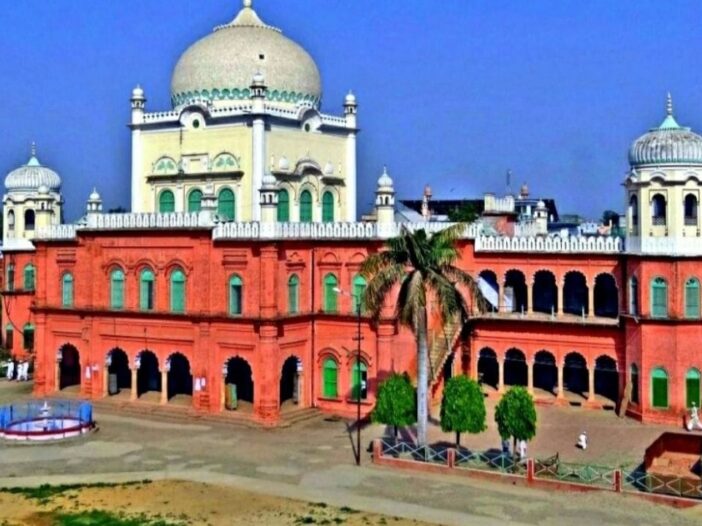
After the rebellion of 1857, in the name of promoting religious education and social reform in the Muslim society, Maulana Qasim Nanautavi had established Darul Uloom Deoband in Deoband, Uttar Pradesh in the year 1866. With this, Deobandi ideology started spreading in other countries of the Indian subcontinent also. After the partition of India in 1947, it developed in different ways in India, Pakistan and Bangladesh.
At present, the Qaumi (Deobandi) Madrasa, which started from Darul Uloom Deoband in India, has today become the largest network of Madrasas in Bangladesh. In all three respects, number of institutions, number of students and expansion, Bangladesh has now overtaken India and Pakistan. According to recent figures, about 60 percent of the students studying in Deobandi or Qaumi madrassas of the world are now in Bangladesh.
What is the number of Deobandi Madrassas in Bangladesh, ahead of India-Pakistan?
According to the data of Bangladesh’s Quami Shiksha Board Befaqul Madrasil Arabia published in Bonic Varta, the number of registered Deobandi madrassas in the country is about 32,730. The number of students studying in these institutions is approximately 70 lakh. Apart from this, there are more than 10,000 madrassas under other community boards. According to this, the total number of national institutions in the country is estimated to be more than 40,000.
At the same time, according to the latest data of All India Board of Religious Education under Jamiat Ulema-e-Hind in India, there were 20,900 educational institutions under their control in 2024. The number of students was 23,71,404. According to the data of Befaqul Madrasil Arabia in Pakistan, there are total 27,048 madrassas under their control and the number of students is 24,23,223.
Why did Deobandi madrassas increase in Bangladesh?
- In most of the Qaumi Madrassas in Bangladesh, education is free or at very low cost. A large number of low-income families send their children to these institutions.
- Most of the population in Bangladesh belongs to the Muslim community. In such a situation, people enroll their children in these madrassas to promote their religion.
- Many parents believe that religious education is not sufficient in the government, modern education system. In such a situation, they send their children to Qaumi Madrassas for Islamic education.
- Most of the Qaumi Madrasas in Bangladesh are outside the government registration system. They have expanded rapidly due to less administrative hurdles.
- In 2018, Bangladesh’s highest level of community education ‘Daura-e-Hadith’ was recognized as equivalent to Master’s degree. This has increased its acceptance.
- In Bangladesh, government (aliya) and Qaumi madrassa education ran parallel. Lack of unified education policy is also the reason for its expansion.
Why is Deobandi Madrassas not increasing so rapidly in India and Pakistan as compared to Bangladesh?
Most of the Qaumi Madrassas in Bangladesh are outside the government registration system. However, in 2018, the highest level of community education ‘Daura-e-Hadith’ was recognized as equivalent to Master’s degree. But lower and middle level education is still not fully within the scope of government recognition. In contrast, the organizations running these madrassas in India and Pakistan are legally registered. Also work with government recognized systems at various levels. This is the reason that the number of Qaumi Madrassas in these countries is less as compared to Bangladesh.
There are two types of opinions on Madrassa education in Bangladesh.
There are two types of opinions regarding Qaumi Madrassas in Bangladesh. One side believes that these institutions are preserving Islamic education and religious tradition. If there is government control over them, their freedom will be affected. Whereas, the other side believes that government registration and quality control on such institutions is necessary. This will increase the quality, transparency and employment opportunities of education. Along with religious education, students also need education related to modern skills.
What is the relation between the challenge of employment and Madrasa education?
According to a study by BRAC Institute of Governance and Development, only 2.17% of the students who complete their studies from Qaumi Madrasas work in the government or private sector. At the same time, 46.55% work as Imam, Muezzin, Khateeb or teachers in mosques, madrassas and other religious institutions. The remaining students are in business, small enterprises or other informal employment. This clearly means that due to government recognition and limited connection with mainstream education, the students of Qaumi Madrasas face the challenge of employment.

Leave a Reply