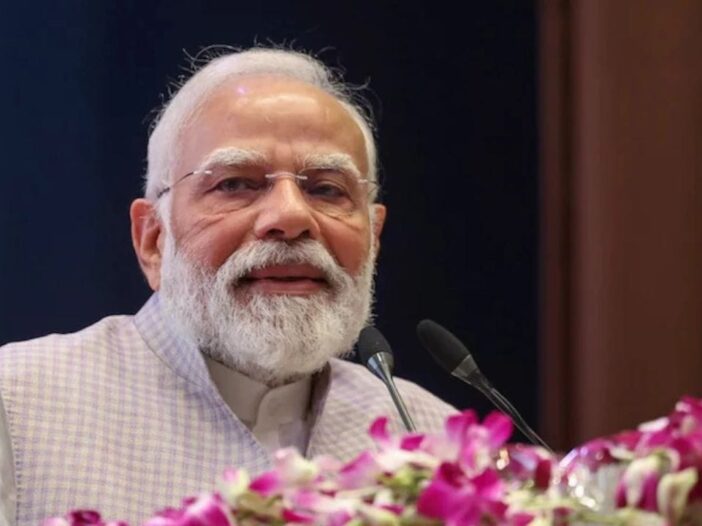
With geopolitical risks rising, Indian Prime Minister Narendra Modi is taking steps to reduce vital imports into the economy to secure supply chains and ease pressure on the currency. According to officials with knowledge of the matter, Modi’s office has directed key ministries to identify categories of goods for which there is high dependence on imports and which can be replaced with locally made products, Bloomberg reported. He said that the government is considering providing subsidies and other incentives to promote domestic production.
Officials said that the Commerce and Industry Ministry is preparing a list of more than 100 products, including electronics, chemicals, major medicines, fertilizers, semiconductors, automobiles and machinery, whose production can be increased. Officials said discussions are going on between several ministries and no final decision has been taken yet.
Big announcements on chip and smartphone production
This new step to promote domestic manufacturing was taken on Wednesday, when Modi’s cabinet approved a plan to increase financial assistance for chip and smartphone production by another 1.9 trillion rupees ($19.7 billion). It also approved a policy to increase local fertilizer production after the shortage related to the closure of the Strait of Hormuz. Indian manufacturing is largely dependent on imported inputs, particularly from China, leaving the industry at risk in the event of supply disruptions, as India’s auto and tech industries experienced last year. Iran War has further exposed India’s dependence. In recent months, due to severe energy shortage and rising import bills, the currency has reached a record low.
Government created task force
During the financial year ending in March, India imported goods worth about $775 billion, of which about one-fifth came from China alone. Increasing domestic capacity is now an important part of Modi’s economic agenda. Its objective is to reduce trade deficit, save foreign currency and make India a manufacturing hub as an alternative to China. Officials with knowledge of the matter said in a Bloomberg report that Shaktikanta Das, a former central bank governor and now principal secretary in Modi’s office, is leading a task force. This task force is preparing a blueprint for import substitution for the economy. Members of the Prime Minister’s Economic Advisory Council are also involved in this project.
India imports extensively from China and the Middle East
|
Country |
import (in billion dollars) |
|
China |
131.63 |
|
uae |
63.89 |
|
Russia |
55.37 |
|
America |
52.90 |
|
saudi arabia |
30.79 |
|
Iraq |
24.56 |
|
hong kong |
24.33 |
|
Switzerland |
24.27 |
|
Singapore |
24.24 |
|
Japan |
21.44 |
Consider these options
Officials said Modi has directed key government ministries to identify areas where India can produce goods in a better way and at a lower cost. He said that the government can consider giving manufacturing incentives to private and foreign investors to set up factories in the country or can ask government companies to increase their capacity through joint ventures. Commerce Minister Piyush Goyal this month asked states and industries to identify products that can be manufactured competitively in the country. He said that these efforts will help in reducing dependence on imports and saving foreign exchange. Additionally, the domestic supply chain will be strengthened to reduce the risks arising from excessive dependence on foreign suppliers.
America’s Russian bill will become a problem
India is the third largest oil importer in the world. It buys most of its oil from the Middle East and Russia, making the country sensitive to geopolitical tensions. The US is proposing to impose new sanctions on the five largest buyers of Russian oil and natural gas – including India and China. This will give President Donald Trump the right to impose up to 100 percent tariff on these countries. Officials in New Delhi said that although it is difficult to find substitutes for imports of crude oil, gold and essential minerals, the government is looking at scope to reduce dependence on other commodities like pulses and edible oil through agricultural reforms.
Idea of giving relaxation related to export
People said that in sectors where it is not possible to find import substitutes immediately, the government is planning to adopt a long-term strategy to increase domestic production. In some sectors, such as critical intermediate products required for electric vehicles, China plays a vital role in the global supply chain and cannot be replaced. One person said that other proposals being considered include the option of relaxing export conditions for exporters. This relaxation can be provided if they use mostly locally made capital goods for their exports.
Officials are also considering making changes in the ‘Advanced Authorization Program’. Under this program, exporters can import raw materials without paying custom duty, provided they export finished products of a certain value within the stipulated time frame and do at least 15 percent value addition at the domestic level. The person said that the discussions are mainly on whether value addition rules can be relaxed if exporters increase the use of locally made intermediate products.
A person with knowledge of the matter said that the government is aiming to reduce the import of fertilizer by 30 percent in the next three years. The person said that as part of this effort, officials are planning to restart closed home fertilizer plants, and some projects are expected to be completed by next year.

Leave a Reply