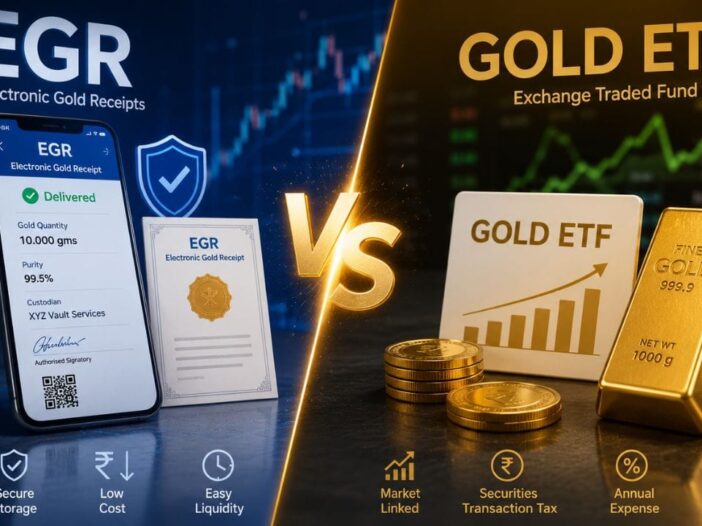
Indian investors’ love for gold is not hidden from anyone. We invest a lot of money in everything from jewelery to digital gold. Recently the National Stock Exchange (NSE) has introduced a new investment option, Electronic Gold Receipt i.e. EGR. This new method is directly competing with Gold ETF. In such a situation, it is natural that the question arises in the mind of an investor that which is better for taxes, expenses and good returns in future. Let us understand.
Gold from safe now directly transferred to demat account
EGR is actually a digital certificate behind which there is actual gold. This gold is kept in secure vaults monitored by market regulator SEBI. You can buy and sell it in the stock market just like the shares of any company. After purchase it remains safe in your demat account. Its biggest difference from gold ETFs is that you can convert your EGR into actual gold coins or bars if needed. This facility is available to investors in convenient quantities ranging from 100 mg to 1 kg.
Why did it take so many years to come to market?
This question may come to your mind that why did it take so long for this excellent system to reach the market. The main reason for this was to prepare the technical and regulatory framework. SEBI had to make strict rules for vault managers, stock exchanges, from NSDL to CDSL. Strict arrangements had to be made to ensure that for every receipt issued, an equal amount of real gold was kept safe in the vault.
Hidden costs vs real benefits
At present, Indian investors either prefer to buy jewelery in the traditional way or they turn to gold ETFs. EGR is currently trying to create a space between the two. Since it is new, there is little trading activity in it. Due to low liquidity, its price may be slightly higher than spot gold.
Talking about expenses, while buying EGR you do not have to pay 3% GST like buying gold directly. But, you have to pay brokerage, demat charges and vaulting charges. At the same time, if you convert this receipt into real gold in future, then you will have to pay 3% GST along with the delivery charge. These additional expenses sometimes make it a little more expensive than ETFs.
Exact mathematics of tax on profits
On the tax front, EGR rules are applicable like those for stock market listed securities. If you sell it within 12 months and make a profit, it will come under short term capital gain as per your income tax slab. At the same time, if sold after 12 months, the profit will be taxed at 12.5% without indexation. It is a matter of relief that under the current rules, there is no capital gains tax on converting EGR into physical gold.

Leave a Reply