The government’s efforts towards implementing ‘one country, one election’ in the country seem to be intensifying. Chairman of the Joint Committee of Parliament (JPC) P.P. Chaudhary said on Friday that the committee is working on preparing such a system by which the system of holding simultaneous elections can be implemented in the entire country by the 2029 Lok Sabha elections. However, he also indicated that if a consensus is reached between political parties and states, then in some states this system may be implemented even before 2029.
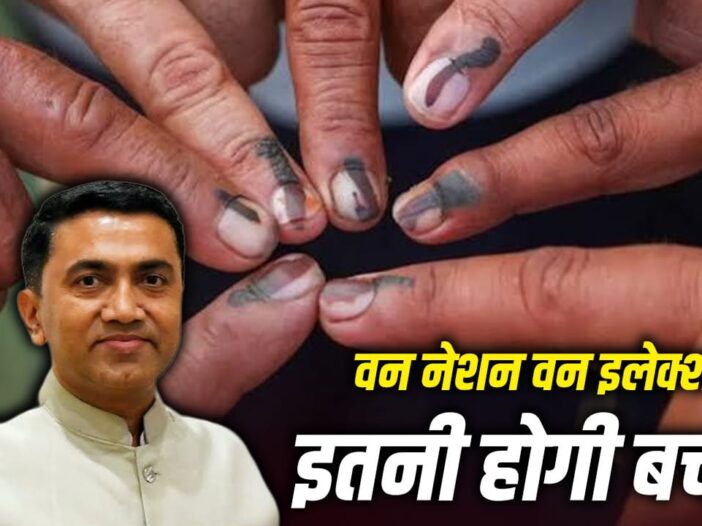
These days the Joint Committee is reviewing the Constitution (129th Amendment) Bill, 2024 in Goa. The two-day meeting began with discussions with Goa Chief Minister Pramod Sawant and members of his cabinet. During this, the practical and constitutional challenges of holding simultaneous elections were discussed in detail. The committee also sought suggestions from the state government as to what measures would be needed to implement this system and how a balance could be struck between all the parties.
One country, one election possible by 2029?
Chairman of the Joint Committee of Parliament (JPC) P.P. Chaudhary has indicated that if all constitutional and political processes are completed on time, the ‘one country, one election’ system can be implemented by the 2029 Lok Sabha elections. He said that the committee is working keeping this goal in mind. Also, if political parties and state governments voluntarily agree, then in some states this system can be implemented even before 2029.
What preparations are there?
The joint committee is collecting suggestions across the country regarding ‘one country, one election’. In this series, a two-day meeting was organized in Goa, where detailed discussions were held with Chief Minister Pramod Sawant and his cabinet. The challenges faced in holding simultaneous elections and their solutions were discussed in the meeting. Apart from this, the committee has visited many states including Gujarat, Maharashtra, Karnataka, Himachal Pradesh, Uttarakhand, Punjab, Haryana and Delhi. Opinions are also being taken from constitutional experts, academicians, civil organizations and other stakeholders. P.P. According to Chaudhary, about 99 percent of the civil organizations with whom discussions have been held so far have supported this proposal.
How much money will be saved?
The Chairman of the Joint Committee claims that due to Lok Sabha and Assembly elections being held at different times in the country, there is an economic loss of about Rs 7 lakh crore. This includes the expense of conducting elections, deployment of security forces, duties of government employees, delay in development work due to repeatedly enforced code of conduct and impact on economic activities. The government believes that holding simultaneous elections will bring a major reduction in these expenses.
Earlier in April last year, in a seminar organized on ‘One Country, One Election’ (ONOE) at SRM University, Chennai, Union Finance Minister Nirmala Sitharaman had said that if Lok Sabha and Assembly elections are held simultaneously in the country, then India’s GDP can increase by about Rs 4.5 lakh crore. According to him, this will increase the GDP by about 1.5%. He had said that only when the country’s economy becomes strong, people of every class and every community will benefit from it. He said that if Lok Sabha and Assembly elections are held simultaneously, then around Rs 12,000 crore can be saved. He said that this money can later be spent on schemes for the development and welfare of the people.
What is the legal challenge now?
‘One country, one election’ Many amendments will have to be made in the Constitution to implement it. The biggest challenge is to bring the tenure of the Lok Sabha and all the state assemblies at the same time. Apart from this, if the tenure of any government ends midway or the government falls, then a legal solution will have to be decided as to how elections will be conducted in that situation. To amend the Constitution, along with a special majority in the Parliament, the approval of the states will also be necessary in some cases. This is why the government and the joint committee are trying to create a broad consensus among all political parties and states.

Leave a Reply