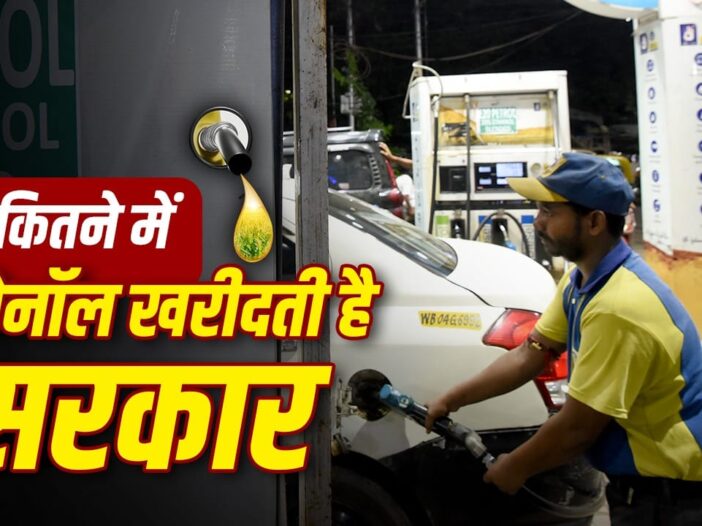
The government has made it clear in the Parliament that it has no intention of selling ethanol mixed petrol i.e. E20 at a cheaper price. Minister of State for Petroleum and Natural Gas Suresh Gopi said in response to a question in the Lok Sabha that the ethanol blending program is being run not to increase the profits of oil companies, but to strengthen the energy security of the country, reduce dependence on crude oil imports, give good prices to farmers and save foreign exchange. This is the reason why despite ethanol being cheaper, the price of petrol is not directly reduced that much. Let us tell you in detail what the government has told regarding the price.
1. Buying ethanol is also not cheap
According to the information given in the Parliament, in the current ethanol supply year 2025-26, the purchase price of ethanol for oil companies is around Rs 71 per liter including GST and transport expenses. This cost is almost equal for all three big government oil companies – IOCL, HPCL and BPCL, i.e. between Rs 71.10 to 71.21 per liter.
The price of ethanol made from different raw materials is also different. Ethanol made from sugarcane juice or sugar is the most expensive, at around Rs 65.61 per litre, while ethanol made from C-heavy molasses is the cheapest, at around Rs 57.97 per litre. Ethanol made from corn is the most expensive, it costs around Rs 71.86 per liter. Putting all these together, the average price comes to around Rs 66.61 per litre.

2. The price of petrol is not determined only by ethanol
The government said that the retail price of petrol is not decided only by looking at the cost of ethanol. Many other things are also added to it, like the price of crude oil in the international market, value of rupee against dollar, freight cost, taxes and operating expenses of companies. That means ethanol is only a part, many other factors play a role in determining the overall price.
3. Oil companies are facing losses
According to the government, the average depot price of petrol between March and June 2026 was around Rs 85.8 per liter. But the retail price was kept lower than what was determined by the market. Due to this, government oil companies suffered an average loss of Rs 11 per liter i.e. under-recovery. In this period of four months, this loss reached about Rs 21,300 crore. The government says that when companies are already facing so much loss, there is no scope for giving separate discount on E20 petrol.
4. Real benefit shown in times of crisis
Enumerating the biggest advantage of ethanol blending in Parliament, the government said that this was clearly visible during the West Asia crisis. This crisis started from 28 February 2026 and is still continuing. During this period, due to closure of the strait, there was a crisis on both supply and prices. During this period, the prices of crude oil increased by 70 to 80 percent globally, but the price of petrol in India increased only by 7 to 8 percent.
The government says that when the price of Indian crude basket had reached around $ 135 per barrel, then according to the market price, petrol could have gone up to around Rs 125 per liter. But Indian consumers continued to get petrol at only Rs 94.77 per liter in Delhi, because oil companies were able to buy ethanol at around Rs 70 per liter. That is, due to ethanol, a part of the imported petrol was replaced by domestically produced ethanol, which reduced the impact of fluctuations in crude oil prices and dollar-rupee fluctuations.

5. Safety related questions also arose regarding E20
It was also asked in the question whether ethanol blending is having any adverse effect on vehicles. In response, the government said that the E20 program has been implemented in a phased manner in collaboration with NITI Aayog, vehicle manufacturing companies, oil companies, agencies like ARAI, SIAM and the Indian Institute of Petroleum. In India, about 8 crore vehicles reach petrol pumps every day, out of which about 80 percent are petrol vehicles. According to the government, more than 20 crore two-wheelers and more than 3 crore petrol cars have been running on E20 for a long time, and till now there has been no concrete complaint of engine failure or vehicle stalling. Companies have also continued to provide warranty on vehicles using E20. Overall, the government’s stance is that ethanol blending should not be seen as a cheap petrol scheme, but as a long-term investment in energy security, price stability and helping farmers.

Leave a Reply