While buying a flat, people first look at the location, price and reputation of the builder. But there is also a document, after receiving which it is believed that if this certificate is received, then it is completely safe and legally ready to live. This is called occupancy certificate. But a case has come to light in Bengaluru which has raised a big question for the country’s real estate sector, regulatory bodies and flat buyers.
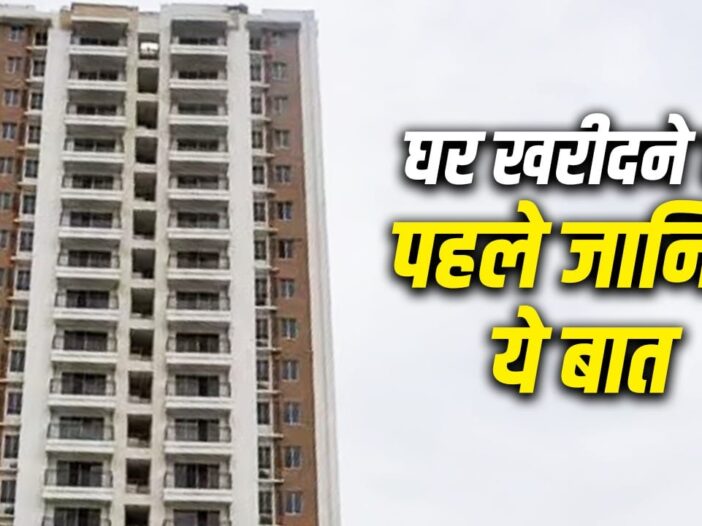
In fact, a residential building of 18 floors of SNN Raj Etternia project located in HSR Layout of Bengaluru city had received the occupancy certificate just a few months ago. This flat was completely ready for handover to the buyers. But before that, during investigation, one of its towers was found to be leaning. Now the builder himself has decided to demolish it and rebuild it.
The biggest thing in this is that Karnataka Real Estate Regulatory Authority (KRERA) has described this as the first case of its kind in the country. According to KRERA Chairman Rakesh Singh, till now no such case has come to light in which, after getting the occupancy certificate, a builder has voluntarily decided to demolish and rebuild the entire building in view of structural safety.
According to the builder, the mistake was not in the construction but in the geotechnical report. The external agency which tested the soil made a mistake in the borehole readings. The place which was described as hard rock in the report. There was loose soil. The foundation was designed on the basis of this report. In a short time this tower tilted 200 mm. This inclination may not be visible to the naked eye. Special equipment is needed for this.
Is occupancy report a guarantee of structural stability of a building or not?
Occupancy certificate is a document which is issued by the local development authority, municipal corporation or the concerned urban body after the completion of the construction of a building. Taking legal occupation of any residential project without OC is considered against the rules in many states.
Experts say that the occupancy certificate shows that the building is constructed as per the approved plans and construction rules. On paper the building was considered habitable. But this does not guarantee soil quality or future structural stability in every situation. Therefore, buying a house or flat just by looking at the occupancy certificate is not the right way.
What checks are done before issuing OC?
- Whether the building is built as per the approved plan or not
- Building height and floor area conform to norms
- Facilities like fire safety, lifts and emergency exits are available
- Basic facilities like water, electricity and sewerage are available
- Environmental and local building bye-laws have been complied with
Getting a certificate of occupancy for a building means that every structural aspect of it has been independently rechecked. It is often issued on the basis of certificates given by the architect, structural engineer and builder. In such a situation, if it is later found that there was a mistake in soil testing, the foundation design was weak, technical mistakes were made during construction and due to this the building has tilted, then it can be declared unsafe. Getting the occupancy certificate does not mean that there cannot be any structural fault in the building in future.
Apart from the occupancy certificate, what documents should flat buyers check?
- RERA registration
- Completion Certificate (CC)
- Occupancy Certificate (OC)
- approved building plan
- Structure Ability Certificate
- fire noc
- Title Documents
- encumbrance certificate
- Records related to land ownership
Where can one complain if there is a defect in the building due to the builder’s mistake?
If defects are found in the building, the flat buyer can complain under the Real Estate (Regulation and Development) Act (RERA). Also, consumers can approach the commission. Buyers can demand repairs, reconstruction or compensation from the builder. If serious negligence is proven, civil and other legal action is also possible.
If a building has to be demolished due to negligence of the builder or defects in construction, then such cases are decided on the basis of Real Estate (Regulation and Development) Act, 2016 (RERA), Consumer Protection Act, 2019 and Agreement of Sale. Under Section 14(3) of RERA, if any quality of construction, structural defect, material or any other technical deficiency is detected within five years of getting the possession, the builder will have to rectify the same without charging extra fees.
If the builder does not do this then the buyer can demand compensation from him. This clearly means that even after receiving the occupancy certificate, the builder’s responsibility towards the building does not end. If the entire building is unsafe, the buyer can demand reconstruction or a new flat. If the buyer wishes, he can demand return of the entire deposited amount. You can demand compensation for the financial and mental loss caused by the negligence of the builder.
What may be included in compensation?
- rental living expenses
- Loss of home loan EMI
- shifting expenses
- mental pain and discomfort
- Can also demand rent due to RERA’s intervention
According to the rules, action can be taken against the builder
This clearly means that if a building is demolished due to the fault of the builder then the buyer is not completely helpless. He can demand removal of structural defects, refund, compensation and action under RERA and Consumer Protection Acts. In such a situation, if any such situation arises, the buyer should approach RERA or Consumer Commission as soon as possible and keep all his documents safe. If the builder does not obey the orders of RERA or Consumer Commission, he may also be fined. There could also be jail.

Leave a Reply