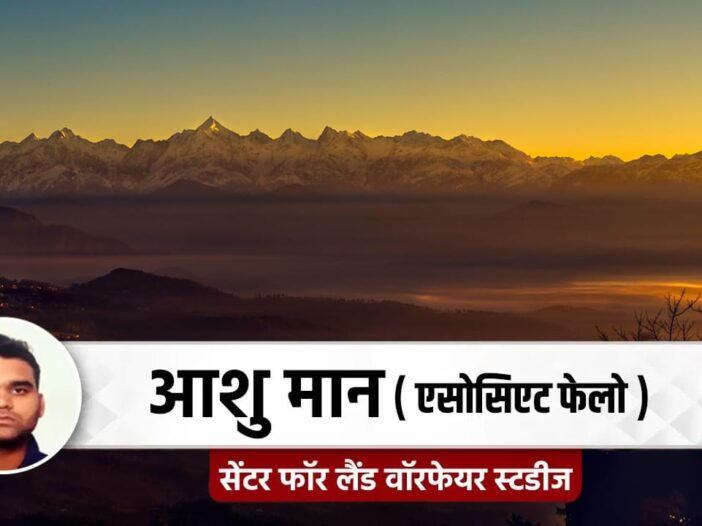
There are some places in the Himalayas which do not announce their presence. They simply exist. In complete silence. When you know about them, your perception about mountains changes. Somdhara is one such place. Somdhara is situated at an altitude of about 5,346 meters in the remote Kumaon Himalayas of Uttarakhand, near the border of India and Tibet.
This peak is located at 30°52’02” North and 80°00’35” East. Over the centuries, this place has been important to people in many ways—sometimes as a geographical identity, sometimes as a spiritual place, sometimes as a part of old trade routes and sometimes as a mystery on maps.
But before all that, it had a name that said it all. Som- which means moon and Dhara means water stream. Both together create a picture which is difficult to describe in precise words. As if a cool, moon-like shining stream is flowing silently from the heights towards the valleys, as if the light itself is descending in the form of water.
Its streams join the tributaries of Ganga.
The land around Somdhara reminds you how young and bustling civilization really is. The air here is thin. Winds blow without permission. Snow and rocks are spread in every direction. Untouched by the pace and pressure of modern life.
This peak is part of the vast Himalayan range and its contribution to the ecology of the region goes far beyond its remoteness. On these slopes, the streams emanating from melted snow and glaciers join the tributaries of the Kali and Gori Ganga rivers. Ultimately supporting the lives and livelihoods of people who may have never even heard of Somdhara.
For most of the year this mountain is covered with snow which absorbs the light and turns it into a silvery shine. People who see it call it supernatural and this word is absolutely appropriate for it.
Somadhara is situated between two worlds. On one side are the green, breath-taking valleys of Kumaon and on the other side are the vast and cold plateaus of Tibet. There is a bridge between these two which maintains its place in silence.
What is the spiritual importance of Somdhara?
The spiritual importance of this mountain is centuries old. In the Vedic tradition, the Moon is not just a celestial body. It is a symbol of peace, healing and nectar. Which is the divine nectar of immortality. Therefore, Somadhara is not just snow and height. It is seen as a sacred repository, a place where cosmic coolness and purity is concentrated and then spread out into the world.
Accordingly, the streams flowing from its slopes are not mere water. They purify things. Gives new life and takes a part of that lunar peace to the heat and restlessness of the plains below.
It is worth pondering over this for a moment, as it reflects what the high Himalayas have always offered to seekers and sages. An environment so far away from the usual distractions that the mind, when given time, begins to settle within itself.
For centuries people have believed that places like Somadhara allow not only meditation. In fact, they actively invite it. Its spiritual importance is also because-
1. The Kumaon region has played a central role in India’s spiritual and historical journey for countless years. It has been the main gateway for generations of pilgrims traveling from the plains to Mount Kailash and Lake Manasarovar.
2. From the 7th to the 11th century, during the reign of the Katyuri kings and later under the Chand dynasty, the high peaks of these ranges were worshiped as sacred protectors.
Somdhara was also the center of trade with Tibet
Rivers, forests, mountains and waterfalls were not resources to be managed. He was a presence worthy of respect. This respect meant that remote peaks like Somdhara were protected not just because of their inaccessibility, but for a deeper reason. The shared faith of the people living in their shadow.
For a long period of history the passes near Somdhara were by no means remote from human viewpoint. Tribes like the Bhotiyas regularly transported salt, wool, silk and grain between India and Tibet through these corridors.
The mountain passes were well-trodden by the comings and goings of people over generations, and the nearby Lipulekh Pass was a key gateway for trans-Himalayan trade and pilgrimage—a threshold between two worlds.
Due to such contact over centuries, the Vedic and Tibetan Buddhist traditions merged rather than clashing with each other. Monasteries and pilgrimage sites came into existence. Folk songs and oral traditions gave rise to a shared spiritual culture, which no party could claim as its own.
The Himalayas, often described as a range. In fact it was quite the opposite – a place where civilizations met. They traded and left marks on each other that have not been erased till date.
No documents, no machine…yet the land was measured
Then came the colonial era and with it a completely different kind of attention. The British had to scale the subcontinent—the entire subcontinent, including those parts where they themselves could not safely enter. So he trained an extraordinary group of Indian explorers known as Pandits.
These explorers traveled into the high Himalayas disguised as traders and pilgrims, collecting data that European surveyors could never collect without revealing their identities.
Nain Singh Rawat is the most famous among them. A man whose travels to Tibet and mountain ranges helped create maps of places the outside world had rarely heard of. For colonial cartographers, peaks like Somdhara were the limits of the known. They lay between the empire and whatever lay beyond it.
There is an important pattern in Indian philosophical thought. Mountains represent higher states of consciousness and watersheds represent points of transition. Where one thing turns into another. Somadhara fits both of these descriptions almost exactly.
It is the place where snow becomes a river and where silence approaches insight for those who travel. The Himalayas have long been considered the mind of the Earth and if this is true, then Somadhara may be the point where that mind is most evident. Pure, stable, lunar.
The glacier that supplies water to Somdhara is melting
Clarity is now under pressure. The glaciers that provide water to Somdhara are slowly melting. Not dramatically in any one year, but consistently. Like that slow erosion that always happens – quietly, then suddenly.
Due to rising temperatures, the melting of glaciers is accelerating in the entire Himalayan region and the rivers originating from these glaciers sustain the life of millions of people in Northern India. Agriculture. Forest. Wildlife. Entire civilizations are based on the assumption that water will come continuously.
The ecological impact of this region is not limited to the peaks only. Extends to Nanda Devi Biosphere Sanctuary and adjacent ecosystems of Jim Corbett National Park.
Protecting these wetlands is no longer just a matter of sentiment or tradition. This is a practical necessity and that too very necessary.

Leave a Reply