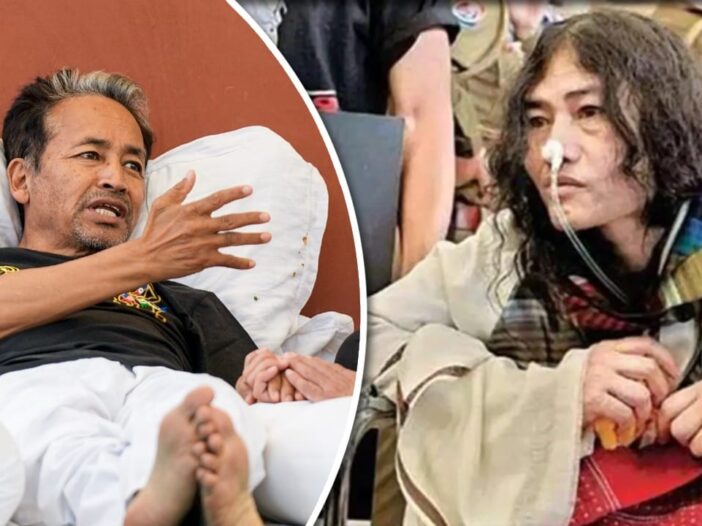
Today Friday is the 20th day of the hunger strike of social and climate activist Sonam Wangchuk. His weight is falling rapidly, so far he has lost 9 kg. His health is now becoming serious. Due to being on hunger strike for a long time, his organs have started getting affected. The High Court also said that life is precious and one should constantly keep an eye on health. In such a situation, what option does the government have to save the life of Wangchuk who is adamant on continuing the strike?
Delhi High Court on Thursday expressed concern over Wangchuk’s deteriorating health. The court said that the life of every citizen is valuable and the government should make every effort to save it. The court also directed the Center that government doctors should check his health daily and do continuous clinical monitoring.
9 kg weight lost in 19 days, condition critical
Amidst the court’s instructions, doctors have also started warning that due to the hunger strike for several days, he has reached a very serious stage. Their organs may start getting affected. Due to the hunger strike of the last 19 days, his weight has declined by more than 9 kilograms. But Wangchuk is not ready to end his strike.
Earlier, Wangchuk released a video message late on Wednesday in which he refused to end the hunger strike despite appeals from political party leaders and supporters. He says that ending the strike without getting any response from the government will send a wrong message. He also appealed to all the people to join the proposed Parliament march of Cockroach Janata Party on 20th July.
Will the government adopt Sharmila’s method?
Sonam Wangchuk is adamant on her insistence and is continuing her hunger strike. The opposition seems to be standing in support of Wangchuk. The court has also given instructions to save his life, so what option is left with the government to keep Wangchuk alive. Can the government adopt the approach of human rights activist Irom Sharmila, due to which she went on a hunger strike for 16 consecutive years?
Irom Sharmila, known as the Iron Lady of Manipur, is also a social activist, and started a movement in November 2000 demanding the abolition of AFSPA from the state. This law provides extraordinary powers and legal protection to security forces (army and paramilitary forces) in dealing with insurgency and terrorism.
Why did Irom Sharmila start the strike?
On 2 November 2000, 10 civilians were shot dead while waiting for a bus at a bus stop in the Malom area of Imphal Valley, Manipur. This firing was done by the soldiers of Assam Rifles. Sharmila sat on a hunger strike near the murder site on 5 November, three days after the massacre, demanding action against the soldiers and removal of AFSPA.
The police termed it a suicide attempt. This was considered illegal according to the Indian Penal Code (IPC), and Sharmila was sent to judicial custody. While in jail, he had to be forcibly fed through the mouth, but he convinced the doctor to use a tube through his nose instead of through his mouth. For this, she said that if food is fed through the nose, then she will stick to her promise of not eating food till the removal of AFSPA.
Armed guards, and team of doctors-nurses
Seeing the continuous loss of weight and critical condition due to the hunger strike, on 21st November, the 17th day of the movement, food was forcibly given through the nose (Nasogastric Intubation) to keep him alive. He had to spend most of his 16-year long hunger strike in a hospital room.
During this time, armed guards and a team of doctors and nurses were stationed around him, who used to give him liquid nutrients and medicines by forcibly inserting a pipe into his nose. This process was sometimes done up to three times a day. This continued for the next 16 years. He was kept alive by pumping a mixture of nutrients and water through a 3 feet long tube between his nose and stomach.
What did you eat to break your fast?
Due to fluids being given through a tube, he always had a tube in his nose and this later became his special identity. Irom Sharmila started the hunger strike in November 2000 and after 16 years, she ended it in August 2016 ahead of the assembly elections in the state.
Sharmila, who held the record for the world’s longest hunger strike, broke her fast by tasting the honey on her palm with her finger. He ate something by himself for the first time in 16 years. “Before this, he had last eaten food of his own free will on November 4, 2000.”

Leave a Reply